 |
|
Monte Carlo Ray Tracing: BRDF Sampling
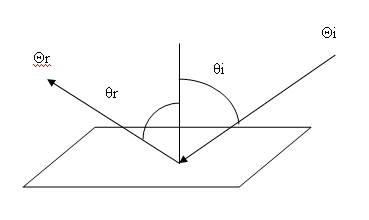
Radiance at a point x in direction w' is given by:

Where Li is the incoming ray direction ,n is the normal, and the BRDF is fr. To solve Kajiya's rendering equation and estimate the Radiance Lo at a point, we must integrate the radiance contribution of the solid angle dw over the entire hemisphere . For Monte Carlo Integration, we must thus generate random samples over the hemisphere by selecting an appropriate probability density function, and express the integral as a summation.
I chose to work with the Phong BRDF (Lafortune, 1994) and to use importance sampling. I would have liked to use the Schlick BRDF, but was not clear on how to Importance Sample it (though rejection sampling would have worked). The phong BRDF is:

 are the maximum energy reflected through the diffuse part and specular part respectively. These are the phong “material” properties. The integral can be written as a summation of the diffuse and specular terms (these lines are from GI compendium):
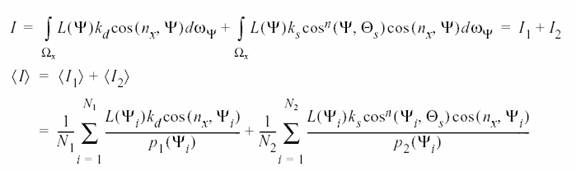
Choosing a probability function
For p1 (x), generate random direction on unit hemisphere proportional to cosine-weighted solid angle

We generate 2 random numbers r1 and r2 in [0,1] and then transform them as follows:
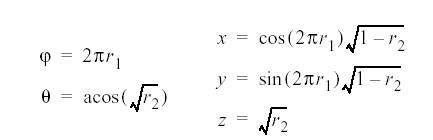
This yields the integral for the diffuse part:
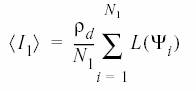
For p2 (x), we generate random direction on unit hemisphere proportional to cosine lobe around the normal:
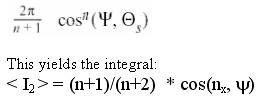
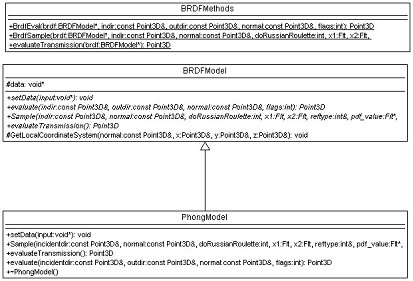
The UML for the BRDF classes is shown below. Any BRDF model can be sampled by extending BRDFModel. The Sample() function generates a sample, and returns a pdf.Russian Roulette is used to decide between diffuse or specular reflectance and based on that <I1> or <I2> is evaluated.
| Send feedback regarding this page to [email protected] |
Last Modified: 11/10/2003 |