
CONTACT MINNESOTA GOVERNOR

CONTACT U.S. PRESIDENT

CONTACT
FEDERAL BOP

HOME

E-MAIL
Linda Tant Miller

MURDERED BY FEDERAL BOP IN MINNESOTA
DeWAYNE MURPHY
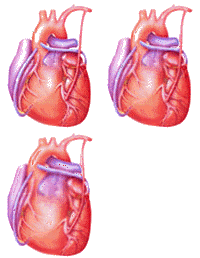


INMATE FEARS DEATH BECAUSE PRISON WON'T FINANCE TRANSPLANT
By GINA KOLATA
If DeWayne Murphy were not in Federal prison, he would be on a waiting list for a heart transplant or might even have had one by now.
But the Federal Bureau of Prisons, which is responsible for his medical costs, does not pay for organ transplants, so the 33-year-old Mr. Murphy is living in a medical ward at the Rochester Federal Medical Center in Minnesota, agonizing over his case. One prisoners' rights advocate argues that by not financing a heart transplant for Mr. Murphy the Bureau of Prisons has converted his four-year sentence to a death sentence.
Mr. Murphy says his health is rapidly deteriorating as his heart fails. He says that he is weak and short of breath and that he must sleep sitting up, with an oxygen mask over his face. His mother, Pat Murphy of Liberty, Mo., says her son is afraid to fall asleep at night.
Mr. Murphy's case, ethicists and lawyers say, raises troubling questions about access to health care for those in the criminal-justice system.
A Host of Questions
Should the nation provide expensive care and scarce organs to convicted felons? Can it justify a system in which an estimated one in four employed Americans cannot have a transplant because they are uninsured or underinsured, yet ask the Bureau of Prisons to provide them for prisoners?
If the Bureau will not pay for a transplant, should it pay for a quadruple bypass? Or, looking at it another way, should a nonviolent criminal like Mr. Murphy get a heart, but a murderer or rapist not? What about someone convicted of a white-collar crime, like tax fraud? Where, if at all, should society draw the line?
Esther Benenson, a spokeswoman for the United Network for Organ Sharing, the national group that allocates organs for transplant, said 2,856 Americans were waiting for heart transplants on Jan. 26. She said about half the people on heart-transplant lists eventually received organs.
Mr. Murphy was arrested in March 1991 for possession, with intent to sell, of about a pound of methamphetamine. It was his first Federal offense and he pleaded guilty. He was already desperately ill with cardiomyopathy, a progressive weakening of the heart muscle.
A Longer Sentence
Before his arrest, he had been evaluated at St. Luke's Hospital in Kansas City, Mo., where he was told that he was a candidate for a transplant. But instead of going on the transplant list, he went to prison. And now that his health has deteriorated, he must be re-evaluated before he can be put on the list.
Mr. Murphy, perhaps naively, never expected to serve a long prison term. "Everything considered, I figured I would get maybe six months or home confinement or something similar to that," Mr. Murphy said in a telephone interview. But Federal mandatory sentencing laws resulted in a four-year sentence, with no chance of early release, beginning in January 1992.
Before he was arrested, Mr. Murphy had Medicaid coverage because he was unemployed and Medicare coverage because he was disabled. Both pay for transplants. To be eligible for Medicare a person must be disabled for two years. In Mr. Murphy's case, the disability that made him eligible for Medicare was not heart disease but Lyme disease. He says the cardiomyopathy is a result of the Lyme disease, although experts say most cardiomyopathy is of unknown origin.
A public information officer at the Bureau of Prisons, Gregory Bogdan, said that the bureau provided "essential, basic, health care that is consistent with community standards" but that it did "not ordinarily pay for transplants."
Out of Options
The bureau says it would permit him to leave on medical furlough to have the transplant if he had a way to pay it. But because Medicare does not cover Federal prisoners and because Missouri Medicaid will not cover him because he is now out of state, he has no options.
A heart transplant costs about $123,000, said Dr. Roger Evans, the director of health services evaluation at the Mayo Clinic; moreover, transplant patients must take immuno-suppressive drugs, which cost $5,000 to $6,000 a year, for the rest of their lives, he added.
"Every convicted felon has a right to health care," Dr. Evans said. Still, he acknowledged that transplanting a heart into a felon at public expense "sends a perverse message to people considering organ donation."
"There's going to be another person waiting on that list who potentially could be returned to productive capacity," he said. If a heart goes to a prisoner, Dr. Evans said, "we're essentially paying twice."
"We're paying to house them and then we're incurring a substantial cost for their medical care," he said.
A Death Sentence
But John Boston, a lawyer who is project director for the Prisoners' Rights Project of the Legal Aid Society of New York City, said that by refusing to provide Mr. Murphy with a new heart the Bureau of Prisons is essentially giving him a death sentence. Mr. Boston, who had not heard of Mr. Murphy's case until he was asked about it this week, said he thought it would not stand up a challenge under the Constitution's Eighth Amendment, which prohibits cruel and unusual punishment.
Dr. Arthur Caplan, director of the Center for Bioethics at the University of Minnesota, said he believed that there was no ethical justification for denying organs to prisoners on any basis other than failure to meet medical criteria. "For me, it's open and shut," he said. "It's absolutely wrong to make judgments about past behavior, criminal conduct, moral worth, indictments, charges or convictions."
Dr. Nancy Dubler, the director of the division of bioethics at the Montefiore Medical Center in the Bronx, said that the case reminded her of the early days of artificial kidney machines, when citizen committees, often referred to as "God squads," decided which patients with kidney failure would have access to the scarce machines -- in essence, deciding who would live and who would die.
The Worthiness of a Life
Ethicists and the public eventually found it so distasteful to rate the worthiness of a human life that, Dr. Dubler said, "the clear movement since then has been to establish rigorously abstract criteria so that the worth of an individual is not factored in" when deciding who should get organs or other lifesaving medical treatments.
Dr. Caplan said he understood the argument that it would be galling to give a new heart to a felon when many working Americans could not have a heart transplant because they have no health insurance; but, he said, that is a problem of health insurance in America. "The answer is not to kill DeWayne Murphy," he said.
Mr. Murphy said he just hoped he lived long enough for his case to be resolved. "I've been here 11 months and my health has deteriorated," he said. "If it deteriorates any more, I'll be on life support. And there's only one thing left after life support."
"All I'm asking for is a chance," Mr. Murphy pleaded. "This was my first offense. I was never in trouble before this. I think I've learned my lesson."
Time Magazine
DeWayne Murphy, also known as Prisoner 06764-045, won't step outside during winter: the frigid Minnesota air leaves him gasping. His sleep is plagued by night sweats and cramps. "They sent me here to be rehabilitated," he says of the Rochester Federal Medical Facility, where he is incarcerated. "But how can you be rehabilitated if you die?"
He's got a point. Though Murphy is just a first-time felon serving a mandatory four-year sentence for drug possession, the ailing 33-year-old inmate finds himself on a kind of de facto death row; his weakened heart has one-sixth its normal pumping power. He needs a transplant.
New hearts are difficult for anyone to come by; for inmates, it's even harder. The U.S. Bureau of Prisons doesn't pay for transplants. Medicare will pay -- if Murphy is released. The bureau will release Murphy -- if a doctor accepts him for the necessary pre-transplant work-up. But no doctor will take him -- unless he's released.
It may sound like a somewhat heavy-handed lampoon of the American health- care system -- bad Joseph Heller, say. It gets worse. If Murphy is furloughed for the prolonged pre-transplant regimen, afterward he would return to prison. Would he be furloughed promptly again if a heart became available unexpectedly, as donor hearts are wont to do? The Bureau of Prisons says he would be. Murphy has his doubts. Doctors see a logistical snarl that could hopelessly compromise the success of the transplant. The authorities shrug. "The Bureau of Prisons doesn't have a hang-up," explains Robert McFadden, executive assistant to the warden at Rochester. "When we're presented with the information we request, we can go forward."
Murphy's troubles started in 1990, when he was fired from his job as a warehouse foreman in Kansas City, Missouri, for being sick too much. Suffering from what he thought was pneumonia, he got a chest X ray, which showed that his heart was greatly enlarged. He was told he would need a transplant and placed in intensive care.
Murphy improved just enough to be released. Divorced, broke and sick, he was arrested with a bag of methamphetamine in his home in 1991. He says he was merely keeping it for a friend, though in anticipation of being paid for doing so.
Pudgy, stringy-haired, constantly out of breath, Murphy has deteriorated & since he was incarcerated in March 1993. A local attorney has filed suit against the Bureau of Prisons seeking his release, but Murphy doesn't really have time for a protracted legal battle. When he arrived at Rochester, he says, he could walk a lap or two on the prison track. Now he's winded after climbing down a flight of stairs. He must sleep virtually sitting up, and gets oxygen all night. He fears that a heart attack or stroke could leave him on life support rather than kill him outright. "Serving a four-year sentence on life support," Murphy shudders. "That's scary." Ironically, his life seeps away just minutes from the Mayo Clinic, home to a world-famous heart- transplant program. "It drives me crazy," he says. He stops to breathe. "I'm sitting here dying, and there's nothin' I can do about it."
TIMES-PICAYUNE
OFFICIALS WON'T AID INMATE WHO NEEDS NEW HEART
DeWayne Murphy needs a heart transplant.
Everyone says so. Doctors, lawyers, his family - even the warden at the Federal Medical Center in Rochester, Minn., where Murphy is locked up - say the Clay County man will die unless he gets a new heart.
But Murphy, 33, who has congestive heart failure caused by Lyme disease, is not even on a list of transplant candidates. Although doctors report his condition is worsening, authorities oppose all attempts to get him the operation.
Warden William Hedrick says the Bureau of Prisons does not provide heart transplants to inmates.
But some people familiar with the case say it comes down to this: Few hearts are available for transplants. Law-abiding citizens and children come first.
There's no room in the lifeboat for Murphy.
He was caught three times with large amounts of methamphetamine - the last time after he had pleaded guilty to possession with intent to distribute. He could have gotten 40 years but was sentenced to four - leniency from the judge because of his health.
Now the drug history and defiant behavior appear to have slammed the door on pleas from Murphy's mother and his attorneys.
Murphy's release is scheduled Aug. 1, 1996. If doctors are correct, he will be dead before then.
"No question, this is a tragic case," said Chris Whitley, spokesman for the U.S. attorney's office in Kansas City, Mo., which prosecuted Murphy. "But does he deserve our sympathy? Given his behavior, he's exhausted our sympathy."
The case is out of the Kansas City office's hands, Whitley said.
*******************************************************
Published: February 5, 1994
The New York Times

By Marc Hequet
In Rochester, MN
January 30, 1994 Sunday
BYLINE: By DONALD BRADLEY
The Kansas City Star
DATELINE: KANSAS CITY, MO.
The doctors were correct- DeWayne Murphy died on October 12, 1995, at the age of 34.
*******************************************************

FACTOR 8: THE ARKANSAS PRISON BLOOD SCANDAL
Kelly Duda and Concrete Films have produced a documentary which details the corruption and greed that led the Arkansas Department of Correction to spread death from Arkansas prisons to the entire world. Hear the story from the mouths of those responsible for the harvesting of infected human blood plasma, and its sale to be made into medicines.
Duda's award-winning film unflinchingly documents the whole story the U.S. government and the state of Arkansas have tried to keep hidden from the world.
Click the photo of Kelly Duda at work to order your own copy of
Click the photo of Kelly Duda at work to visit the
Please help spread the word about this important film,
"Factor 8: The Arkansas Prison Blood Scandal"

Factor 8 Documentary website
along with the urls to the linked pages.
|
Read my DreamBook guestbook! Sign my DreamBook! |

|
