White Dwarfs & BLack Dwarfs
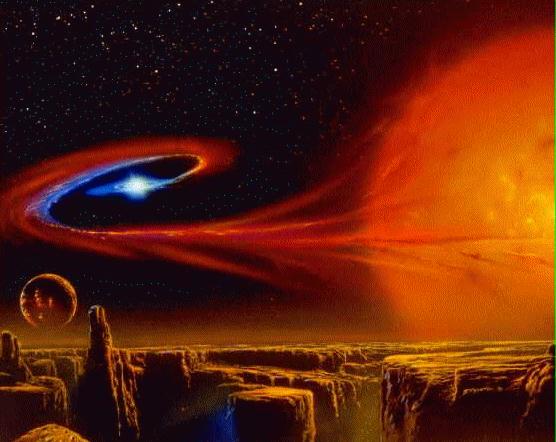
Stellar Evolution
Formation: The space between stars contains gas and dust at a very low density. This INTERSTELLAR MATTER tends to gather into clouds. Sometimes the density becomes high enough so that gravity causes contraction, leading to the formation of a protostar. As a protostar slowly contracts, its pressure and temperature increase, the temperature rise being the result of the release of gravitational energy. Any hot object radiates energy, and the protostar eventually becomes hot enough to shine,
although temperatures are not yet great enough to sustain nuclear reactions. The pressure builds up enough almost to balance gravity, but the radiation emitted drains energy and inhibits the ability of the internal pressure to complete the balance. Therefore the contraction (and heating) slowly continue.
The temperature at the center of the protostar finally becomes high enough to initiate nuclear reactions and the subsequent release of nuclear energy. Hydrogen is the most abundant element, and hydrogen-burning reactions, in which hydrogen is converted to helium with an accompanying release of large amounts of energy, are the first ones to become important. When the nuclear energy released exactly balances the radiation energy lost into space, the protostar finally enters a state of balance, and contraction
ceases. At this point the object becomes a true star.
Hydrogen-Burning and Helium-Burning Stages
A star that is in balance and burning hydrogen in its core is called a MAIN SEQUENCE star. On a plot of luminosity versus temperature, known as a HERTZSPRUNG-RUSSELL DIAGRAM, main-sequence stars fall into a diagonal line. All stars begin their careers in the main-sequence phase. If a main-sequence star has a large mass, it will have a high surface temperature and will therefore be very luminous. If it has a small mass, it will be rather cool and faint. The Sun is a main-sequence star somewhat above average
in mass, surface temperature, and radiant energy output.
When the hydrogen fuel in the core is used up, the star loses its main-sequence status. This can happen in less than a million years for the most luminous stars but takes many trillions of years for the faintest. The Sun has a main-sequence lifetime of about 10 billion years, of which half is over.
When the core hydrogen has all been converted to helium through nuclear reactions, the nuclear energy release stops. The star falls out of energy balance, and the central portions contract further under gravity and grow still hotter. The end of nuclear reactions does not, however, stop a star from radiating energy into space. Stars shine because they are hot, and a post-main-sequence star is still quite hot.
As the central parts of a star get hotter, nuclear reactions can be resumed. This may be in the form of hydrogen-burning in the regions just outside the helium core, or else in the form of helium-burning reactions in the core itself. Any nucleus can undergo nuclear reactions if conditions are violent enough. Hydrogen-burning takes place at temperatures of about 10 million K, but it requires about 100 million K to ignite helium. Hydrogen-burning produces helium, while helium-burning produces carbon, oxygen,
and other rather heavy nuclei. The heavier the nucleus, the higher is the temperature required to bring it into nuclear reaction.
The later nuclear reactions are brought about by the further contraction and heating of the inner parts of the star, after the hydrogen has been exhausted in the core. During this phase the outer layers of the star actually expand and cool, and the luminosity can become quite high. The star, no longer on the main sequence, is now what astronomers call a giant, or, if the luminosity is extremely great, a SUPER GIANT.
Old Age and Death
In old age, with further contraction and heating of the inner parts of a star, heavier particles are ignited. The burning of helium is followed by the burning of carbon, oxygen, silicon, and so on. As the giant or super giant star ages, it builds up layers of successively heavier elements in its interior, with the heaviest materials in the core and lighter materials in shells around the core. This process cannot go on indefinitely, however. In smaller stars the material can become so dense that it resists
further contractions, a state known as "degeneracy." The star then slowly radiates away what heat energy is available and ends its life as a cold, dark body. A star of this type that is observable is known as a WHITE DWARF. It has not yet cooled to the point at which it fades from view and becomes a BLACK DWARF.
The densities needed to produce electron degeneracy are quite large. White dwarfs themselves have densities that are typically tons per cubic centimeter. The electrons in a star cannot become degenerate if the star has a mass greater than about 1.4 times the mass of the Sun. This mass, known as the CHANDRASEKHAR LIMIT, is an upper limit for the mass of a white dwarf. Stars with masses greater than this limit may undergo violent explosions that eject much of their material into space. These explosions are
called super novae. The core of such a star apparently collapses with violence, driving off the outer layers and breaking down the core particles into neutrons. In several cases the remnants of supernova explosions have been detected and are known as neutron stars. A rotating neutron star is called a PULSAR. Neutron stars, which cannot contract further, end as cold, dark bodies.
If a star never sheds enough mass to become degenerate, there is nothing to stop continued contraction when the nuclear sources have been completely used up. The star will keep getting smaller until it becomes an object known as a BLACK HOLE.
Black Dwarfs
A black dwarf is the final phase in the STELLAR EVOLUTION of WHITE DWARFS. Such stars have exhausted their nuclear energy sources; thus any light they produce is from gravitational contraction. The cold, dark hulks that remain when this energy is expended are called black dwarfs. Because they are small and emit no light, no black dwarfs have yet been discovered.
White Dwarfs
White dwarfs are stars that are nearing the end of their lives, having exhausted the hydrogen and helium in their interiors by nuclear reactions. They are considered the next-to-final stage in STELLAR EVOLUTION for stars less than 1.4 times as massive as the Sun, the final stage being black dwarfs, or burned-out stars. The best-known white dwarf is the companion of SIRIUS, the brightest star in Earth's sky.
White dwarfs have radii about 0.01 times the Sun's radius, absolute visual magnitudes ranging from + 10 to + 16, and surface temperatures ranging from below 4,000 to 25,000 K. Their extremely dense matter is in a degenerate state; that is, atomic nuclei are stripped of their electrons. The term white is a misnomer for many of these stars, which are often reddish and show a wide range of spectral types. Some have apparently featureless spectra, while others exhibit strong banding; some cool white dwarfs show
lines of calcium and iron. Some spectra indicate high magnetic fields of 1 to 20 mega gauss, as compared to the Earth's 1 gauss; one white dwarf is known to have a magnetic field of 700 mega gauss.
Many white dwarfs are members of BINARY STAR systems and exhibit NOVA behavior, exploding periodically because of incoming material from their larger companions. Variable white dwarfs with pure hydrogen surfaces, called ZZ Ceti stars, are among the most numerous of all variable stars. The star cataloged as GD 358, discovered in the 1980s, is considered the prototype of another type of white-dwarf variable; these stars have a pure helium surface.

The following was copied directly for a Grollier Encyclopedia dealing with the subject of "Constellations" It's by no means the purpose of the author of this web page to misrepresent them or take credit for their work.
