Here's some Astronomy Notes
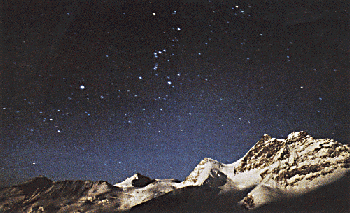
Hipparchus a Greek Astronomer, in 134B.C. was looking at Scorpius. He found a star he didn't see on any of his star charts that was in Scorpius, the others were there. Question was: did observers fail to chart it? or was it a new star? He didn't know. It was probably a Nova. He decided to make a star chart after several months he charted over 1,000. He's credited with the first (accurate) chart for the time. He categorized stars by Brightness or Magnitude- measure of luminosity of a star or other objects. To each star he gave them a number by their magnitude. Example: 1st Mag was Brightest, 2nd Mag....6th Mag. As the number increases the magnitude decreases. This was developed over 2000 years ago. They still use this today only slightly modified. Hipparchus used the naked eye to make the Magnitude Chart. In the mid 1800's instruments became available to observe stars better. Allowed people to see stars individually. Seeing through instruments you found some stars were brighter than others on the same Magnitude number.
Normand Pogson took the Magnitude Scale and put it on truly numerical basis. Example: 1st Mag was Brightest, now though it was 1.0, 1.1, 1.2,......6th Mag. Next thing he wanted to do is use reference stars on his new chart. The two stars were Aldebaran and Altair for which he used. (NOTE any stars named with "A" are probably named from Arabians) You'll see these two stars pretty much all the time in the sky. Aldebaron during winter and spring and Altair during Summer and fall.
Sirius is the brightest star its 10x brighter than either Aldebaran or Altair so its 10x brighter then 1.0 on the Mag Scale.
Magnitude (Apparent) brightness of star as viewed from the Earth.
Magnitude (Absolute) measure of a stars true luminosity. Stars are treated as if they are located at a standard distance from us which is 10 parsecs.
Limiting Magnitude represents the faintest magnitude that can be observed with a given instrument under a given set of conditions. (NOTE The Hubble Space Telescope is the best cause its in space not having the Earth's Atmosphere blocking it)
Photographic Limiting Magnitude is the faintest magnitude that can be photographed with a given instrument under a given set of conditions.
Stellar Spectra If you can see a star you can get a spectrum from it. Some are the same, many are different. In late 1880's a system was produced. They based it upon the linesin Hydrogen, (strong hydrogen) A---->(weak hydrogen) P. Most prominent lines of hydrogen are in A they were called Spectral Class (Type) A Stars. That was used for awhile then another system come about based on Star Temperature of the surface not the interior. Astronomers abandoned the first system, there was a debate and they made a new system but used the old system also. But only had 7 spectral classes: O, B, A, F, G, K, M rating from hotest to coolest.
The Stellar Spectra
Type O stars are Blue-White in color; Temp ranges 60,000k - 30,000k with an "O" star you'll see lines that are very thin lines of helium. Has 2 Electrons, these would be the most prominent lines and there not very bright. "O" stars are rare! There are no O0, O1, or O2.
Type B stars are between 30,000k - 10,000k. Their color is blue-white, the lines are few but more obvious. Some type B Stars are: Regulus, Rigel, and Spica.
Type A stars are between 10,000k - 7,500k. They have strongest lines of hydrogen. Color is blue-white, type A Stars include: Sirius, Altair, Vega, Deneb.
Type F stars are between 7,500k - 6,000k. Their color is blue-white to white. Hydrogen lines are much weaker but you start seeing lines of metals. A Type F Star: Polaris.
Type G stars are between 6,000k - 5,000k. Color are yellowish. Type G Stars: Sun, Rigel Kentaurus(Alpha Centari A). You'll find lines of quite a few metals. The most prominent lines are of Calcium or Sodium. You would find over 60 lines in the suns spectrum of different elements.
Type K stars are between 5,000k - 3,500k. Color for these stars are an orange. Type K Stars: Aldebaran, Arcturus. Lines of many metals begin to appear.
Type M stars are below 3,500k. Lines of molecules begin to appear on these Titanium Oxide especially. H20 also. Core is Red, a dull brick color. Type M Stars: Betelegeuse, Antares. Lines of many elements ( metals) are in these, more than the rest.