Betelgeuse
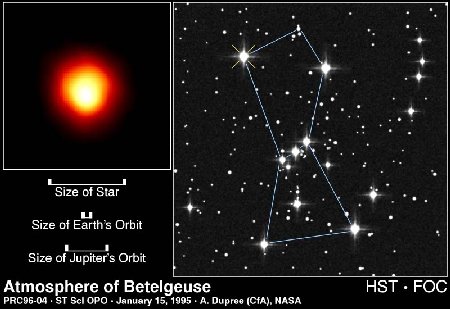
The above picture was taken by the Hubble Space Telescope. Betelgeuse is a M class star. Its believed to be in its 2nd Red Giant Phase. When it blows up it could possibly be as bright as our moon. Betelgeuse is part of the Orion Constellation. In reality Betelgeuse isn't a very bright star, the reason we
can see it so clearly however is because its so big. Betelgeuse is classified as a Red Super Giant. If it would take the place of our sun it would wipe out Mercury, Venus, Earth, and Mars. Betelgeuse is the top left star in the orion constellation.
"The Orion nebula, also known as M42, is a galactic NEBULA consisting of gas and dust, which because of its brightness and angular size has been much studied by astronomers. The nebula is located at a distance of about 1,500 light-years. It has a strong emission-line spectrum. The main sources of its radiative energy--which is absorbed and reradiated by gas in the nebula--are the two brightest stars in an area known as the Trapezium, a small group of six stars. Photographs taken with large telescopes
show that the gas has a patchy, irregular structure.
The Orion nebula also has a weak continuous spectrum, with absorption lines. It is formed by light from the stars in the Trapezium, scattered by the interstellar dust in the nebula. Strong infrared radiation is emitted by this dust, which is heated by the shorter-wavelength radiation it absorbs. Many interstellar molecules are present in the dense condensations of interstellar matter in the nebula."

The information above was in my personal written astronomy notes taken from a College Astronomy Course its not meaning to represent any ones works. The picture taken was by the Hubble Space Telescope. The copied part of this section came directly from a Grollier Encyclopedia.