How
the mummies were created?
K.
M. Mahmud Hasan (Prince)
Mummification
in ancient Egypt was a very long and expensive process.
From start to finish, it took about seventy days to embalm a body. Since the
Egyptians believed that mummification was essential for passage to the afterlife
(life after dead), people were mummified and buried as well as they could
possibly afford. High-ranking officials, priests and other nobles who had served
the pharaoh and his queen had fairly elaborate burials. The
pharaohs, who were believed to become gods when they died, had the most
magnificent burials of all. In the case of a royal or noble
burial, the embalmers set up workshops near the tomb of the mummy.
In
the art of mummification, we can see that their techniques are so scientific
ever we could think then. They use natron, a special salt to dry out dead bodies
and too many more.
 The
art of Egyptian mummification consisted of many steps. First, the body was
washed and ritually purified. The next step was to remove the deceased person's
inner organs. A slit was cut into the left side of the body so
that the embalmers could remove the intestines, the liver, the stomach and the
lungs. Each of these organs was embalmed using natron, which served to dry out
the organs and discourage bacteria from decaying the tissues.
The
art of Egyptian mummification consisted of many steps. First, the body was
washed and ritually purified. The next step was to remove the deceased person's
inner organs. A slit was cut into the left side of the body so
that the embalmers could remove the intestines, the liver, the stomach and the
lungs. Each of these organs was embalmed using natron, which served to dry out
the organs and discourage bacteria from decaying the tissues.
The
organs were then individually wrapped using long strips of linen and placed in
canopic jars.
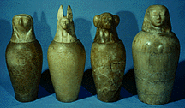
The lids of these jars were fashioned after the four sons of Horus, who were
each entrusted with protecting a particular organ.
|
Here
are some canopic jars with lids depicting the four sons of Horus:
Qebehsenuef,
the falcon head -- intestines
Duamutef, the
jackal head -- stomach
Hapy, the
baboon head -- lungs
Imsety, the
human head -- liver
|
|
After
the removal of the inner organs, the body cavity was stuffed with natron.
The brain was then removed through the nose using long hooks. Since the ancient
Egyptians considered the brain unimportant, it was probably thrown away.
The
body was then placed on a slanted embalming table and completely covered with
natron.
This allowed fluids to drip away as the body slowly dried out. This part of the
process took about forty days, after which the natron was removed, inside and
out, to reveal a dried, shrunken body. After another cleaning, the body was
rubbed with unguents to aid in preserving the mummy's skin. The head and body
cavity were stuffed with packing.
 The
mummy was then prepared for bandaging. First, the embalming cut
in the side of the body was sewn up and covered with a patching depicting the
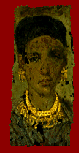
protective eye of Horus. The body was adorned with gold, jewels and protective
amulets. Fingers and toes were covered with protective gold caps and
individually wrapped with long, narrow strips of linen. Arms and legs were also
wrapped, then the entire body was wrapped to a depth of about twenty layers. The
embalmers used resin to glue the layers of wrappings together. The wrapped head
was covered with a mummy mask. Finally, the last layer of bandages went on and
was given one last coating of resin. The mummy was the ready for burial.
The
mummy was then prepared for bandaging. First, the embalming cut
in the side of the body was sewn up and covered with a patching depicting the
protective eye of Horus. The body was adorned with gold, jewels and protective
amulets. Fingers and toes were covered with protective gold caps and
individually wrapped with long, narrow strips of linen. Arms and legs were also
wrapped, then the entire body was wrapped to a depth of about twenty layers. The
embalmers used resin to glue the layers of wrappings together. The wrapped head
was covered with a mummy mask. Finally, the last layer of bandages went on and
was given one last coating of resin. The mummy was the ready for burial.
Once
the mummy was finally prepared, it was time for the funeral.
The mummy and its canopic jars were transported by sled from the embalming tent
to the tomb. People were hired to demonstrate their grief by crying and throwing
dust on their hair. At the site of the tomb, religious ceremonies were held to
prepare the dead for the afterlife. In particular, the Opening of the Mouth
ceremony was believed to allow the mummy to see, hear, eat and drink in the
spirit world.
See the making was not so easy. It was
too scientific but one think wrong that they were think that brain are only
garbage.
Goto
Home Page ||| Goto Article Page