HUMOR
IN ANCIENT EGYPT
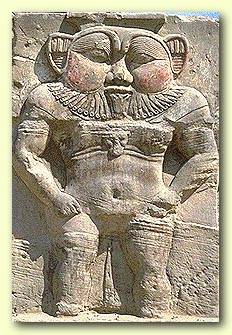 Many
people will picture ancient Egypt visually as slaves building the Great
Pyramids. It is was comes to one's an the common man's mind's eye, though today
we believe that the Pyramids were probably not built primarily with slave labor.
Still, the concept does not lend itself easily to smiling, happy faces. In fact
there seems to have been little outlet for humor within the confines of official
funerary and religious art and literature. Yet we know that ancient Egyptians
had a since of humor, even as they toiled to build the ancient monumental
buildings. In fact, they even had a god of humor in the form of Bes (A GOD That
give protection from evil), who was a fat, bearded dwarf; ugly to the point of
being comical.
Many
people will picture ancient Egypt visually as slaves building the Great
Pyramids. It is was comes to one's an the common man's mind's eye, though today
we believe that the Pyramids were probably not built primarily with slave labor.
Still, the concept does not lend itself easily to smiling, happy faces. In fact
there seems to have been little outlet for humor within the confines of official
funerary and religious art and literature. Yet we know that ancient Egyptians
had a since of humor, even as they toiled to build the ancient monumental
buildings. In fact, they even had a god of humor in the form of Bes (A GOD That
give protection from evil), who was a fat, bearded dwarf; ugly to the point of
being comical.
It
is difficult for us to analyze humor even in different modern cultures, much
less those of ancient civilizations. Humor and satire are most often associated
with the subversion and undermining of normal social decorum, but if the normal
social decorum is not fully understood, then the humor or satire will be lost to
us.
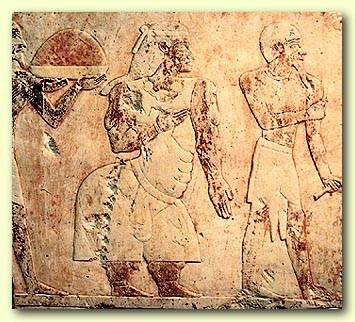 Most
humor comes to us from "unofficial" sources, such as rough sketches
and Ostraca, though occasionally we even find official humor, though it most
often regards matters outside the Egyptian royal audience. Notable is the scene
at the temple of Hatshepsut at Deir el-Bahri ( A King)
that portrays the overweight figure of the queen of Punt, followed by a
small donkey. The caption reads, "the donkey that had to carry the
queen", and apparently the ordinary Egyptians thought this was funny as
well, for they repeated the drawing in rough sketch clearly copied from the
original.
Most
humor comes to us from "unofficial" sources, such as rough sketches
and Ostraca, though occasionally we even find official humor, though it most
often regards matters outside the Egyptian royal audience. Notable is the scene
at the temple of Hatshepsut at Deir el-Bahri ( A King)
that portrays the overweight figure of the queen of Punt, followed by a
small donkey. The caption reads, "the donkey that had to carry the
queen", and apparently the ordinary Egyptians thought this was funny as
well, for they repeated the drawing in rough sketch clearly copied from the
original.
In
a number of texts, scribes corned just about every other trade (with the
exception of their own). Some of this was clearly meant to be humorous, though
considering the ego that scribes clearly enjoyed, some of the text were probably
out and out scorn. Even in private tombs, there was sometimes mockery of some of
the laborers.
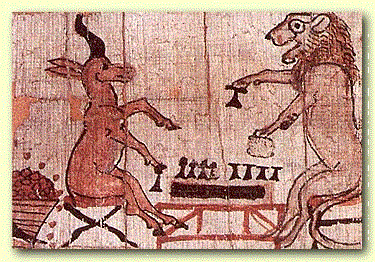
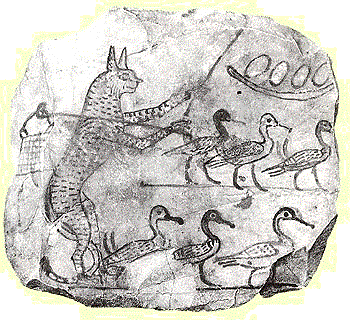
Probably
the most obvious and one of the largest bodies of humor are sketches and
paintings depicting animals such as mice and cats engaged in typical human
activities. They are shown beating captives, driving chariots, and in one
papyrus, a lion and antelope are shown playing a board game while a cat is shown
herding geese. It has been suggested that these might have been illustrations
for animal fables, but if this were true, no text has survived as proof.
We are likely
to never know the full extent of ancient Egyptian humor. Today we know have
considerable knowledge of the royal and religious aspects of ancient Egypt. But
while our understanding of common Egyptians is increasing, there is yet much to
be learned. I was probably the common Egyptians who formulated most humor, and
who probably needed it the most in order to deal with their lives. Today, Egypt
remain a society with a great sense of humor.
Copyright ©
Prince Khan
Helped from
John Waren
Link
to Home Page || Link to Articles Page