| Labs & Projects |
| This page has pictures of the basic happenings and events in my classroom. This is your chaance to meet the critters of D-110, including the roaches! Also shown here is my personal collection of skulls and skeletons that I have collected. I guess you can say it is a small hobby of mine, collecting dead things and putting them back together again. Also notice below here there are links to the various courses that I teach. Each of these pages contains pictures and information about specific projects for each subject. Please check back to all of these pages from time to time and stay current with what is happenig in Mr. Young's World of Science. |
 |
 |
 |
 |
 |
 |
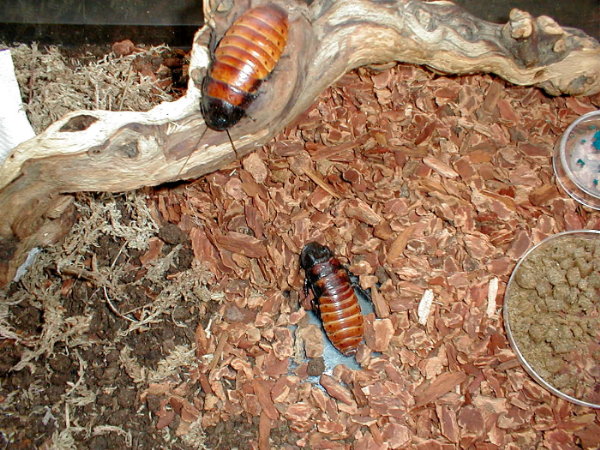
| These lovable looking guys are called Madagascan Hissing Cockroaches. The classes know them more as discusting! It is very easy to distinguish males from females. The male roaches have two large knobs on the top of their heads, while the females have a smooth top surface to their heads. These enlarged versions of our American Cockroach live on the Island of Madagascar, located off of the South Eastern caost of Africa. This magestic Island is the home to many other precious animals such as lemurs , Aye Ayes and Safaki (all types of primates). Please check out my links page to find links about Madagascar and its inhabitants. |
 |
 |
|
 |
 |
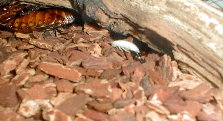
| This little white critter that the arrow is pointing to is a newly emerged roach. Like many other animals, insects shed their outer layer as they grow. This particular roach had just came out of its old skin. Once the new body has been exposed to the air and has dried it will become darker and look just like the adults. |
 |
 |
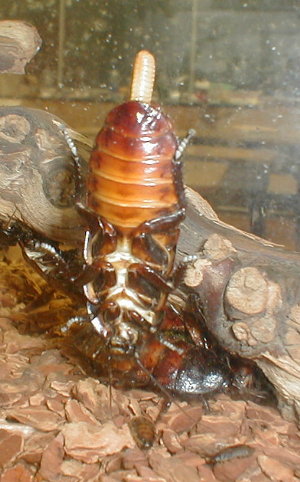
| A momma roach laying an egg sack |
| THE SKULL and BONE COLLECTION |
| What follows is my personal collection of skulls and skeletons that I have either found, acquired or purchased. My love of evolution has precipitated into a love of skeletons and how the body fits togther and works as one unit. So much can be told by skeletons about an animals habits of eating, muscle structure and many other facets of its life. Comparative structures can also be easily seen through bones. See what you can tell about these critters and the structures they share. How do they differ? How do they compare? Enjoy! |
 |
 |
 |
 |
 |
 |
 |
 |
 |
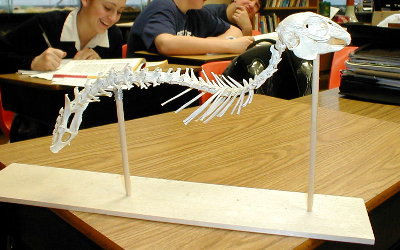 |
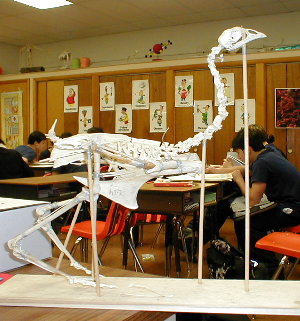 |
| Just like a 3-D puzzle, reconstructing skeletons, for me, is very relaxing. Being able to see and undersatnd how bones articulate with one another and the variety of bone shapes that relates to their functions can very extremely interesting. Just the differences in shapes of vertebraes tells |
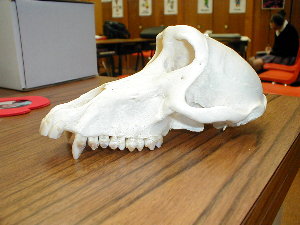
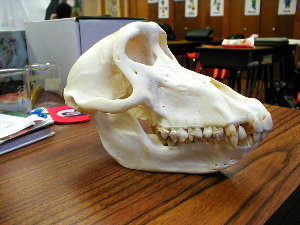
| have complex societies called troops. Dominate females rule the troops while males travel looking for females to mate with. Baboons rear 1 sometimes 2 infants at a time. Twins are rare in the primate world among most species of primates. The skull pictured to the right is of a female adult Chacma Baboon. Try to see resemblences to our earliest precursors of humans, such as A. aferensis or A. africanus |
| My major interest and love in science is the evolution of humans and their relationship that they have with other primates. Primate family and social structures are, at times, very closely linked and mimic to our way of life. Baboons are one of those primates. They |
 |
| a lot about what the animal does and where it lives. Pictured above are 2 skeletons that I have re-articulated myself. Pictured on the left is a wild turkey skeleton and the partial skeleton on the right is of a rabbit. |
|
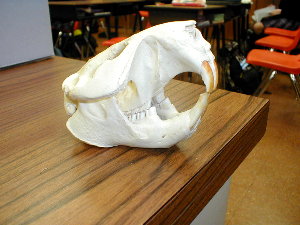
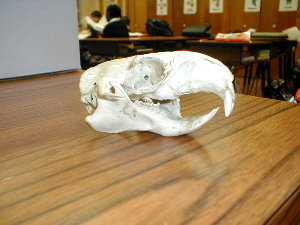
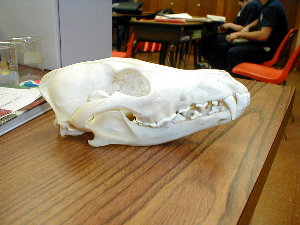
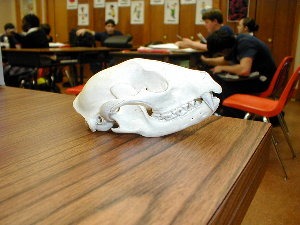
| While we know that Primates are mammals as well, I found it important to seperate them out from the rest, hence the reason they are not here. Pictures 1 and 2 are of rodents. Rodents are not just the size of our mice and rats and their family members. Skull 1 is of a beaver, and a rather large one at that. This skull measures nearly 5 1/2 inches in length. Skull 2 is of a muskrat. Notice the similarities between the species. Both have huge incisors and a gap between them and the molars. This is very characteristic of rodents. Skull 3 is of a racoon, skull 4 is of a cow and skull 5 is the predator in the group, he is a coyote. Notice the similarities between the racoon and the coyote with their teeth. Huge canines hang down and go up, surrounded by incisors in the front and molars in the back. These teeth are used for ripping and pulling apart of meat or tearing into flesh. The incisors are used for holding and the molars are used for grinding and chewing of meat and some plant material. |
| 1. |
| 2. |
| 3. |
| 4. |
| 5. |
|
| REPTILES & AMPHIBIANS |
| MAMMALS |
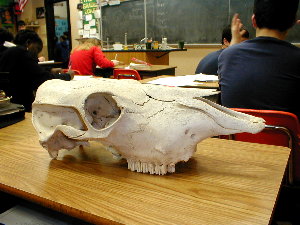
| The cow, pictured in #4, is a plant eater. Notice the differences in his teeth compared to that of the rodents and the predators. The cow's teeth are flat, they all look like molars. In fact, the cow does have incisors, canines and molars and in the same location as the others. The difference is function. Cows do not tear apart meat or grab their prey. They are indeed herbivors, meaning that they eat plants only. They need teeth that will grind apart the grass for easier digestion. Plant material is very hard to digest due to the amount of starch (a form of carbohardrate) and therefor involves a lot of grinding. |
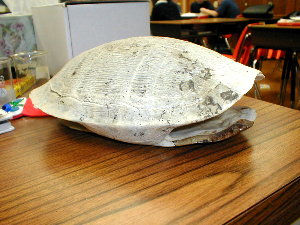
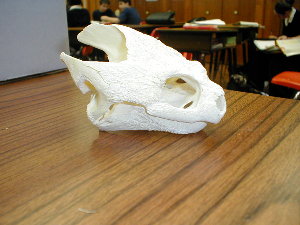
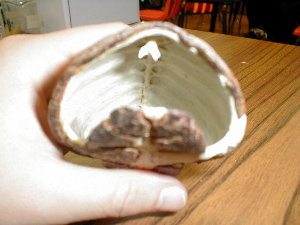
| Reptiles and Amphibians are next on the list of critters. Pictured to the left is a shell of a turtle. Inside the shell one could find the turtles vertabrae fused into the upper portion of the shell. The skull pictured next to the shell is of a snapping turtle. The surface of this skull is extremly rough and bumpy, usually a sign of lots of muscle attachments to the bone. |
| Notice with this skull the lack of teeth. The turtle has a peak like mouth which it uses for ripping and tearing of meat. It also uses this beak as a means to grab food and hold on to it. The turtle does no chewing of its food, it simply swallows the meal whole. |
 |
 |
 |
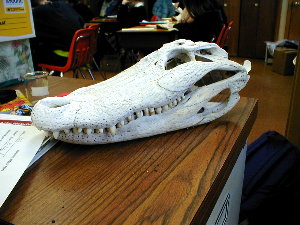 |
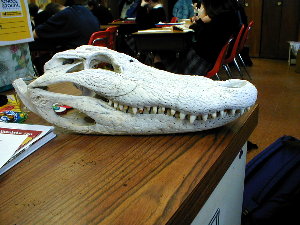
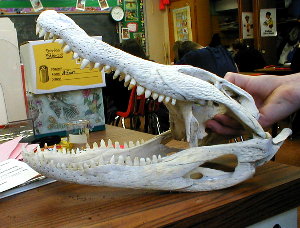
| Pictured above is the skull of an alligator. This particular skull was aquired legally from the state of Florida. It is probably from an alligator of a length of 9.5 - 10 feet long. Notice the teeth of this reptile. Unlike the turtle skull, this creature is designed to grab, rip and tear, and swallow. Alligators are not chewing animals, they swallow their food in whole pieces, dependant on the size that they rip off of their prey.Their slender design allows them to peak their eyes out of the water, while keeping the rest of their body under water. This creates a sneak-attack method of hunting. Southern states, including Flordia and Louisianna, are known for their alligator meat industry. Alligator farms are a way of life for many in the south. According to federal law, the complete alliagator must provide some form of revenue and or usefulness. With this in mind, none of the animal is wasted. Alligator meat has become increasingly popular over the past few years. Souvenir Stores sell alligator heads on a regular bases. Alligator feet key chains, alligator skin wallets, boots, belts, pocketbooks and etc. can be found everywhere down south. Some of the funds earned must be put back into the preservation of these powerful creatures. Much of these products that are available for sale come from the alligators raised on the alligator farms, which are raised specifically for the purpose of food and products. This alone helps to preserve the wild populations of gators. |
|
 |
 |
 |
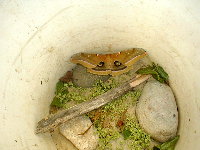 |
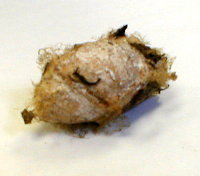
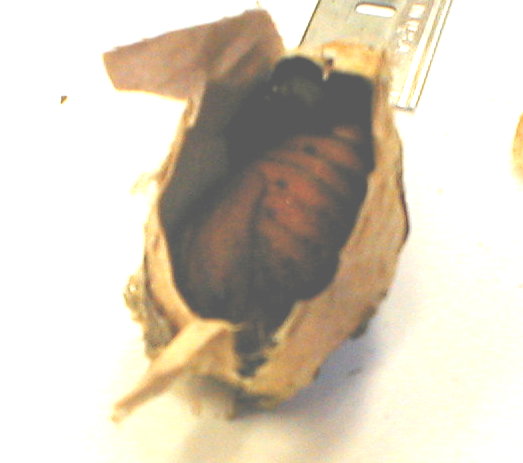
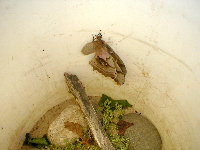
| The following pictures are of a Polyphemus Moth and its metamorphic stages. This speciemen was brought in to the class by a student who found it in his yard back in the fall. During the fall the catipillar goes into a cocoon, shown in picture one. By mid-spring the transformation is complete and the Polyphemus is ready to emerge from his cage. To do this the adult secretes a chemical called cocoonase to break down the silk strands of the cocoon. Once through the cocoon the nearly emerged moth climbs up the limb and starts to pump fluid into the wings to stiffen them up. After a short while the polyphemus moth is ready for flight. |
| 1. |
| 2. |
| 3. |
| 4. |
| Polyphemus cocoon |
| Polyphemus pupae |
| Polyphemus Moth nearly emerged (about 10 minutes) |
| The moth on the following day. |
 |
|
|