Deities of Gens Ritulia |
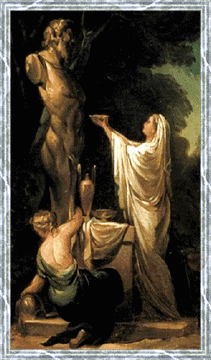 |
| Gens Ritulia�s patron deities are Bacchus (Dionysus), Venus (Aphrodite), Trivia (Hekate), Vesta (Hestia), and the Lares/Penates. This page will show a picture of each deity and give a brief description of them. In the future this page will also contain links that describe their rituals and ceremonies to each of them. |
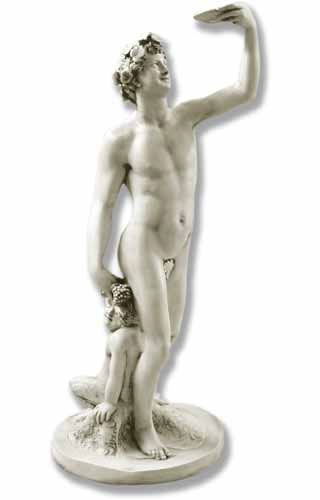 |
| Bacchus is the Roman god of wine and intoxication and is equated with the Greek god Dionysus. His festival was celebrated on March 16 and 17 and was named the Bacchanalia it consisted of orgies in honor of him. This festival was introduced in Rome around 200 BCE. and were infamous celebrations, notorious for their ecstatic character. His festivals became so outrageous that they were forbidden by the Roman Senate in 186 BCE. Bacchus is also identified with the old-Italian god Liber, god of fertility and growth in nature. In later times Liber ("the free one") was equated with Dionysus and became thus a god of viniculture. His feminine counterpart was the goddess Libera; she was later equated with Proserpine. Their festival, the Liberia, was observed on March 17. |
| Bacchus / Dionysus |
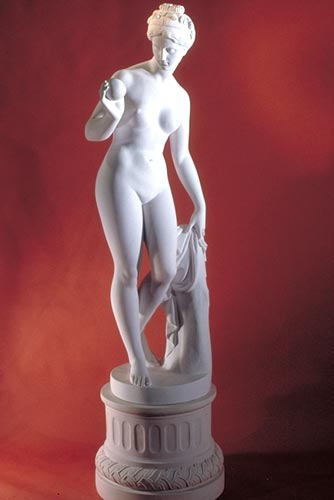 |
| Venus / Aphrodite |
| Venus was the Roman goddess of love and beauty, but originally she was a vegetation goddess and patroness of gardens and vineyards. Later, under Greek influence, she was equated with Aphrodite the goddess of love, beauty and sexual rapture. Her cult originated from Ardea and Lavinium in Latium. The oldest temple known of Venus dates back to 293 BCE, and was inaugurated on August 18. Later, on this date the Vinalia Rustica was observed, a second festival the Veneralia was celebrated on April 1 in honor of Venus Verticordia, who later became the guardian against vice. Her temple was built in 114 BCE. after the Roman defeat near Lake Trasum in 215 BCE, a temple was built on the Capitol for Venus Erycina. This temple was officially opened on April 23, and a festival, the Vinalia Priora, was instituted to celebrate the occasion. |
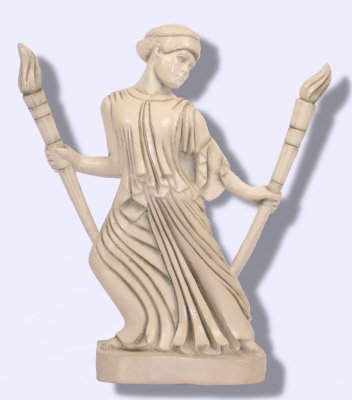
| Trivia / Hekate |
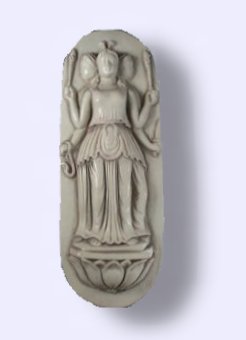 |
| Trivia is the personified deity of crossroads, derived from the Latin word trivium ("meeting of three roads"). She was often represented with three faces, and sometimes identified with the Greek goddess Hecate who was the protectress of far away places, roads, and byways. When depicted as having three heads they usually were, a dogs head, a snakes, and that of a horse. She is usually seen with two ghost hounds that were said to serve her. Hecate is most often misperceived as the goddess of witchcraft or evil. Hecate is said to haunt a three-way crossroads, each of her heads facing in a different direction and is said to appear when the ebony moon shines. Food offerings called "Hecate's Suppers" were left near crossroads late at night on the eve of the full Moon. The person leaving the food walked away without looking back for fear of confronting the goddess face to face. This was a way of honoring the threefold goddess; other offerings included honey, dogs, and black ewes. She was also honored at the Compitalia held January 5 or 7 (originally this festival date varied up to two weeks). Lares Compitales, was a festival held in honor of the guardian deities of crossroads, fields, and roads. This was a day to meet with neighbors for fun and games. |
 |
| Hymn & Ritual to come |
| Hymn & Ritual to come |
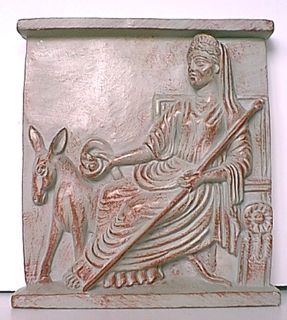 |
| Vesta / Hestia |
| Vesta was the goddess of the hearth, equated with the Greek Hestia. She was at first only worshipped in Roman homes, as part of the private cult, eventually it evolved into a state cult. It is believed that king Numa Pompilius (715-673 BCE) created her worship. In her temple on the Palatine Hill, the sacred fire of the Roman state burned, which was maintained by the Vestal Virgins. At the start of the new Roman year, March 1 the fire was renewed and burned until 394 CE. Vesta's temple was situated on the Forum Romanum and was built in the third century BCE. None of her temples, however, contained her statue; her festival is the Vestalia, which was observed from June 7 - 15. On the first day of this festival, the 'penus Vestae', the inner sanctum of her temple which was kept closed the entire year, was opened for women, who came bare-footed to bring her offerings. The temple was ritually cleansed on the last day. The ass was Vesta's sacred animal, who�s braying supposedly kept the lascivious Priapus away. |
| Hymn & Ritual to come |
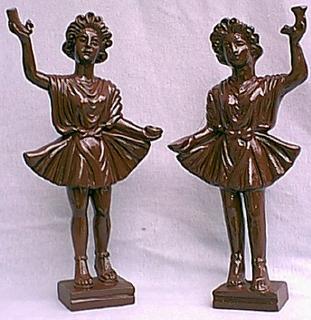 |
| Lares & Penates |
| Lares were guardian spirits of house and fields. The cult of the Lares is probably derived from the worshipping of the deceased master of the family. It was believed that he blessed the house and brought fertility to the fields. Just like the Penates, the Lares were worshipped in small sanctuaries or shrines, called Lararium, which could be found in every Roman house. They were placed in the atrium (the main room) or in the peristylium (a small open court) of the house. Here people sacrificed food to the Lares on holidays. In contrast to their malignant counterparts the Larvae (Lemures), the Lares are beneficent and friendly spirits. There were many different types of guardian spirits; the most important were the Lares Familiares (guardians of the family), Lares Domestici (guardians of the house), Lares Patrii and Lares Privati. Other guardians were the Lares Permarini (guardians of the sea), Lares Rurales (guardians of the land), Lares Compitales (guardians of crossroads), Lares Viales (guardians of travelers) and Lares Praestitis (guardians of the state). As progenitors of the family, they were accompanied by a symbolic phallic serpents. In Roman mythology, the Penates ("the inner ones") are the patron gods of the storeroom. Later they gradually changed into patron gods for the entire household. Their cult is closely related to that of Vesta and the Lares. They were worshipped at the hearth and were given their part of the daily meals. |
| Hymn & Ritual to come |
 |
 |