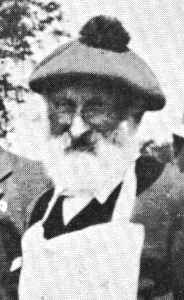
LIPPIA REPENS(Kate Sessions, California Garden, June 1928, Vol 19 #12. Page 15)Dr. F. Franceschi wrote this interesting account of the introduction of Lippia repens about twenty years ago. It was in 1869, barely before the fall of the Second Empire, when the centennial of the first Napoleon was celebrated with great festivities at his birthplace, Ajaccio in Corsica. The Superintendent of Parks of the City of Florence, Signor Pucci, to whom the floral decorations had been entrusted, was quite struck with Lippia, as it had been used in the public garden of Ajaccio. He took some with him to Florence and put it on trial in one of the public gardens. There it did so well that it spread to other parts of Italy, and particularly along the Riviera where the climatic conditions are very much like Southern California. "In the year 1898, my daughter, who had recently come from Italy called my attention to the fact that for several years already Lippia, had been used to carpet the esplanade at the Naval Academy at Leghorn, where five hundred boys had their daily drilling, and all sorts of games. It was obvious to think that if Lippia had done so well in Italy that it ought to do the same in California. From the Director of the Botanic Garden in Rome, .1 secured by mail a small tin box of Lippia, less than twelve ounces in weight. Now after six years, there are hundreds of acres planted in Lippia in California. Arizona, Mexico and Australia, and it all came out of that small tin box, and had it not been for this celebration of the centennial of the great Napoleon, probably this humble plant would still grow, little known, and unappreciated only on the coast of Corsica and the other points along the Mediterranean." The following are the cultural directions for establishing lawns of this plant, have your ground well worked and pulverized, levelled, and rolled if possible. No manure is recommended. Lippia needs very sparingly or not at all. The best and quickest way to propagate it is by planting small sod (two square inches) at a distance of about six inches or one foot apart. The closer it is planted the sooner the ground will be carpeted. Each small sod contains many joints, and from each joint runners and roots will soon appear that will branch in every direction, and will anchor it in the ground, rooting again as they run or spread. Press well and firm the sods in the ground, and give sufficient water to start growth. Occasionally rolling will be an advantage. Frequent walking over it will have the same effect. If the lilac covered flowers, much enjoyed by the bees, are not desired they may be removed by an ordinary lawn mower. During the dry season water must be given at intervals as the conditions will suggest�one-half as much water as blue grass requires cutting about twice a year with a lawn mower and raking out the long runners; a very light coating of good soil is helpful once a year. The best planting season is February to June. Lippia citriodora is our local Lemon Verbena Shrub which every gardener enjoys. Dr. Franceschi, an Italian plant enthusiast from Florence, lived in Santa Barbara for about twenty years and during that time he introduced and cultivated a large number of very desirable plants He also wrote very generously of plants, and was in correspondence with all the botanical gardens of the world. About 1920 he returned to Italy and undertook similar work in Tripoli for the Italian government until his death in 1924. Lippia makes a practical ground cover for children's playgrounds, for a sod beneath clothes lines, and for the strip between skeleton runways to the garage. Mr. Walter S. Merrill has used it with great success for all the paths in his home garden. |