|
Unlocking secrets of deadly pathogens
Federal scientists busier than ever researching West
Nile, other diseases
Monday, December 30, 2002
Posted: 10:54 AM EST (1554 GMT)
FORT COLLINS, Colorado (AP) -- Giant
beakers filled with blood clutter countertops and extra refrigerators
cramp the hallways at the federal government's main research center for
West Nile virus.
Scientists at the Centers for Disease Control and Prevention have had
to sharply shift the focus of their work toward the sometimes fatal
disease that is spreading across most of the country.
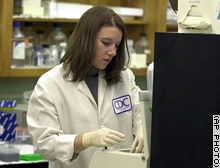
Biologist
Trudy Chambers runs a test on a horses blood for
West
Nile virus at the CDC's lab in Fort Collins, Colorado.
The individual labs within the white building are packed with beakers
of blood and other animal specimens that may carry the virus. Former
offices have been relocated to temporary structures outside to make room
for extra lab space.
Lab officials say their workload increased dramatically since West
Nile virus first appeared in a few dozen U.S. cases in 1999. Already
this year, more than 3,500 human cases of the mosquito-borne illness
have been confirmed. And recently the CDC noted that the United States
had suffered this year the biggest reported outbreak of West Nile
encephalitis in the world.
"Our workload has been a lot, and there is no sign that it is
going to let up," said John T. Roehrig, chief of the arbovirus
diseases branch of the CDC's Division of Vector-Borne Infectious
Diseases.
West Nile previously received the same attention as countless
diseases affecting the global community. Now, as the CDC's primary West
Nile virus research facility, up to 90 percent of the lab's time and
resources are devoted to this disease.
About 150 people work at the lab.
West Nile in the spotlight
The emphasis on West Nile comes while the lab also tries to address
its responsibility for research on plague and tularemia, both highly
infectious agents with potential for use in bioterrorism.
And with an increased concern about bioterrorism since the September
11 terrorist attacks, the lab has made a series of security changes
including the installation of a giant barbed-wire fence around its
perimeter.
Roehrig acknowledged that other research projects have been put on
the back burner to make room for West Nile studies.
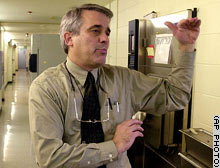
John
T. Roehrig with the CDC says their workload has jumped
because
of the West Nile virus, with no relief in sight.
"We try to maintain expertise and credibility for all the
diseases we're responsible for. But where we've had the biggest effect
is in our field teams, who are now responding to West Nile,"
Roehrig said.
He said lab scientists are trying to develop better diagnostic
testing for West Nile virus. One model, which detects genetic material
from the virus, is being used in scientific investigations and may one
day be used to screen donated blood for West Nile virus.
Other research projects include new vaccines for horses and possibly
birds, and studies of how the virus may be transmitted between humans
through breast milk, blood transfusions and organ donations.
Roehrig said drug companies are investigating a possible human West
Nile vaccine, which he expects to see within a couple of years.
In the beginning, the Fort Collins lab was responsible for confirming
all human cases of West Nile virus. Since then, lab workers have trained
state and local agencies to do their own testing when possible.
A wake-up call
One of the main lessons learned from the arrival of West Nile was
that state and local health agencies were far less prepared for an
infectious disease outbreak than they should have been, said Duane J.
Gubler, director of the CDC's Division of Vector-Borne Infectious
Diseases.
He said West Nile is a wake-up call to a public health system that
has grown complacent about vector-borne infectious diseases since the
advent of powerful new drugs and antibiotics over the last few decades.
"Along with that complacency, we allowed the public health
infrastructure to deteriorate," Gubler said.
Case in point: the aging, cramped lab in Fort Collins.
Built in 1967 to help the CDC deal with arboviral encephalitis in the
western United States, the lab soon took over research duties for
plague, Dengue fever, Lyme disease and other zoonotic bacterial
infections.
As duties grew, the lab became more crowded. By about 1998, some
offices were moved to temporary structures outside of the main building
to make room for more lab space.
But West Nile virus has the lab busier and more crowded than ever.
The electrical wiring, heating and cooling systems are antiquated and
desperately need to be replaced.
"We're crowded. We need a new lab. And right now the plan is to
build it," Gubler said.
In the meantime, scientists will learn from changes the lab has
undergone in the last few years.
"One of the main lessons we've taken home from this experience
is that we need to keep an open mind and expect the unexpected,"
Gubler said.
Source: cnn.com
|