|
Backyard Birders Help Track West Nile Virus
By Cat Lazaroff
WASHINGTON, DC, February 13, 2003 (ENS) - Armchair
birdwatchers will have a special task this weekend: helping biologists
to learn what impact the West Nile virus is having on America's wild
birds. This weekend's sixth annual Backyard Bird Count will focus on the
effects of threats like disease and loss of habitat, and add vital new
information to scientific understanding of birds and their environment.
This year's count comes on the heels of a new report identifying more
than 100 bird species that the U.S. Fish and Wildlife Service (USFWS)
has identified as needing prompt conservation attention to stabilize or
increase populations or to secure threatened habitats. Among the new
threats facing many U.S. birds is the West Nile virus, which has
decimated some bird populations.
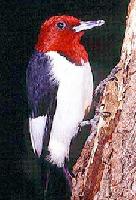
The red headed
woodpecker - one of many birds threatened by loss of habitat - requires
open fields for catching insects, and hollow trees for nesting. (Photo
© Ohio Department of Natural Resources)
"We need every birder to join us," said Frank Gill, senior vice
president of science for the National Audubon Society, which sponsors the
Great Backyard Bird Count along with the Cornell Lab of Ornithology.
"The Great Backyard Bird Count has become a important means of
gathering data to help birds, but it can't happen unless people take
part," added Gill. "Whether you're a novice or an expert, we
need you to take part and help us help birds."
Audubon and Cornell are asking participants to pay special attention to
the more than 200 species on the Audubon 2002 WatchList, issued last
autumn, which lists North American birds in danger or decline. Many of the
birds on that list also appear on the USFWS Birds of Conservation Concern
2002 report; of the 151 species on the WatchList that are not listed as
either endangered or threatened - or are hunted - 86 are on the USFWS
national list and 27 are on regional lists.
"WatchList is an early warning system designed to raise awareness
of birds in trouble, before they become endangered or threatened,"
explained Audubon's Gill. "Think of it as preventative medicine,
protecting our great natural heritage."
The GBBC website (http://www.birdsource.org/gbbc)
includes features on these dwindling birds, and what participants can do
to help them.
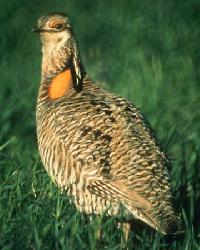
Endangered birds like
the Attwater's greater prairie chicken could be wiped out by West Nile
virus. (Photo by Gary P. Montoya/USFWS)
The GBBC will also focus on the effects of West Nile virus on crows and
jays, owls, raptors and other birds, and will educate participants about
the disease.
"We need as many volunteer counters as possible to tell us what
they see," said Sally Conyne, Audubon director of special projects.
"The GBBC can serve to educate people about the real effects of the
disease, and will help our scientists reach a better understanding."
Last week, Audubon and the Smithsonian Environmental Research Center (SERC)
hosted a summit in Maryland regarding the spread of West Nile and its
potential impacts on birds and other wildlife. The two day workshop,
titled "Impacts of West Nile Virus on Wildlife Health," was
co-chaired by Peter Marra of SERC and Robert McLean of the National
Wildlife Research Center of the U.S. Department of Agriculture (USDA).
The summit, cosponsored by the USDA and U.S. Geological Survey, was
attended by scientists from many different disciplines. The researchers
outlined a series of steps that need to be taken to understand West Nile
virus and its effects on people and wildlife.
"West Nile virus is one of the most serious invasive pathogens to
enter this country in the past century," said Marra, an animal
ecologist at SERC. "This meeting was the first of its kind
coordinating government agencies, academic institutions, non-profits, and
others to think about West Nile virus and other emerging diseases as
threats to wildlife populations. We were able to bring together
researchers and scientists to prioritize and coordinate research efforts,
and to work to standardize methodologies to determine the effects of this
virus on wildlife."
Among the more urgent topics the scientists discussed was the threat West
Nile poses to native bird populations.
"West Nile has infected more than 100 bird species, and has killed
countless numbers of birds and other wildlife," said Audubon's Gill.
"The virus adds yet another life threatening challenge to the
existence of North American birds at a time when they are under severe
stress from other problems."
West Nile virus potentially threatens many endangered species,
including scrub jays, whooping cranes, condors, prairie chickens and
red-cockaded woodpeckers, to name a few.
Since the virus invaded the U.S. in 1999, it has killed 263 people and
infected more than 4,000. Last year's West Nile virus epidemic in humans
was the largest ever recorded in the world.
The disease is most commonly transmitted through the bites of infected
mosquitoes, although host to host transmission - from human to human or
bird to bird - has now been confirmed.
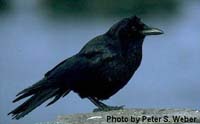
American crows seem
particulary susceptible to West Nile Virus (Photo by Peter S. Weber,
courtesy USGS)
Wild bird mortality has aided public health agencies in tracking the path
of the West Nile virus, and continues to provide an early warning system
for the emergence of the virus in new locations. Researchers at last
week's summit said more research needs to be done to determine how the
virus spreads geographically, how it is transmitted from host to host, how
the virus overwinters, how to assess its impact on birds and wildlife, and
how disease experts might intervene to reduce the impacts of the disease.
The extent and impact on wildlife health is difficult to measure and
quantify, said Robert McLean of the National Wildlife Research Center.
Hundreds of thousands of birds, mammals and reptiles throughout the United
States have died.
"West Nile virus appears to be indiscriminate in how it affects
groups of organisms," McLean said, "and it is very efficient in
what it does."
There are now more than 150 wild bird species, 15 mammal species and
one reptile species known infected with the virus in the United States.
"We know that some local bird populations have been affected by
West Nile Virus," said Christopher Brand, a wildlife disease
scientist for the U.S. Geological Survey. "But on a regional or
continent wide basis, we don't know what the long term ramifications are,
especially to threatened or endangered species, where even small
geographic scale disease outbreaks could be disastrous."
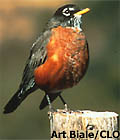
American robins seem
to avoid snow covered areas, the GBBC has shown in past years. (Photo
courtesy Cornell
Lab of Ornithology)
One way to gather information on the impacts of the disease on birds is to
enlist the help of people who like to watch birds anyway.
The GBBC combines high tech web tools with an army of "citizen
scientist" bird observers. The Count asks families, individuals,
classrooms and community groups to count the numbers and kinds of birds
that visit their feeders, local parks, schoolyards and other areas during
any or all of the four count days - February 14-17, 2003.
Participants enter their observations on the Count website, developed
by Audubon and the Cornell Lab. Visitors to that site can watch as counts
are posted in near-real time, and learn what birds are being spotted in
what parts of the country.
Since the first count in 1998, the GBBC has engaged more than a
quarter-million Americans of all ages and backgrounds in the effort to
keep common birds common. In 2002, more than 47,000 participants counted
millions of birds throughout North America, helping reveal information on
evening grosbeaks, snowy owls, collared doves and many other birds.
"When the last ivory-billed woodpecker was seen in the 1930s, there
was no concrete way for citizens to help professional ornithologists
monitor bird populations," said Cornell Lab of Ornithology director
John Fitzpatrick, who this past year led an expedition to try to
rediscover the ivory bill, possibly North America's rarest bird.
"We cannot allow other species to face the same fate as the
ivory-bill," Fitzpatrick added. "The Great Backyard Bird Count
provides a way for citizens to help us determine which birds are where and
in what numbers, so we can take steps to protect those that need
protecting."
The GBBC site provides useful information to make participation in the
count easy and enjoyable. No registration is required, and participation
is free to all.
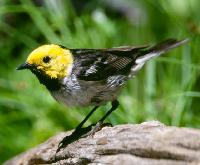
The hermit warbler, a songbird
of Western states, appears on the Audubon WatchList 2002 due to its
declining numbers. (Photo © George Steele, courtesy National
Audubon Society)
The website offers tips on bird watching and bird feeding, sound clips of
bird vocalizations and more. Educators may find the bibliography and
geography sections handy, along with suggestions on how to conduct the
Count with groups of children; and for those tired of winter and ready for
spring, there are tips about planning and preparing for the spring bird
garden.
For more information on the Great Backyard Bird Count, visit:
http://www.birdsource.org/gbbc/
The USFWS Birds of Concern 2002 list is available at: http://migratorybirds.fws.gov
The National Audubon Society's WatchList 2002 is available at: http://www.audubon.org/bird/watchlist/index.html
For information on the West Nile Virus workshop, visit: http://www.serc.si.edu/migratorybirds/current_events_fin.htm
For the latest information on the human impacts of the virus, visit: http://www.cdc.gov/ncidod/dvbid/westnile/
|