Front Page
Tue September 04 2001
|
Staff Correspondent
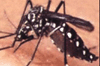
The Dhaka City Corporation (DCC) has taken up a special programme to destroy eggs of Aedes mosquito, carrier of the deadly dengue virus. The DCC has recently issued letters to its 90 ward commissioners, asking them identify areas and houses where eggs of Aedes mosquito are found. All city hospitals and clinics have also been asked to report dengue cases to the DCC so that it can carry out spraying in the areas where the patients come from. A surveillance team of fourteen entomologists or scientists studying insects under a Tk 14 lakh project is now conducting special larvae or egg sample collection to help identify the eggs commonly found in plastic and earthen containers. The study found exceptionally high density of Aedes mosquito. Compared to last year, this year's study on density of Aedes population in all 90 wards has found very high concentration, DCC officials said. "We have formed a 'Rapid Action Force' to prevent hatching of millions of eggs found in levels beyond our belief during a scientific study by the City Corporation. We are alarmed by the quantity of Aedes mosquito eggs have been found in most of the houses our surveillance teams visited," said Dr Ashraf Uddin, chief health officer of the DCC during a press briefing at the Nagar Bhaban yesterday. He also said that all high officials concerned of various agencies of the government had met the advisor for health and family welfare prior to the briefing at the secretariat to discuss the special drive. "Obviously, the drive aims at destroying eggs laid by Aedes but it would also focus on killing the adult mosquitoes," said Dr Ashraf. A special taskforce has also been formed in each of its ten zones comprising inspection teams, spray men, fumigators, cleaners and entomologists focusing on dengue prevention measures. A total of 600 men with 24 supervisors have been deployed to help both awareness and prevention activities by the DCC. Mayor Mohammad Hanif, who was late joining yesterday's briefing, said that the strength was not sufficient but DCC had enough spraying machines and insecticides. "Machines and our men cannot alone prevent dengue attack. We must create awareness among citizens to prevent hatching of eggs by the Aedes mosquito. It is the only way how we can achieve the goal of dengue prevention." Citing examples of Thailand, Myanmar, India, Southern China and Singapore, Dr Shahidur Rahman, DCC health officer supervising the ongoing larvae identification survey, said, "Once dengue virus enters a country it is difficult to control the disease but what we can do is to control the vector or the insect. This is where we want to give emphasis on and we want everyone's participation here." DCC teams would visit all ten zones of the city to conduct the spraying activities. This will be an ongoing process, the officials said. The latest study identified Old City having the highest density of Aedes population. Most of the houses visited had very high concentration of Aedes mosquito eggs. The entire Dhaka University areas, Kalabagan, Elephant Road, Mohammadpur, Lalmatia, Central Road, North Dhanmandi, Tejgaon Industrial Area, Minto Road, Kakrail and Mirpur also have high density of Aedes population. Meanwhile, a total of 512 people, since January, were infected with dengue virus spread by Aedes mosquito that bites human during daybreak and just before sunset. Out of the total seven people died, two at the Dhaka Paediatric Hospital, two at the Dhaka medical College Hospital, one at the Mitford Hospital and two at the BIRDEM Hospital since January. In last 48 hours 72 more people were hospitalised in different city hospitals and private clinics, health directorate control room said yesterday. The World Health Organisation has also sounded an alarm and asked South Asian nations to prepare for special prevention measures. The WHO anticipates massive dengue attack in the region this year.
|