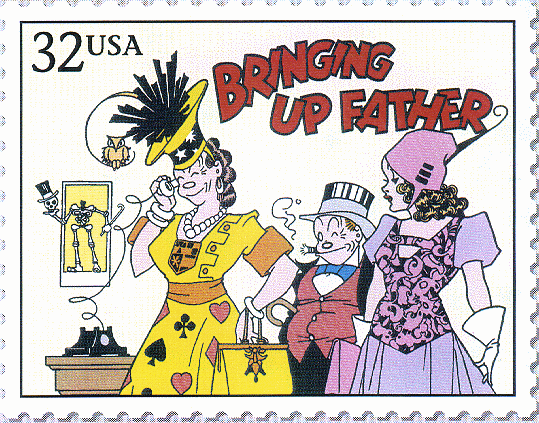
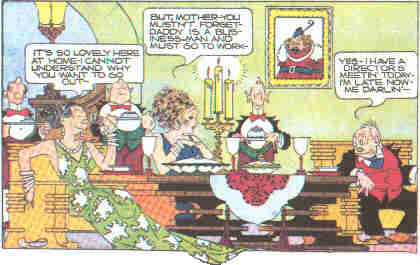
Books and magazines were all over the place, when I was little. My early memories were sitting on somebody's lap and looking at pictures from an open book. Pa, my Grandfather, who lived downstairs with Nana, was always reading the Charlotte Observer, or playing solitaire. I especially remember him in his favorite chair as the Sunday morning light poured into the living room through the glass doors that opened out onto the tile terrace. The big chair with wings, scroll work arms, wicker work and all from another era, was big enough for his lean frame and a wiggle worm three-something boy. His legs were not so good anymore, and I think it hurt him to be on his lap. One of his favorite comic in the paper was "Bringing Up Father", in vivid color every Sunday. While everybody else in the house was busy getting ready for church, I would pester Pa to read it to me. He always obliged, explaining the humor patiently, as I squirmed. I was amused at the surrealism of the strip. The funny way Jiggs was drawn with his hair a constant red cowlick, Bart Simpson for the 30's, and Maggie with her airs and aquiline neck and nose. Jiggs and Maggie, their constant battles, the Irish neuveau riche, a Beverly Hillbillies precursor. I was fascinated the way the people and objects depicted in the pictures on the wall Pictures on the walls would not stay in the frames, but became part of the living space. There was a juggler whose ten-pins invaded the space of the entire cartoon frame, going outside, the pins going to the ceiling. Things like that. A child picks up the details. I think that I became a bit of a rebel artist, exposed to comic drawing like that. I did not want my crayon drawings to "stay in the lines!" My crayons would bounce all over the paper, and the outlines did not seem to be the point. The wonderful color that my waxy thrusting, jabbing marker was laying on the page, the life that was being created right there, from my own hand and arm-motion, was the whole reason for this scribble.
Pa also taught me about the playing cards. and about Solitaire, the seven-card spread and the nine card spread. Ace King Queen Jack. There was a lot of card playing in those pre-TV days everywhere. His friends would come over often. Mama would always be going out for a bridge game somewhere, or her friends would come over for games at the house. (I well remember being in my high sided crib, screaming because Mom and her girl friends were playing bridge in the next room. I got a spanking. I could only lie there and listen to the bidding. "One heart." "Two clubs". "Two no-trumps". My vocabulary grew.)Often, Pa would have someone, almost always Mama, drive him in his big Hudson to the M & M Men's Club, on Union Street just north of the business district for a card game with his buddies. (I cannot remember what the initials stood for. "Men and Machines?") Decorated in heavy, dark, very masculine furniture. The place smelled of good cigars and leather. Set back from the North Union Street, beside the august Victorian Central Methodist Church, the building was simple art deco in design, Bauhaus influenced. Down stairs was the Public Library. At the back, there was a big meeting space with a grand mural spanning the entire length of the room. An artist had been commissioned to do it during the WPA era, probably paid in part by New Deal Federal Funds, The artist and his wife came to town, creating much excitement, painting the history of the county in big impressionist strokes. The most attractive part was the ante-bellum era, with women, the artist's wife as model for most, dolled up like Scarlet O'Hera, and men like Rhet Butler. "Gone with the Wind" was soon to be released. The scenes depicted were framed in cumulous clouds. I do not know his name, but he was no Thomas Hart Benton, but it was quite grand for Concord. Outside the big windows, was the YMCA Public Swimming Pool, full of kids splashing the summer away. White folks only. It cost the same as the movie theaters, and I would later spend many summer afternoons splashing in the chlorine laced waters. Older kids and adults came at night. It was about all there was to do in Concord in those days.
While Pa played bridge and poker with his friends at the M & M, Mama and I would go "shopping" by Belks Department Store, the A & P, Mr. Gruber's meat market, down to Uncle George's and Uncle Maury's. Richmond-Flowe. I would get a cookie from Uncle George's glass cookie case, (an Oreo, or a fig newton. I was not allowed a Malamar, but I could have a raison square, do not remember the name. It had a dark sweetness with a bit of bitter mixed in I came to love,) and go next door to Uncle Maury's haberdashery. (We never bought any groceries there, since the store made deliveries. Nana would order what she wanted every morning by telephone, and Shirley, a man!, would bring it early enough for Non to cook a great dinner for all.) I loved the smell of the shoes. He had the best selection of everything in town. Shirts and suites. Socks and ties. (whenever I outgrew my shoes, Uncle Maury always had a nice pair of new ones for me.) Then we would repair to Gibsons Drug Store on the square, where Daddy worked, for a soda. Only I was not allowed to have cokes. They were still called "dopes", and were thought to contain cocaine. (I do not know to this day if they did. The formula is held under armed guard in Atlanta somewhere, in some vaulted dungeon. At least that is what we were told.) The tables were high for a yard ape like me, and I enjoyed scraping the chewing gum off from under the tables, which were about over my head. I crawled a lot anyway. Until I got caught, I would put the stuff in my mouth. Then I would get a spanking of sorts. She would meet her friends, Inez Eifford White, wife of our cousin Stokes, Miriam Coltraine, from the banking family, owners of Concord Telephone, Winnie Pegram Morris, Aunt Craig's sister. They did not work, I guess. Mom had quit her school job when she got married. Daddy made twenty-nine dollars a week at the drug store in those depression days. He had worked at Gibson's since high school. Eggs were a dime a dozen. A loaf of bread was a nickel. A quarter would get you into a movie. (Nine cents for kids under 12.)
Back home, dinner would be set up in the breakfast room, between the kitchen and the dining room. Non would have a full meal ready. Nana would complain that the vegetables had too much salt and pork fat in them, but she could never break Non of the southern seasoning. Nana ate like a bird, a bite here and there, would take a spoonful of sugar raw for energy, and was quite thin, as were all her children. Pa liked hearty food, and would bring in hams, his one of his favorite meats. Steak, also, and would eat the fat, claiming it was the flavor of the meat. Hams, Nana would serve disparagingly. We always had fresh rolls. Nana did not approve of biscuits, since they were made with lots of lard. And store bought "light bread", was looked down on for its instability. Daddy would get a ride home at noon from one of his fellow workers, Pee Wee Bourage or Charlie Short, who had a plate in his head from an accident or war injury, I did not know which, or which war? "Much obliged", was Daddy's thank you call, as he got out, coming up the walkway. Bobu, Aunt Ellen, was still living at home, as my memories began. Before she married Uncle Laurin, she would walk home at lunch from Penn Carol Hosery, where she was secretary, or some other office job. She forbade me into her room, next to the bathroom upstairs where we stayed also.
We all ate dinner together, and then Nana and Pa would take a nap for awhile, and Mama would try to, but she would have to read to me. I loved getting read to. Of course, Nana and Pa, and Boo, next door, would do it too. My first absolute favorite book was "Clementina, the Flying Pig"
"Clementina was darling little pig. She was round and rosy, and had the curliest little tail you ever saw. No one ever ever paid much attention to Clementina, until one day, the horse looked at the cow in surprise and said: "What could that be growing out of Clementina's back?" "Its wings", said the cow. "Sure enough", said the horse!!!"
I could quote it verbatim. Sometimes the readers would miss a word, and I would correct them. Another book I loved was Peter Pan. It was much richer and more complicated. But Peter Pan really became a life favorite for me, since I hated the idea of "growing up". Barry sure hit on a good note there. Before I was reading "Tom Sawyer" and "Huck Finn", there was Peter Pan. Before "Catcher in the Rye" and "Of Mice and Men", there was Peter Pan. I never forgave them for letting a girl play the role. Suggesting that any girl would ever have the bravery, the charisma, the intelligence of PETER PAN. I never forgave Broadway and Hollywood for that. Actually, the cartoon version was not bad, but I refused to see it for a long time, because I was sure they would get it wrong. The story was already a movie in my mind, and I did not want to see any revisionist version of my private fantasy. Mary Martin was OK as Nellie Forbush in "South Pacific", but as Peter Pan? NO WAY!!!! If I could, I would prefer to live in Never Never Land with Windy and have fun with the Lost Boys and Tiger Lilly and the fairy Tinka Bell.
About that time, Daddy bought the Harvard Classics, on some sort of inspired whim. This big box of blue books arrived at 25 Georgia Avenue one day. I must have been 4 or 5 by then. A six foot shelf of books containing the greatest writings of all times, as judged by professors at Harvard. All subjects were included. Daddy said if you read all the books, it would be the equivalent of a college education at an Ivy League University! Science was well covered with both "The Origin of Species" and "The Voyage of the Beagle". Essays by Faraday and Heimholtz, Kelvin and Newton. William Henry Huxley. Philosophy: Descartes, Socrates, Hume. And much much more. Literature was especially well represented: every thing from the Bible to I Promissi Sposi. The divine Comedy, Paradise Lost. Religion. Shakespeare. Mama read to me from"Folklore and Fable". Fontaine, to whom we were supposedly kin, Grimm and Anderson. Aesop. The stories were bloody and brutal. But I loved them. Mama liked to read these lying on the bed after lunch, begging me not to wiggle and squirm so much. Snow White and Rose Red. Strange beings with strange names. Rumplestilskin! Repunsel. Cyclops. Billy Goats Gruff.
Boo was the best reader. Every Sunday, especially, after church, on her front porch in warm weather. Roses bloomed on an trellis over the end of this porch every spring. We sat in big green rockers, or on the floor, leaning against the bannisters. She wore these wire rimmed reading glasses, and made the stories so interesting. We would always start out with the Bible. We read through the Old Testament. She abridged a bit, leaving out the confusing and monotonous genealogies, the "begets". And the laws in Leviticus and Numbers and all. But I was quite familiar with Noah, Abraham and Isaac, Jacob and the magic ladder and wrestling with the Angel. Joseph and his many colored coat, and Potophor and Potaphor's lecherous wife. Samuel. David and Jonathan and Saul. Absolom and Soloman.
After the Bible, came the secular. Twain's "Tom Sawyer" or "Huck Finn". Hardy Boys, I loved, and dog books like "Bob, Son of Battle". She read one called "Toby Tyler, or Ten Weeks With the Circus", which described its characters so vividly, I still remember them. Also "Alice in Wonderland". Every Christmas, she would read Charles Dickens' "A Christmas Carol". I delighted in Scrooge and Marley and the vivid depiction of the ghosts. Quite a stretching for a child to grasp the rich language and illusions of Dickens Victorian rhetoric. I liked Scrooge and his gruffness. He was like all the men I knew. Uncle George and Uncle Maury. Daddy, even. Self-righteous, intolerant, self assured. They tended to look down on the Bob Cratchet's and Tiny Tim's that were abroad as always. The opposite of Boo, who was as tolerant and giving, as loving as Jesus Himself, or any saint you could name. The care-giver. Too bad, their was no one to be her care-giver, and she died in the State Hospital for the Indigent, alone, abandoned by all those she had cared for in her life. Family love as its limits, sad to say. Such is the nature of modern American reality.
Boo was such a great reader, and this custom continued a while after I learned to read myself. Maury and Chal were read to up into there teens, it seems, for one Sunday, they had her reading "Of Mice and Men." Things were going along OK until some of the working class language Steinbeck did not hesitate to use, came out. A few "bastards" and a "son of a bitch", had Uncle Maury shouting from the next room: "Willy Willy, don't read that to them!!!" That just about ended the readings. The boys long since should have been reading it themselves. In fact, I think they had.
But books were everywhere in the two houses. At Boo's, my great grandfather's library, mostly in a tall oak case with glass door, contained some complete editions of Dickens and Walter Scott. George Hazzard Richmond had entered Lees Mcrae College just as the Civil War began. His brothers left home to serve, but our Grandfather, the youngest, got to stay home at Woodside and tend the farm. Wish I still had all those books, and the case, but Mama gave most of them away when she and Dad moved to the coast in 1969. There was Robert Browning and Longfellow and Bobby Burns, and Lord Byron and Shelley and Keats. There was Shakespeare complete. When Uncle Maury became so senile and had to go to an institution in Pinehurst, I spent many many hours over there, going through the collection. It was my favorite hangout in High School, too, and I read "Catcher in the Rye", a bunch of Faulkner and Hemingway over there. In a platform rocker, in front of the gothic window radio. On saturday's, the Metropolitan Opera. In 1948, the Democratic convention. I learn about life and politics. How fortunate I was with many places to hang out. When Maury was born, and a sickly baby, could not drink Mama's milk, but had to have expensive formulas, I was no longer the center of her life. This little crushing event was not unnoticed by Daddy. He roared with laughter telling the story for years: Mama, lying in bed, saying "Bring me my little darling." I said, according to Daddy, in all innocence, "Do you mean me, Mama?". But I did not mourn my loss for long. I moved next door to the indulgent comfort of Boo and Uncle Maury.