 |
Pressgang Productions Oxford's contemporary theatre specialists |
|
|
|
||
|
|
Does God Play Maths? |
|
|
"Physical laws should have mathematical beauty" -Dirac
|
In Tom Stoppard’s Arcadia Thomasina Coverly
embodies a fundamental human drive – the desire for knowledge. A scientist is born and not bred; she is the child who always
asks “why”. Thomasina
demonstrates this instinctive curiosity early in the play, asking about
Fermat’s Last Theorem. Born
in 1601 to a leather merchant, Pierre de Fermat became a legal clerk by
trade. (It is his lack of formal training that earned Fermat the
nickname “Prince of Amateurs” among mathematicians.) Fermat read widely, and was fond of annotating texts.
In 1637 he left a marginal note in Diophantus’ masterwork, Arithmetica
that has intrigued and puzzled mathematicians for more than 350 years.
He stated that “it is impossible to separate… any power above
the second into two powers of the same degree”.
In more modern notation, we say that the equation xn
+ yn = zn has no solution in whole numbers if n
is greater than two. (Any
GCSE mathematics student will recognise the case when n equals two
as Pythagoras’ Theorem.) This
problem owes its fame in no small part to the fact that Fermat claimed he
has a “truly marvellous” proof of the theorem, but gave no details.
This was the famous “note in the margin”, which Thomasina
claims was simply “a joke to make you all mad.”
Did Fermat really have a proof?
Unlikely. British
mathematician Andrew Wiles finally published a correct proof in 1994, but
this could not have been the proof Fermat may have had.
Wiles’ proof took the simple problem of Fermat’s Last Theorem,
and solved it using complicated twentieth century techniques.
Fermat’s problem was so simple, so smooth, that to get a grip on
it it was necessary to add many layers of complexity.
Wiles had to work, in Thomasina’s words, “outward from the
middle of the maze.”
The idealism of the young Thomasina becomes apparent
when she claims that “if you could stop every atom in its position and
direction… then if you were really really good at algebra you could
write a formula for all the future.” This concept – the deterministic universe – was
destroyed earlier this century with the birth of Heisenburg’s
Uncertainty Principal. Werner
Heisenburg showed that the greater the certainty with which you know where
an atom is, the lesser the certainty with which you know how it is moving.
In order for Thomasina’s “formula for all the future” to be
calculated you would need to know exactly where every atom was, exactly
which way it was moving, and exactly how quickly.
Impossible, said Heisenburg. Simply
by observing an atom you are bouncing light off it, altering its velocity.
This fundamental principle has led to the study of quantum
mechanics – describing the behaviour of atoms in terms of
probability rather than certainty. Thomasina’s formula would also rely on Newton’s
equations being the fundamental rules determining how all objects behave.
Thomasina challenges herself here, asking “is God a Newtonian?”
In 19th century England, when copies of Newton’s Principia
adorned every coffee table in the country, this might have been considered
sacrilege. But Newton’s
laws are simply a theorem; a scientific model that Newton formulated to
best model the facts he had. In
the last century, Newton’s laws have been superceded by another model:
Einstein’s relativity. Is this scientific theory the magna carta for the
behaviour of the universe? No.
Will another, more accurate model replace it?
Almost certainly. And
with each cut of the carpet, we find ourselves closer to a solution.
However, it is my beliefs that as close as we may get to that
solution, we will never attain it. The
laws that govern our universe are simply too wonderful to be laid down in
the language of mathematics, and too abstract to be understood by any
human being.
All of Thomasina’s ideas concern simplicity and
complexity in the physical world and the way it is described. Newton’s laws, fractal geometry, the second law of
thermodynamics, even Fermat’s problem, all attempt to tell us something
about the way the world works. By
increasing the complexity of the problems – by adding more structure –
we attempt to get closer to the truth.
Sadly, but inevitably, we fall so far short.
Do the answers lie in simple equations like that of Fermat’s Last
Theorem, or in vast, complex formulae like Thomasina’s “equation of
the future”? Perhaps time
will tell. But through this
uncertainty one thing becomes clear: Mathematics and Science are in their
infancy, whereas Nature is fully matured.
Perhaps it is time we learnt to walk before we can run. HARRY SMITH
|
|
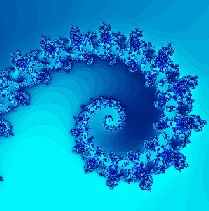 For
hundreds of years, scientists have used and abused the language of
mathematics in an effort to describe the behaviour of the physical world.
For
hundreds of years, scientists have used and abused the language of
mathematics in an effort to describe the behaviour of the physical world.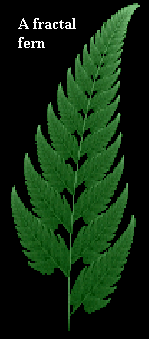 Thomasina’s
interest in mathematics flourishes later in the play as she turns her
attention to geometry.
Thomasina’s
interest in mathematics flourishes later in the play as she turns her
attention to geometry.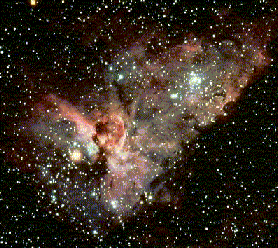 As
Arcadia draws to a close, and disorder takes hold of Sidley Park,
Thomasina makes her most startling observation, the second law of
thermodynamics.
As
Arcadia draws to a close, and disorder takes hold of Sidley Park,
Thomasina makes her most startling observation, the second law of
thermodynamics.