 |
Pressgang Productions Oxford's contemporary theatre specialists |
|
|
|
|
|
Sidley's Sublime Geometry |
|
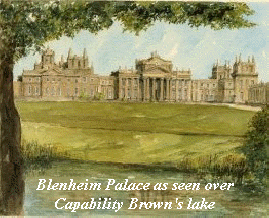
At the beginning of the eighteenth century English landscape gardening was dominated by the French formal style, of which the most influential exponent was Andre Le Notre (1613-1700). But this style quickly fell out of fashion partly, perhaps, because the English countryside itself was becoming increasingly regularised by the continuing enclosure of common land and agricultural expansion. It was succeeded by a style that is usually described as classical picturesque, inspired principally by the great seventeenth century French landscape painter Claude Lorrain. The greatest English exponent of the classical picturesque style in Landscape gardening was Lancelot “Capability” Brown (1716-83), whose principals reigned supreme for thirty years from the 1750s. He hit upon a popular formula in the 1740s which he subsequently repeated, without variation, choosing to consolidate rather than to innovate. It was a formula which paid little regard to the architectural style of the house whose grounds were being ‘improved’. Unlike the gardens of the early eighteenth century, a garden shaped by Brown was not intended to stimulate philosophical reflection. Instead it was intended to stimulate a sense of well-being by presenting a vision of an ideal, timeless state of nature. Brown’s principles are analogous to those of Edmund Burke in his Philosophical Inquiry into the Origin of our Ideas of the Sublime and Beautiful (1753), which was one of the most important aesthetic documents of the eighteenth century. Here beauty is defined in the following terms: “Smallness, Smoothness, Gradual Variation and Delicacy of form.” Although Brown’s style became the height of fashion, there were those who were uneasy about its ubiquity. For example: Brown began work at Longleat in Wiltshire in the mid 1750s and his improvements involved the destruction of a 17th century formal garden. It is hard not to detect a note of regret for all that has been lost in this description of Longleat in 1760 by a Mrs Delany: “There is not much alteration in the house, but the gardens are no more! They are succeeded by a fine lawn, a serpentine river, wooded hills, grand paths meandering round a shrubbery, all modernised by the ingenious and much sought after Mr Brown.” Animation in Brown’s tranquil landscapes was provided by constant but small-scale patterns of movement, such as made by slow-moving sheep or cattle, or passing clouds reflected in the obligatory lake. Indeed, Brown’s primary ambition was almost invariably the creation of a lake in the middle distance, surrounded by trees which would be reflected in the water. After Brown’s death the torch passed to the hugely industrious Humphry Repton (1752-1818), who had pursued a variety of professions (unsuccessfully) until, during the course of one sleepless night in 1788, he decided to try landscape gardening – a subject in which he had been passionately interested for many years. He didn’t simply imitate Brown’s style, however; he introduced, for instance, a ‘transitional’ area of walks, terraces, and even flowerbeds between house and parkland, thus breaking up the sweeping unity which had been Brown’s ideal. He was also more sensitive to the character of a house and its environs than Brown, who tended to impose a standard pattern. Repton, unlike Brown, was also a talented artist. His “Red Books” are famous. In them he illustrated his proposals in skilful watercolours, which were often fitted with flaps (or “slides” as Repton called them) that showed the existing prospect. When the flaps were lifted, they revealed the prospect as it would be after Repton’s improvements. Between 1789 and 1815 Repton undertook almost 200 commissions, many of the adaptations of existing parks. He was, perhaps, more practical, less dogmatic than many of his contemporaries: “I have discovered that utility must often take the lead of beauty, and convenience be preferred to picturesque effect, in the neighbourhood of man’s habitation.”
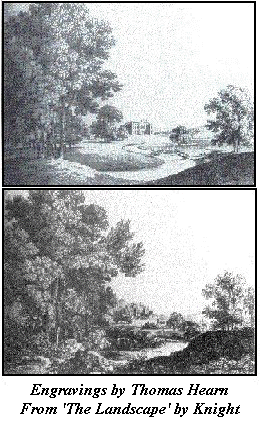
Fresh from
th’improver’s desolating hand, ‘Midst shaven
lawns, that far around it creep In one eternal undulating sweep… In the other engraving an Elizabethan style mansion stands in a rough landscape thick with trees and foliage and littered with rocks, reflecting Knight’s advice to his ideal landscape gardener: Through the rough thicket or the flowery meadow; Till bursting
from some deep-imbowered shade, Some narrow
valley, or some opening glade, Well mix’d and
blended in the scene, you show The stately
mansion rising to the view. Arcadia’s Mr Noakes would surely approve of such sentiments. Although, in the words of the play text, he is “obviously an admirer of Humphry Repton’s Red Books,” he is not a Reptonian; his views are closer to those of Price and Knight: “BRICE: It is all irregular, Mr Noakes. NOAKES: It is, sir. Irregularity is one of the chiefest principles of the picturesque style.”
STUART LEEKS
This article originally appeared in the Wolsey Theatre's Arcadia programme, April 1997. It is reproduced here by kind permission of the author and the Wolsey Theatre, Ipswich. The copyright on this article remains with the author.
|
 “HANNAH:
 Opposition to the Brown/Repton
stranglehold on English gardening taste came from Uvedale Price (1747-1829)
and Richard Payne Knight (1750-1824).
Opposition to the Brown/Repton
stranglehold on English gardening taste came from Uvedale Price (1747-1829)
and Richard Payne Knight (1750-1824).