 |
Pressgang Productions Oxford's contemporary theatre specialists |
|
|
|
|
|
Et in Albania? |
|
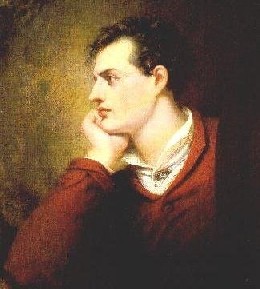
Ever since the day in 1824 when his executors solemnly
gathered to burn the manuscript of his memoirs, Byron has proved
biography’s greatest fascination and frustration.
So much fame, so densely documented – yet over crucial episodes of
his life, nobody has been able to sum up the evidence and close the case.
Posterity has been left to fantasize what it cannot sleuth. One important gap in our knowledge of Byron concerns
his reasons for leaving England in the summer of 1809. Earlier that year, he had come of age and taken his seat in
the House of Lords, but he was in no mood to turn respectably adult.
Binges of gambling and whoring, as well as the liability of his
crumbling ancestral pile, Newstead Abbey, were plummeting him into the
quicksand of debt. His first
book of poems, Hours of Idleness, had been sneeringly received, and
he was now taking his revenge on the literary establishment in a satirical
broadside, English Bards and Scotch Reviewers. Meanwhile, two of his friends had been killed in
terrible accidents, a servant girl he had seduced became pregnant (what
became of the child, if there was one, is unknown), and most upsetting of
all, his beloved dog Boatswain died. In
a fit of stagey melancholy, he turned a human skull into his drinking cup,
and announced that there were “circumstances which render it absolutely
indispensable” that he “quit the country immediately”.
“I will never live in England if I can avoid it,” he wrote from
Albania. “Why, must
remain a secret.” What was all this about?
Obviously, he was running away from the din of his debts; obviously
he wanted to travel; obviously, he was in a rotten frame of mind.
but why the note of desperate anxiety?
One explanation (which Stoppard says was considered at length by
Bernard Nightingale in Even in Arcadia: Sex, Literature and Death at
Sidley Park, but found unpersuasive), cogently offered by scholar Louis
Crompton in his excellent book Byron and Greek Love (pub. 1988) is
that fear of the exposure of his furtive homosexual affairs – sodomy
carried the death penalty in this era – impelled him to leave and seek out
the more erotically tolerant cultures of Greece and the Levant.
In any case, he was back in England in 1811, womanising with
phenomenal energy. Perhaps it
was all talk, all showing-off. Inevitably, the gossip proliferated, and by the time of
his heroic death at Missolonghi, the myths far outweighed the facts.
His friends campaigned to keep his image clean and decent: Thomas
Moore’s “official” biography, published in 1830-31, is a monument to
the tactful asterisk, as much of a lie as the scores of tabloid-style
exposees which surrounded it, and it took a further forty-odd years before a
more honest line of research began to open.
RUPERT CHRISTIANSEN This article was originally commissioned by the Royal National Theatre for its programme for Arcadia. It is reproduced here by kind permission of the author and the RNT. The copyright on this article remains with the author.
|
 "BERNARD:
On April 16th 1809, a few days after he left Sidley Park, Byron wrote to his
solicitor John Hanson:
"BERNARD:
On April 16th 1809, a few days after he left Sidley Park, Byron wrote to his
solicitor John Hanson: Today,
the annual journal of the International Byron Society (which has branches as
far afield as Uzbekistan and Sri Lanka) bears extraordinary witness to the
continuing piecing-together of this jigsaw.
Today,
the annual journal of the International Byron Society (which has branches as
far afield as Uzbekistan and Sri Lanka) bears extraordinary witness to the
continuing piecing-together of this jigsaw.