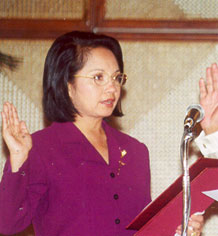
President Gloria Macapagal Arroyo of the Philippines is leading a Fascistic and Corrupt Administration, and is again running for President for 2004.
She argues that President Estrada should leave Malacañang soon to save the failing economy. When asked if things would improve if she would replace Estrada, Arroyo said: "Yes. Things are so bad now. Leadership by example, transparency, a good work ethic and a dignified lifestyle," Arroyo said of the kind of government she intends to lead. "I'll just have to emulate my father (President Diosdado Macapagal, who served from 1961-1965). During his time, the Philippines was second only to Japan in Asia."
But did she do or work on what she had promised? Leading the Philippines
by her example not only promoted corruption in every sector of her administration
including her family members but also exemplified herself in downgrading the
economic and political stability of the country.
Source: INQ7.net with Agence France-Presse) PRESIDENT Gloria Macapagal-Arroyo on Thursday said an estimated 650 to 682 million dollars (about 36 billion pesos) in funds of the late president Ferdinand Marcos that was recently awarded to the government by the Supreme Court would be used both for land reform and to compensate human rights victims of his regime. Using the money for land reform could boost the anti-insurgency program, the President said, noting that resolving the problem of inequitable land distribution would strike at the roots of the country's decades-old communist insurgency.
Ms Macapagal also said part of the funds should be used to "lend recognition to the Filipino people's struggle for freedom, justice and redemption - and the individuals who sacrificed life and limb" during the 20-year Marcos regime. She, however, did not say how the money would be made available to the victims and which government agency would disburse it to them.
In what was touted as a victory against the Marcos family, the Supreme Court
early this week stripped the former president's estate of any claim to Swiss
bank funds worth an estimated 650 to 682 million dollars and awarded them to
the government.
FACTS: (Source: GoAsiaPacific )The Philippine president, Gloria Arroyo, has denounced a United States court order stopping the transfer to the government of about $US700 million in Swiss bank funds, once controlled by former president Ferdinand Marcos.
The AFP news agency says an order by a US district judge stops the transfer of any assets of the Marcos estate without approval of the US court.
(Source: Associated Press Writer ) "A U.S. district court's order cannot stop the transfer to the Philippine government of $683 million in Swiss bank deposits from late dictator Ferdinand Marcos, President Gloria Macapagal Arroyo said Friday.
"Foreign courts cannot overturn our own Supreme Court," Arroyo said, invoking the principle of sovereignty. "To invoke a foreign court's decision to enforce Philippine policy or jurisdiction is absurd and a travesty of justice itself." Arroyo's statement follows a U.S. judge's warning that banks could face contempt charges if they release the funds to the Philippines. The judge's move comes despite a Philippine Supreme Court decision in July to transfer the money to the government."
(Source: United Press International) MANILA, Philippines, Feb. 2 (UPI) -- "About $621 million of the money hidden in Swiss banks by the former first family of the Philippines was returned to the country Monday, a report said. The Manila Times said the total money stashed away by the family of the late dictator Ferdinand Marcos was estimated at $684 million.
But it said the national treasury got only $621 million. The rest included legal and agent fees and the $22 million a Singapore-based bank refused to turn over to the Philippines. The Philippine National Bank said Monday it had transferred the money to the government. The action follows a ruling by the supreme court the money was part of the ill-gotten wealth of the Marcoses."
BUT WHERE IS THIS ALLEGED ILL-GOTTEN MONEY FROM
THE MARCOSES?
SINCE IT WAS RETURNED BACK TO THE PHILIPPINE GOVERNMENT, DOES PRESIDENT ARROYO HAVE IT IN HER PERSONAL ACCOUNT??? DID SHE SHARE THE POT OF GOLD WITH HER CABINET MEMBERS??
THERE WAS NO ACCOUNTABILITY, WHATSOEVER,OF THIS MONEY SINCE IT WAS TRANSFERRED TO THE PHILIPPINE GOVERNMENT.
SHOULD THIS MONEY SUPPOSE TO PAY OFF DEBTS OF THE PHILIPPINES?
FACTS: (Source: UPI ) "MANILA, Philippines, April 1 (UPI) -- The International Monetary Fund has expressed "serious concerns" over the Philippines government's budget and indebtedness.
In a regular report, the IMF said the government's plan to cut its deficit to 4.5 percent of gross domestic product this year from 4.9 percent in 2003 is not ambitious enough. The IMF urged the Philiippines government to raise taxes on cigarettes, alcohol and petroleum. An unstable political environment, heavy debt and fiscal deficit dampened the economic outlook for the year ahead, it said, predicting a flat growth of 4.5 percent in 2004.
FACTS: (Source: UPI ) "MANILA, Philippines, March 18 (UPI) -- The next Philippines government must act immediately to narrow the nation's budget deficit, Philippines central bank governor Rafael Buenaventura said. He warned the government debt could otherwise become "unsustainable" within three years.
Buenaventura said Wednesday the new president will have to pass legislation quickly to raise revenues by such acts as reducing corruption at revenue agencies, imposing higher alcohol taxes, and creating a new tax on mobile phone messaging. He also said the next government should privatize the Philippines power industry within a year to resolve that sector's massive debts and costs.
Interest payments on debt, including more than $60 billion in international loans, accounted for nearly a third of government spending in January, The Philippines Star reported."
WHAT ARE THE OTHER CORRUPT AND ILLEGAL DEALS OF HER ADMINISTRATION?
FACTS: Four days after it assumed office, the Arroyo administration signed the most controversial power plant contract in the country and turned it over to the Argentine firm IMPSA. In fact, it was so controversial even the past Estrada-administration officials refused to approve it despite pressure from the ousted president. Why and how it was finally approved raises very grave questions about the transparency of government contracts and the integrity of this administration. To this date, serious issues concerning the IMPSA deal remain unresolved.
FACTS: (Source: Editorial, Philippine Inquirer Newpaper), "President Gloria Macapagal Arroyo is nowhere near the reform and justice that was her EDSA II (revolution) mandate. On the early morning of Sunday, July 27, we saw an elite faction of the military stage a mutiny, labeled by the government a coup, in the financial district of Makati City. We all thought we saw the last of these with the 1989 coup attempt to topple the government of Cory Aquino. The July 27 mutineers claimed to be seeking reform and justice. Among other issues raised, they echoed the cry for reform in the widely perceived corrupt Armed Forces establishment and demanded that the administration give the soldiers (who are fighting a vicious war with Muslim and Communist insurgents) their dues in terms of combat equipment and benefits. They also wanted justice served on the traitors among their ranks who they claim are supplying their enemies with war material from the very stock rooms of the military.
The lack of proper support, in terms of soldiers' benefits and combat equipment, is an old sad refrain we've become familiar with since the time of the coup attempts during the Aquino presidency. The issue of supplying the very enemies that the Armed Forces is fighting provides a totally new dimension which alarms many sectors of society because: (1) The very top people of the Defense establishment were implicated with no less than Department of National Defense secretary, Angie Reyes, said to be involved; (2) The issue has been talked about before. The kidnapped Fr. Nacorda wrote about it as did Gracia Burnham. So with junior officers now saying it lends credence to it and the public tends to believe it; (3) If true, this surpasses the treachery that they want to tag on the mutineers. If true, the mutineers are the heroes for risking their careers to expose it and these arms merchants are the traitors.
I thought the President (Gloria Macapagal Arroyo) would have realized:
1. That fighting the poverty situation alone - which to begin with is the root of the communist and Muslim insurgencies - is a herculean problem that the government needs to overcome. The last thing government needed was to be engaged on two other fronts with the Reds and the Muslims. Has Ms Macapagal-Arroyo forgotten the mistakes of Napoleon and Hitler?
2. That the Romanov dynasty in Russia met its end when Tsar Nicholas II made the mistake of pitting his 19th century army in a 20th century World War I. The discipline and morale of the Tsar's army broke down and that marked the beginning of the end (the Tsar was in good company as the Austrian emperor and German Kaiser also saw the end of their line with that silly war) of the Romanov dynasty.
What scares the students of history is that our president not only failed to heed the lessons of history, she is also seen as some sort of a Nero who was characterized as fiddling while Rome was burning (historians debunk that though as propaganda which was used to agitate the people against Nero). Minutes after the mutineers agreed to end the Oakwood siege, Ms Macapagal goes on nationwide television to make a statement. She walks to the podium like Caesar Augustus entering Alexandria and then like some sophomore cheerleader in the UAAP, raises her hands as if they just won the championship.
Great presidents with a sense of propriety and history would never have done that! Abe Lincoln became one of the greatest US presidents for preserving the union and the magnanimity that he showed in victory. But then Lincoln, unlike PGMA, is not sophomoric. Right after the South surrendered at Appomattox, Lincoln initiated the policy to heal the wounds of the nation. Cory Aquino never did a similar childish folly and Ms. Aquino faced even more serious threats than the July 27 mutiny which, from its first three hours, we foresaw would fail.
In contrast to the Abe Lincoln example, Ms. Macapagal, has been strutting around like a peacock and even had the gall to proclaim "I did it myself". Not even Ferdinand Marcos, with all the powers he enjoyed and the force of personality that he commanded, ever bragged to having done everything himself. Marcos propaganda projected that for him but Marcos had the good sense - and taste - never to claim it. "Pride goeth before the fall". And false pride accounts for an even harder fall."
FACTS: In an embarrassing tribute to the memory of the President’s late father, graft cases against 26 government officials are now pending before the Sandiganbayan for a 2.3-kilometer portion of the grossly overpriced boulevard that bears his name. Constructed at a cost of Pesos 837.3 Million (US $16 Million) by J.D. Construction, this segment of the proposed "Diosdado Macapagal" Boulevard (named after her late father) was built at a staggering P302,000 (estimated at US $5,491) per lineal meter. Another part of the same road built earlier by the SM Group only cost P54,000 (estimated at US $982) per lineal meter.
The SM Group also constructed a 100-meter bridge for only 552,783 pesos (US $10,000) per lineal meter while another bridge built by Legaspi cost four times more at P1.909M per lineal meter. Based on these comparisons, Sulficio Tagud of the Public Estates Authority (PEA) estimated that the contract with J.D. Legaspi was overpriced by about (Pesos) 600Million (US $11Million). The Ombudsman earlier approved the filing of criminal cases against 20 officials from the Public Estates Authority (PEA) and 6 Commission on Audit (COA) auditors for allegedly conniving to bloat by 250% the budget for the six-lane asphalted road project in the Manila Bay reclamation area.
FACTS: The First Gentleman has also been accused of purportedly keeping illegally acquired funds in the multi-billion peso “Jose Pidal” bank accounts (once converted to US dollars, this amassed wealth could run in estimated millions). His brother, Ignacio, has admitted to the Senate that the funds were his, but refused to answer questions from the senators invoking his right to privacy. The First Gentleman maintains that the funds kept in the controversial accounts were private funds but has yet to explain why he initially denied knowledge of the accounts when the scandal first erupted.
It is worth noting that when the Philippine Congress passed last March 7 Republic Act 9194 which amended the Anti-Money Laundering Act of 2001, there were great expectations that the Philippines would finally be taken off the list of 9 uncooperative countries and territories by the Paris-based Financial Action Task Force. However, the FATF stipulated that the Philippines will remain in the list of non-cooperative countries and territories until it has implemented effectively its new anti-money laundering legislation. The FATF emphasized that “close monitoring of the implementation issues will be crucial in determining the appropriate time for the Philippines to be removed from the NCCT list.” The expectation was that by June 2003, the Philippines will be taken off the FATF’s “dishonor roll”. However, June has passed but no action yet from FATF.
Instead, in its meeting of October 3 in Stockholm, the FATF announced that the Philippines will remain in its NCCT list along with Cook Islands, Egypt, Guatemala, Indonesia, Myanmar, Nauru, Nigeria, and Ukraine. In view of this, it is fair to ask whether the money laundering charges against the First Gentleman could be among the implementation issues that FATF took into account for its holding action on the Philippines.
(Source: CNN
Jakarta Bureau Chief Maria Ressa, Friday, August 22, 2003 Posted: 12:24 AM EDT
(0424 GMT)
MANILA, Philippines (CNN) -- "Political infighting, instability within the military, and corruption charges against the husband of Philippine President Gloria Macapagal Arroyo have all helped drag the nation's currency, the peso, to a 31-month low. In the case of the latter, it is, say some observers, an example of the pot calling the kettle black. "The issue here is all about corruption and the Filipino people deserve to know, especially corruption being committed at the highest level of government bureaucracy," Lacson says. The president's husband, Jose Miguel Arroyo, labels the charges a "fairy tale" designed to divert attention from Lacson's own legal problems.
Even so, economists say, the controversy, political infighting, the fallout from a one-day military mutiny last month and the controversial suspension of the central bank governor have combined to erode investor confidence and push the peso to 31-month lows."
FACTS: (Source: PCIJ Research) How Much is this President Worth? Is this from her amassed corrupted wealth? Judge for yourself.....Here is an analysis of President Gloria Macapagal Arroyo's asset statements since she became senator in 1992. Since her election to the Senate, President Gloria Macapagal Arroyo's net worth has increased more than tenfold, or from 6.7 million pesos (estimated US $121,818) in 1992 to 72 million pesos (estimated US $1.4 Million) in 2003, according to statements of assets and liabilities she has been filing with the Ombudsman.
The bulk of the increase, averaging an annual 29 percent, presumably came from the interest earnings in her bank deposits, the sale and purchase of real property and stocks, and property inheritance. The steepest increase in her net worth was recorded in 1997, a year before she ran for vice president, rising by 71 percent from the previous year's 15.3 million pesos (estimated US $278,181) to P26.1 million pesos (estimated US $474,545).
It was the year her cash in hand and in the banks rose fourfold from P704,540 (US $12,809) to P2.86 million (US $50,909), she bought an agricultural lot in Nasugbu, Batangas, and she inherited property from her father, former President Diosdado Macapagal, valued at P5.4 million. It was also the year she bought a Kia Besta van for which she took out a bank loan of P341,434.
Arroyo also reported sharp increases in her net worth in 1998, the year she was elected vice president, and in 2000, a year before she assumed the presidency. Her net worth rose by P10 million (US $181,818 - 42 percent), from P26.1 million to P37 million (US $672,727), in 1998 and by P18 million (US 327,272 - 48 percent), from P39.5 million to P58.3 million (US $1,060,000), in 2000. In 1998, the increase was apparently the outcome of her increased investments in stocks (P6 million to P11 million), jewelry (from P1.2 million to P2 million), and law books (from 1.5 million to P2.5 million). That year, she acquired a Toyota Revo van and a Mitsubishi GLI sedan through financing.
Arroyo's cash in hand and on bank jumped from a mere P3.8 million (US $69,090) to P36.3 million (US $660,000)in 2000 following what appeared to be the sale of her condominium unit in Ayala, Makati. The unit, with a declared current market fair value of P13.4 million in 1980, was purchased in 1980 for P619,825. She also appeared to have disposed of a substantial volume of her stocks that year, causing the value to drop to P7.5 million from the previous year's P14 million.
The condominium unit was among the five pieces of property Arroyo had declared in her SAL when she was elected to the Senate in 1992. The others were a house and lot in Baguio City bought in 1977, an island in Cagayan bought in 1970, a residential lot in Antipolo bought in 1986, a residential lot in Las Piñas in 1989.
In 1995, the island in Cagayan and Las Las Piñas were dropped from her SAL. In their stead were a commercial lot she bought in Tayabas, Quezon for P1 million and an agricultural lot in Bulacan for P1.17 million. She bought her Nasugbu property two years later.
There were quite a few notable changes in Arroyo's declaration when she became president in 2001: (1) she stopped listing First Gentleman Jose Miguel "Mike" Arroyo's businesses like LTA Inc. and LTA Realty in Makati City and JJ Agricultural Corp. in Bacolod City in her financial statements; (2) She disposed of her race horses which she acquired on various dates for P600,000; (3) She identified more relatives in government positions than she did when she was senator and vice president.
Arroyo had declared her husband's three companies in her statements for 1993, year after she was elected senator. Her declaration for 1999 also listed her husband's law firm, the Arroyo Law Office, and his directorship in Reynolds Philippines Corp., from which he resigned on March 6, 2000.
Also in 1993, Arroyo declared their joint interests in the family-run DM Press, as well as her husband's ownership of Aviatica Management and Travel Corp., a travel agency based in Makati. Interestingly, she also listed the Gloria Macapagal Arroyo Scholarship Foundation Inc. she and her husband established that year.
Coincidentally, the Lualhati Foundation, a charitable organization identified with the First Couple, was founded that same year by members of the Makati Rotary Club to which First Gentleman Jose Miguel "Mike'' Arroyo belongs.
Neither President Arroyo nor her husband are members or officers of the foundation, although the foundation has received donations for Arroyo's projects, including 8 million pesos (US $145,454) from Mark Jimenez in 1999, at the time a business associate of Estrada who was wanted in the U.S. on fraud and tax evasion charges. However, in 2001, Jimenez was elected to the House of Representatives, representing Manila's sixth district, but was subsequently extradited to the U.S.
While race horses no longer appeared in Arroyo's declarations as president, she reported the purchase of a Toyota Lexus in 2001, which is covered by a 3.5 million pesos (US $63,636) loan from the Export and Industry Bank. Arroyo's husband and their son, Pampanga Vice-Governor, Juan Miguel "Mikey" Arroyo, are known for their love for horses, according to an August 18 article that appeared in the fortnightly Newsbreak. Newsbreak said Mikey owns a horse farm, Franchino Farms Inc., which has no less than 20 local and imported race horses in its stables.
When she was senator, Arroyo had listed the following relatives as holding government positions: (1) her half-sister Cielo M. Salgado, Pampanga vice governor; (2) cousin Ramon Guico Jr., mayor of Binalonan, Pangasinan; and (3) cousin Edith Demetria, member of the Pangasinan sangguniang panlalawigan. When she was vice president, her list comprised solely of her brother, Arthur Macapagal, who was with the Clark Development Corp.
During her two years in Malacañang, she identified the following relatives as being in government: (1) her son Mikey, Pampanga vice governor; (2) half-sister Cielo Salgado, Philippine National Bank board director; (3) cousin Erlinda M. B. de Leon, special assistant to the President (confidential secretary); (4) cousin Demetrio P. Macapagal, Quezon City regional trial court judge; (5) cousin-in-law Carlos L. De Leon, Supreme Court assistant court administrator; and (6) cousin-in-law Anthony A. Cortex, deputy executive director of the Garments and Textile Export Board.
Please note these are President Gloria Arroyo’s Networth, 1992-2002, as declared. How much do you think are the undeclared?
FACTS: (Source: PCIJ Research) GMA’s Campaign Expenses and Contributions - IS THIS REAL?
Earlier this week, Sen. Panfilo Lacson accused First Gentleman Jose Miguel Arroyo of siphoning off P270 million in the President Gloria Macapagal Arroyo's excess campaign contributions and "parking them" in a foundation and secret bank accounts.
The PCIJ re-examined the declaration of campaign contributions and expenses that President Arroyo filed at the Commission on Elections (Comelec) after she ran for vice president in 1998. These records show no indication of the huge amounts of money that Lacson claimed she received during the campaign. But they shed light on who Arroyo's biggest contributors were: her family and her lawyers.
Arroyo's husband, her mother Evangeline Macapagal and her other relatives forked out 27,461,432 pesos (US $499,298) or more than half of the 50,211,432 million pesos (US $912,935) she raised for her campaign.
Lawyers at the Carpio Villaraza and Cruz law office, known more popularly these days as "The Firm" because of the clout it supposedly wields over Arroyo, accounted for P11.5 million or close to one-fourth of the contributions, according to the Comelec report. The Lakas-NUCD, the party under which Arroyo ran, contributed P1 million to her campaign kitty.
Family members whom Arroyo said contributed to her campaign were her husband, P5,711,432; mother, P2 million; brother Diosdado Macapagal Jr., P5 million; daughter Ma. Lourdes, P250,000; and brother-in-law Ignacio Arroyo Jr., P5 million. Her husband's family corporation, the LTA Inc., donated P9.5 million. Lawyers at "The Firm" listed as Arroyo's donors were senior partners F. Arthur Villaraza, P5 million; Avelino J. Cruz Jr., P5 million; Raoul Angangco, P750,000; and Simeon V. Marcelo, P750,000.
Also in the list of contributors were lawyer Manuel A. Barcelona Jr., principal partner of the Barcelona, Barcelona and Magdamit Law Offices, and his son Manuel Barcelona III, who donated P500,000 and P100,000, respectively; and Helen Osias, whose contribution totaled P500,000.
When she became president in January 2001 following the second "people power" uprising that toppled then president Joseph Estrada, Arroyo named a number of her contributors to government positions. Cruz is now the presidential chief legal counsel. Marcelo was initially appointed solicitor general; he is now Ombudsman. Osias was given a seat in the board of the United Coconut Planters Bank. Although his name does not appear among the contributors, Antonio Carpio, "The Firm's" founding partner, was appointed Supreme Court chief justice. According to Arroyo's report, she spent everything she raised. A total of P24.46 million or close of half went to the printing of her posters and streamers.
Arroyo's declared contributions and expenses were P1.03 million shy from the limits set by the Comelec on campaign spending. The electoral law allows a candidate to spend P1.50 for every voter and a political party to spend as much. There were 34,163,465 registered voters in the 1998 elections. This means a candidate for national office (president, vice president or senator) could have spent as much as P51,245,197.50.
However, the limits set by law apply to expenditures and contributions only during the 90-day campaign period. The Philippines has no laws regulating political finance outside the 90-day campaign period, including limits on spending or contributions. Politicians and political parties are known to be continuously raising funds long after an election has been concluded, in preparation for the next race.
Some politicians are also known to form foundations that accept donations purportedly for their projects, but accounting of these funds has always been problematic, as in the case of Estrada's Erap Muslim Youth Foundation, which received P200 million from jueteng proceeds, and now Arroyo's Lualhati Foundation, which Lacson claimed received over P40 million in contributions from various individuals.
In 1999, the Lualhati Foundation got P8 million from
Mark Jimenez, at the time a business associate of Estrada who was wanted in
the U.S. on fraud and tax evasion charges. Jimenez later successfully ran
for a seat in the House of Representatives, representing Manila's sixth district,
but was subsequently extradited to the U.S.
FACTS: A GROUP of opposition politicians on Monday asked Congress to impeach Philippines President Gloria Macapagal-Arroyo for alleged graft and other offenses.
The petitioners, led by former senators Juan Ponce Enrile and Francisco Tatad, alleged that Macapagal had "committed again and again the very same offenses for which her predecessor (Joseph Estrada) was impeached." The 18 complainants asked the House of Representatives to initiate impeachment proceedings against Macapagal, who stepped up from the vice presidency when a bloodless military-backed popular revolt forced Estrada from office exactly two years ago on Monday.
Macapagal spokesman Ignacio Bunye declined to comment on the initiative, which accused her of "culpable violation of constitution, bribery, graft and corrupt practices, and betrayal of the public trust."
The group accused Macapagal of "soliciting and accepting gifts" from Mark Jimenez, a House member who was extradited to the United States last month to stand trial for fraud and tax evasion.
They also charged that Macapagal spent 470 million pesos (8.80 million dollars) for a rural electrification project that was not approved by Congress.
Impeachment initiatives have scant chance of prospering unless congressional allies desert the incumbent in droves, as happened to Estrada in late 2000 when he was impeached for allegedly taking bribes from illegal gambling rackets, as well as other charges. Impeachment complaints are first addressed and then approved or thrown out by a House committee whose membership mirrors the overall party division of the chamber.
Once it passes that hurdle, a third of the 218-member House would then endorse the case for trial in the 24-seat Senate, which needs a two-thirds majority vote to remove a president from office. Arroyo allies hold majorities in both chambers.
Macapagal, who was marking two years in office Monday, has announced that "she will not run in the 2004 presidential election".
FACTS: (Source: BBC
NEWS ) "After less than two years
in the job, President Gloria Arroyo appears to have lost heart.
Describing the political atmosphere in the Philippines as "poisonous",
she announced she would not run for president again in the elections scheduled
for 2004." She later announced that she will be again running for President
for the 2004 elections in the Philippines. Are her presidential decisions
the major cause of economic and political instability in the Philippines?
Then Philippines Vice-President Gloria Macapagal-Arroyo answers questions -- finally -- about problems in her country and how she hopes to fix them. But does she do anything to fix them? Or has she done anything to fix them?
NO LEADERSHIP, no direction, but lots of corruption. For months, these comments had been emerging from the Philippines -- a nation that has for too long punched below its weight. The word was that President Joseph Estrada had charisma, but few leadership skills, and that progress made under former President Fidel Ramos was starting to unravel. So Business Asia decided to send reporter Randolph Ramsay back to his country of birth to see for himself -- and to let leaders in the Philippines answer their critics. He lined up an interview with Vice-President Gloria Macapagal-Arroyo, viewed in some quarters as a future national leader. What followed was a shambles. Scheduled interview times were constantly changed and a patient reporter extended his stay for three days while Ms Arroyo's minders made their excuses. Eventually, our reporter could wait no longer and caught his plane out of Manila, with an empty notebook and the suspicion that the critics of Manila's leadership team might be right. How can it run a country if it cannot organise a simple interview? To his credit, Ramsay stuck to his guns and submitted questions and requested a written response from the VP. What follows are edited excerpts of those answers. We apologise for not bringing you a one-on-one interview, but we did try. - Editor, Business Asia, June, 2000
She has ousted the preceding president before her...for what? To incur the income and corrupted money she has always wanted? The position and the power? What was her intentions behind all those hoopla she created in order to create chaos and oust President Estrada? Now a President, Gloria Macapagal Arroyo
BA: What, in your opinion, are the major issues facing the Philippines?
Macapagal-Arroyo: "For the medium- and long-term, we must strengthen the economy and reinforce our political stability. This would entail peacefully resolving the people's faith in democratic processes and proceeding with the other reforms to achieve sustainable growth."
Now a President, Gloria Macapagal Arroyo claims that she has gained experience in encouraging “business activities that are unhampered by corruption.” The Arroyo administration has not encouraged such business activities and the perception of corruption has increased during her three years in office.
FACTS: The Philippines is more corrupt now than before (under President Arroyo's current administration) according to the Berlin-based Transparency International’s Corruption Perception Index (CPI) 2003 released last October 7, 2003. The Philippines scored 2.5 out of a clean score of 10 in the 2003 CPI. When President Macapagal Arroyo first started as president in 2001, the country’s CPI score was 2.9 and then went down to 2.6 in 2002 and went further down to 2.5 this year.
A CPI score relates to perceptions of the degree of corruption as seen by business people, academics and risk analysts, and ranges between 10 which is highly clean and 0 which is highly corrupt. This means that during the last three years of the Macapagal Arroyo administration, the Philippines has been perceived as growing more and more corrupt than previous administrations. In fact, the 2.5 score is the lowest the Philippines has had since Transparency International started its CPI in 1995. In other words, the perception of corruption in the Philippines is at an all time high.
President Gloria Macapagal Arroyo has tried to dismiss the Transparency International’s 2003 CPI as “mere perceptions”. But there is plenty of evidence backing these perceptions. Transparency International is simply tracking methodically the scandals that have hounded President Macapagal Arroyo and her family from the beginning of her term as president. The president’s declaration last October 4, 2003 that “victories against corrupt officials have been won” merely implies the real war against corruption is far from over. If we look past the propaganda and believe just a fraction of the scandals that have continuously hounded the President and her family from the beginning, then her government has failed miserably in combating corruption.
SOURCE: ( NEWSFLASH ) MANILA, OCTOBER 16, 2003 (STAR) By Jess Diaz, Aurea Calica And Marichu Villanueva - "Sen. Panfilo Lacson said yesterday the complaint of extortion filed by German firm Fraport AG against the Philippine government before the World Bank is an indication of high-level corruption in the Arroyo administration."
(SOURCE: USAID) "In 1952, the Philippines had twice the per capita income of Thailand; today, Thailand has twice the per capita income of the Philippines. Going into the regional currency crisis of 1997-98, over 25% of the population of the Philippines still lived below the international $1-per-day poverty line as calculated by the World Bank, compared to less that 20% in Indonesia and less than 2% in Thailand. Indeed now, the Philippines is the only market economy in East Asia that has never achieved a sustained period of rapid growth." This is, of course, under the administration of President Gloria Macapagal Arroyo.
BA: What issues will you personally focus on in the next few years? (asked when she was then Vice-President)
Macapagal-Arroyo: "As Vice-President, I am most concerned about people's perceptions that the leadership is adrift. I have, therefore, embarked on consultations with the basic and strategic sectors throughout the country to find out from them what their problems are and how they think these can be resolved."
MANILA – 10 DECEMBER 2003 - Child prisoners today accused President Gloria Macapagal-Arroyo and her top officials of committing crimes against humanity. In their 50-page complaint before the Ombudsman, five youths aged 11 to 17 – simultaneous with the holding of a rally – decried the torture, rape, cruel and inhumane treatment that children, especially girls, suffer at the hands of the police.
Police habitually lock up kids in cramped police jails without access to legal, medical, social, and psychological assistance and services. “The government of President Gloria Macapagal-Arroyo has concealed this illegal act committed against Filipino children prisoners in an organized, systematic, and widespread manner when the Philippine government submitted its second country report to the United Nations Committee on the Rights of the Child recently,” they said.
Assisted by the Coalition to Stop Child Detention Through Restorative Justice, the kids urged the Ombudsman to slap graft charges against President Arroyo, Interior and Local Governments Secretary and National Police Commission chairman Jose Lina Jr., Philippine National Police chief General Hermogenes Ebdane, and Justice Secretary Simeon Datumanong “for causing undue injury” by committing a crime against humanity to children prisoners which is punishable under Section 3(e) of the Anti-Graft and Corrupt Practices Act (RA 3019). Child rights activists in Manila on 28 October 2003 launched the Coalition to “generate international pressure upon the state to respect, protect, and fulfill the human rights of children detainees.”
The complainants argued that the Philippine government cannot hide behind the cloak of immunity from suit because the 50-year institutionalized practice of jailing children with adult crime suspects constitutes a crime against humanity. “The right of kids not to be detained with adult prisoners is a non-derogable human right, a peremptory norm of international law,” they said, citing the 1924 United Nations Declaration on the Rights of the Child. The “myriad forms of human rights violations routinely committed against children in police custody is an outrage to humanity’s collective conscience,” they pointed out. “It shocks the international community’s very sense of justice and humanity. The hardships, torture, trauma, and dehumanization complainants and other Filipino children prisoners go through during police custody, are despicable and shocking to humanity’s conscience and moral sensibilities. It is an atrocity that undermines children’s inherent dignity and humanity.”
The five youths want the Ombudsman to order the release of all children in police custody and turn them over to the Department of Social Welfare and Development (DSWD) or responsible members of the community. They also asked the Ombudsman to direct the President to indemnify all the victims and provide them with psycho-social trauma healing.
DSWD figures show that 4,544 kids, including 441 girls, had been imprisoned during the first quarter this year. According to Bureau of Jail Management and Penology statistics, of the 2,039 kids who had been detained in September this year, 473 were charged with theft and 384 with robbery. At least 316 others were incarcerated for alleged violation of the Comprehensive Drugs Act (RA 9165). At least 589 of child detainees were in Metro Manila.
“All that the Philippine state has to do is to refrain outright from further incarcerating children in police jails in the company of adult prisoners,” they said in the complaint.
The President “has command responsibility for the perpetration and perpetuation of, as well as the ultimate power and authority to stop, the cruel, inhumane, barbaric, and degrading treatment and punishment of children prisoners by the officers and members of the Philippine National Police.” It is incumbent upon President Gloria Macapagal-Arroyo “to enforce the Philippine state’s international obligation to respect, protect, and fulfill the human rights of children prisoners.” Lina, Ebdane, and Datumanong, according to the complainants, were also “liable for the illegal, cruel, inhumane, and degrading practice of police child detention, by virtue of the principle of command responsibility.”
The PNP (Philippine National Police) “officers and men are responsible for directly perpetrating and perpetuating the illegal, barbaric, and anti-child practice of police child detention … by hauling them off upon arrest to cramped police jails nationwide, mixing them up with adult prisoners, and allowing the children by means of willful and/or gross negligence to be tattooed, raped, beaten up, and subjected to other forms of cruel, inhumane, and degrading treatment and punishment by adult prisoners and/or the lawmen themselves.” The kids complained that officials keep on justifying the jailing of children with adult prisoners by citing lack of facilities. “The government merely pays lip service to the human rights of these children prisoners by citing a welter of laws, which, however, does not translate into reality and is violated by the very institutions – including the exalted office of the President – sworn to uphold the rule of law.”
BA: What do you say to foreign businesses looking at investing in the Philippines? How would you attract them?
Macapagal-Arroyo: Our main attractions are still our human resources -- well educated, flexible, industrious, highly creative and proficient in English. A large percentage of the workforce are not only computer literate, they are well trained for particular IT-related industries. There is great demand for Filipinos in IT and some European IT firms have announced their intentions to relocate here. Our communications infrastructure is also improving.
We also offer a handsome package of incentives for businesses opened here,
to include income tax holidays, allowances for net operating loss carry over,
double deductions for training and R&D, and tax exemptions on imported
capital equipment and spare parts, as well as tax credits on raw materials
and supplies. We guarantee foreign investors full repatriation of investments,
remittance of earnings, securing of foreign loans and contracts, and freedom
from expropriation and non-sequestration of investments. We remain committed
to the free market.
Our macro-economic fundamentals are strong, hence our economy is still stable. Most multinationals can attest that their subsidiaries here continue to contribute their fair share to their mother companies. The Philippines remains the smart choice for investors. Lastly, I would like to emphasise that our peace and order problems are confined to a small portion of Mindanao [the site of a recent hostage crisis in the Philippines]. I hope the foreign press makes this distinction very, very clear. The situation is normal in the rest of the Philippines.
FACTS: (SOURCE: THE MANILA TIMES) "One such survey, conducted late last year (2003) by the aid-giving Japan Bank for International Cooperation (JBIC), showed the Philippines falling out of the list of top 10 favorite destinations for “mid-term investment” plans worldwide by Japanese firms.
By 2001, the Philippines had only 24 out of the total 756 investment plans, and in the first half of 2002 it attracted just seven out of the total of 65 projects pursued by Japanese investors in the Asean5 (Indonesia, Malaysia, Singapore, Thailand and the Philippines)."
BA: What are the government's main priorities for the Philippines?
Macapagal-Arroyo: The government's main thrust is still the alleviation of poverty. Many of our people remain poor, although government was able to decrease the percentage of people living below the poverty line from 40 per cent in the early '90s to about 32 per cent now. Government's aim is sustainable and equitable growth, which means all sectors should grow together. Thus, the programs being emphasised are those that could provide disadvantaged sectors more chances of catching up.
We also continue to subscribe to investment-led growth. With new technologies like e-commerce, we are giving top priority to developing our IT industries. In the long run, we hope to find our own niches in IT. In this part of Asia right now, we are doing pretty well in hardware manufacturing, assembly and data collection and processing services.
FACTS:
BA: What is your vision for the Philippines?
Macapagal-Arroyo: I would like the Filipino people to achieve their dreams of peace and prosperity in a democracy. To attain this, I have proposed a national agenda with four components: 1) an economic philosophy of free enterprise led by the private sector; 2) a social and sectoral bias in our plans, programs and projects so that the poorer sectors can participate in the development process; 3) a modernised agriculture sector founded on social equity; and 4) a society that upholds high moral standards in governance as well as in the conduct of private affairs. Our human resources are highly competitive in Asia and the world, particularly in IT. For the near future, we hope to achieve the highest internet penetration rate in South East Asia and become the knowledge centre in our part of the world.
COPYRIGHT 2000 First Charlton Communications Pty Ltd., COPYRIGHT 2000 Gale Group
"Asian Neighbors Think Alike"
(Source: The Philippine Star (independent),
Manila, The Philippines, July 24, 2001)
As in the case of the Philippines, the transition has been painful. Arroyo is taking over a nation riven by separatism, a nation whose economy is in ruins.
President Arroyo is perceived as a member of the elite and is criticized for her close ties to the military. While she was denouncing President Arroyo is no economist and is considered an intellectual lightweight. But President Arroyo, who has the full backing of the Philippines’ dominant Roman Catholic Church, She will have to court the support of the Philippines’s powerful Muslim clerics in the south.
FACTS:
News: Philippines asks US for help
President Gloria Macapagal Arroyo has formally requested the United States of America to aid her country in the fight against terrorism.
Islamic fundamentalist groups connected to Osama Bin Laden’s Al-Qaeda organisation are destabilising areas of the country around the island of Jolo, where a new insurrection has started.
In her meeting with George Bush on Tuesday, Gloria Arroyo asked for help against the fundamentalist group Abu Sayyaf.
In an address to the University of Georgetown, where she studied international diplomacy, Gloria Arroyo declared that the root cause for terrorism in the Philippines is poverty. She declared that the help of the USA “could spell the beginning of the end of terrorism in the southwest Philippines”.
(Sources: Timothy BANCROFT-HINCHEY - PRAVDA.Ru)
FACTS: (Source: Agence France-Presse ) MANILA, Oct 14 (AFP) - "Philippine President Gloria Arroyo Tuesday denied allegations one of Asia's most wanted terrorist suspects was executed in cold blood to present a publicity coup ahead of US President George W. Bush's visit.
Opposition politicians have reacted with skepticism to government claims Fathur Rohman al-Ghozi, who escaped from a Manila prison three months ago, was killed in a shoot-out with police on southern Mindanao island late Sunday. But Arroyo remained defiant: "I stand by the operational report of the authorities on this case," she said.
The body of al-Ghozi, an Indonesian bomb-maker from the Jemaah Islamiyah group who was accused of staging or planning attacks across Southeast Asia, was flown to Manila on Tuesday to be turned over to the Indonesian embassy. The military said that after a van carrying al-Ghozi was halted for running through a roadblock, he jumped out of the vehicle clutching a grenade while his accomplices escaped.
"The troops tried to incapacitate him and shot him in the arms. When he attempted to remove the pin on the grenade, the troops shot him in the chest," said Army Brigadier General Agustin Demaala.
But some opposition figures alleged al-Ghozi was killed to prevent him revealing alleged police complicity in his escape. Senator Aquilino Pimentel said: "It looks like al-Ghozi and others before him were silenced to prevent them from spilling the beans on the authorities who made their escape possible."