John Jay
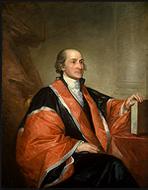
America's first Secretary of State, first Chief Justice of the Supreme Court, one of its first ambassadors, and author of some of the celebrated Federalist Papers, Jay was a Founding Father who, by a quirk of fate, missed signing the Declaration of Independence—at the time of the vote for independence and the signing, he had temporarily left the Continental Congress to serve in New York's revolutionary legislature. Nevertheless, he was chosen by his peers to succeed Henry Laurens as President of the United States—serving a term from December 10, 1778 to September 27, 1779. A conservative New York lawyer who was at first against the idea of independence for the colonies, the aristocratic Jay in 1776 turned into a patriot who was willing to give the next twenty-five years of his life to help establish the new nation. During those years, he won the regard of his peers as a dedicated and accomplished statesman and a man of unwavering principle. In the Continental Congress Jay prepared addresses to the people of Canada and Great Britain. In New York he drafted the State constitution and served as Chief Justice during the war. He was President of the Continental Congress before he undertook the difficult assignment, as ambassador, of trying to gain support and funds from Spain. After helping Franklin, Jefferson, Adams, and Laurens complete peace negotiations in Paris in 1783, Jay returned to become the first Secretary of State, called "Secretary of Foreign Affairs" under the Articles of Confederation. He negotiated valuable commercial treaties with Russia and Morocco, and dealt with the continuing controversy with Britain and Spain over the southern and western boundaries of the United States. He proposed that America and Britain establish a joint commission to arbitrate disputes that remained after the war—a proposal which, though not adopted, influenced the government's use of arbitration and diplomacy in settling later international problems. In this post Jay felt keenly the weakness of the Articles of Confederation and was one of the first to advocate a new governmental compact. He wrote five Federalist Papers supporting the Constitution, and he was a leader in the New York ratification convention. As first Chief Justice of the Supreme Court, Jay made the historic decision that a State could be sued by a citizen from another State, which led to the Eleventh Amendment to the Constitution. On a special mission to London he concluded the "Jay Treaty," which helped avert a renewal of hostilities with Britain but won little popular favor at home—and it is probably for this treaty that this Founding Father is best remembered.