| JOIN TODAY! Use Paypal: Or mail dues of $25.00 for Individual or $100.00 for Underwriter to: Fairhope Historic Preservation Alliance P. O. Box 21 Fairhope, Alabama 36533 Dues and contributions are not tax deductible. For more information, email us at [email protected]. |
 |
| Fairhope Historic Preservation Alliance |
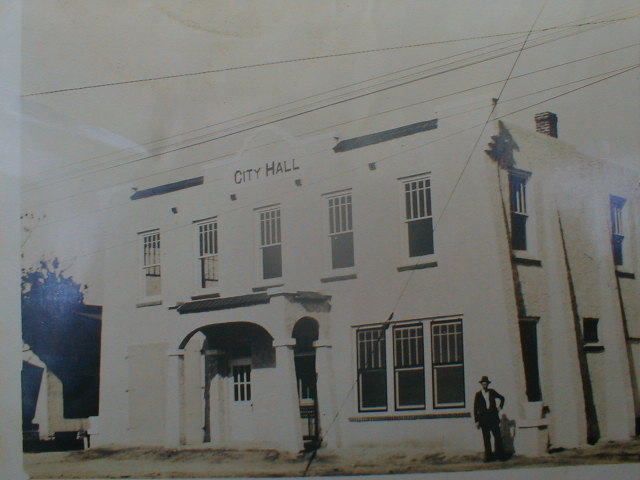 |
| Fairhope's Old City Hall and its builder, Mr. Forster, 1924 |
 |
|
| On the surface, Fairhope is the quintessential small town America. The kind of place the planners at Disney World like to mimic. But Fairhope, founded as a utopia and settled by idealists a little over a hundred years ago, is in danger of losing its uniqueness. Will you miss it if it disappears? In May 2003, the Alabama Historical Commission and the Alabama Preservation Alliance joined forces to name Fairhope to the 2003 Places in Peril list. Places in Peril highlights some of Alabama's most significant endangered historic sites. The program lists 12 sites yearly. Much of Fairhope's uniqueness originates from the town's early planning as a model city. Today, Fairhope is unusual because it has hundreds of registered landmarks but no municipal preservation ordinance to protect or responsibly manage growth in its downtown or original neighborhoods. A recently completed survey of the downtown area, commissioned by the City of Fairhope, lists over 150 buildings as historical structures. Many of these buildings are in danger of being lost because the City isn't participating in a program that could aid owners in rehabilitating rather than razing the landmarks. The Fairhope Historic Preservation Alliance is a newly formed non-profit 501(c)(4) volunteer organization committed to the responsible growth and historic preservation of Fairhope. Members of the Alliance work closely with the Alabama Historical Commission to increase public awareness about the importance of preservation in our community. In particular we seek to make investors in historic buildings aware of the 20% federal tax credit for rehab projects and the 50% cut in state property taxes for historic investment properties. Membership dues will be used for educational seminars and to promote the conservation of historic properties and landmarks in our town. The column at left lists things you can do. Your support and involvement can make a difference in Fairhope's future. Please join the Fairhope Historic Preservation Alliance today! Join! Scroll to the end of the page to see info on how to join the Alliance. |
|
| Things you can do to help: Downtown Historic Tour The Alliance will sponsor a tour of Historic Downtown Fairhope. Be a part of this first-ever celebration of Fairhope's history! Docents, publicity workers, and other volunteers are needed. Email us at [email protected]. Schedule a Slide Show for your organization. "FORGOTTEN FAIRHOPE A Pictorial History" with never-before published photos telling the story of Fairhope's settlement. Email us at [email protected] or call 990 3956, Cori Yonge. Share Your Pre-1950 Photos A photographic archives of interesting people, places and events in pre-1950 Fairhope is being digitized and archived and made available for educational purposes. If you have photos to contribute, email us at [email protected]. Keep Up WIth Alliance Activites through our quarterly newsletter, "What's Historic....About Fairhope." Free to members. |
| Catherine F. Golden, President Corinne S. Yonge, Treasurer Pat Herndon, Secretary Wendy Robertson, Communications |
| Fairhope and Alabama History Links |
| ESILL CLASS :Fairhope Facades, a community ed class sponsored by Eastern Shore Instituteof Lifelong Learning, is being taught by Cathy Donelson. It will be offered in the fall. Email [email protected] A Must if you want to help with the Historic Downtown Tour! |
| Famous Residents, Patrons and Visitors |
| Clarence Darrow John Dewey Baker Brownell Joseph Fels, Soap Baron and Philanthropist Paul Kingston Dealy, Pioneer of the Baha'i Faith |
| This Quarter: What's Historic About Fairhope? The Monopoly Connection Fairhope's role in development of the world's most popular board game. Scroll down! The Alliance Presents: Preservation is Money Attend our program on the financial impact of Fairhope's pending nomination to the National Register of Historic Places. Robert Allen, Professor of Historic Preservation Economics will speak at Noon, Tuesday, July 20, Room 11, USA Classroom Building, $8.00, lunch included. Co-Sponsored by USA. Call 990-3956 to reserve. |
| Did you know Fairhope, because it began as a model community "free from all forms of private monopoly", played a role in the development of Monopoly, the world's most popular board game? As early as 1910, and perhaps even before, "Fairhope Avenue" was a street name on some of the oldest boards existing today. Monopoly, a celebration of capitalism, began as a tool to teach the virtues of Henry George's single tax philosophy. Lizzie Magie, also known as Elizabeth M. Phillips, patented "The Landlord's Game" in 1904. Historians agree this was the forerunner of the modern Monopoly. Magie was an ardent single-taxer who held Henry George School of Social Science classes in her home. Magie's board was primitive, with spaces bearing rent prices, with "Go To Jail" and "Public Park" in two corners. Her board also had spaces inside the ones going around the perimeter. Authentic place names do not appear on this oldest of boards. Magie revised her board in 1910. More colorful and complex than even today's Monopoly, this game could be played by basic rules or by more complex "single tax" rules. The game spread by word of mouth in the early 20th century, even though it was rejected by Parker Bros. as being too long and slow. As the game spread, people made their own boards, |
| using local place names on the spaces and changing the rules. Economics professors at Harvard took to the game and added more rules. Eventually, Charles P. Darrow came in contact with a board with the Atlantic City place names that appear on today's board. He patented his board in 1933. It is similar to the one we use today. The game continued to spread, and when Parker Brothers realized its popularity it bought Darrow's and Magie's patents. Magie received $500, which she stated was enough if the transaction would lead to more people learning the virtues of the single tax philosophy. Parker Brothers did not use the single tax rules because they were perceived as too complicated. The result was a simpler game that, ironically, glorifies monopoly rather than teaching the evils of concentrating wealth in the hands of a few. Magie's 1910 board had many fanciful place names such as "Rickety Row," "Easy Street" and "Soakum Lighting System". Few authentic placenames appear except |
| widely-known ones like "Wall Street." Names connected with the single tax philosophy appear, most notably, for us at the Alliance, "Fairhope Avenue." Its place is near "Johnson Circle" and "George Street." Henry George was very well-known in his time, his book Progess and Poverty having broken sales records. The significance of "Johnson Circle" is a mystery, but a search of a Biographical History of Georgists reveals that there were at least 4 contemporaries of Magie who were known single-taxers, including Marietta Johnson, founder of Fairhope's Organic School. Recently, a segment of PBS' History Detectives uncovered the world's oldest homemade board, a wooden version of The Landlord's Game. It, too, has "Fairhope Avenue" on it. It is owned by Ron Jarrell of Arden, Delaware, who says his grandfather, a carpenter, made it for a local woman. Arden is now part of the Wilmington area but still exists as a small (pop. 474) single tax colony. The Arden board is thought to be the oldest Landlord's Game board known to group properties like today's Monopoly, providing another link between Magie's game and Monopoly. ~~~~~~~~~~~~~~~~~~~~~~~~~~~~~~~~~ |
| What's Historic About Fairhope? a quarterly feature......... The Monopoly Connection |
| Click here for images of several of Magie's boards. |
| More Monopoly History: Monopoly Monopoly |
| Object of The Landlord's Game: To illustrate to players how, under the current system of land tenure,the landlord has an advantage over other enterprisers, and also how the single tax would discourage speculation. - Magie's Rules |
| Object of Monopoly: To buy and rent or sell property so profitably that one becomes the wealthiest player - Parker Brothers Rules |
|
|
|
|
|
|
|
|
|
|
|
|
|
|
|
|
 |
 |
|
|
|
|
|
 |
|
|
|
|
|
|
|
| Email us about this story: [email protected] |