 The Republic of Turkey, founded in
1923, has its roots in two historical sources deep in the depths of the past.
One of these resources inherited by modern Turkey is the successful and shining
history of the Turks over a time frame of more than 4,000 years. The other is
the fact that Turks have been settled in Anatolia since the 11th century.
The Republic of Turkey, founded in
1923, has its roots in two historical sources deep in the depths of the past.
One of these resources inherited by modern Turkey is the successful and shining
history of the Turks over a time frame of more than 4,000 years. The other is
the fact that Turks have been settled in Anatolia since the 11th century.
|
Introduction to Turkey
The Country
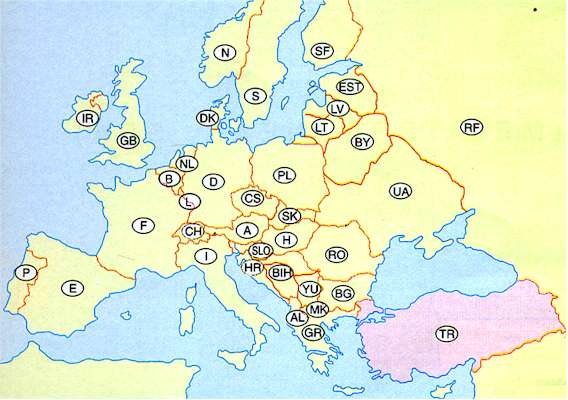
The lands of Turkey are located
at a point where the three continents making up the old world. Asia, Africa
and Europe are closest to each other, and straddle the point where Europe and
Asia meet. Geographically, the country is located in the northern half of the
hemisphere at a point that is about halfway between the equator and the north
pole, at a longitude of 36 degrees N to 42 degrees N and a latitude of 26
degrees E to 45 degrees E. Turkey is roughly rectangular in shape and is
1,660 kilometers wide. Because of its
geographical location the mainland of Anatolia has always found favour throughout
history, and is the birthplace of many great civilizations. It has also been
prominent as a centre of commerce because of its land connections to three
continents and the sea surrounding it on three sides. Area The actual area of
Turkey inclusive of its lakes, is 814,578 square kilometres, of which 790,200
are in Asia and 24,378 are located in Europe. Boundaries The land borders of
Turkey are 2,573 kilometres in total, and coastlines (including islands) are
another 8,333 kilometres, Turkey has two European and six Asian countries for
neighbours along its land borders. The land border to
the northeast with the commonwealth of Independent States is 610 kilometres
long; that with Iran, 454 kilometres long, and that with Iraq 331 kilometres
long. In the south is the 877 kilometre-long border with Syria, which took
its present form in 1939, when the Republic of Hatay joined Turkey. Turkey's
borders on the European continent consist of a 212-kilometre frontier with
Greece and a 269-kilometre border with Bulgaria. Turkey is generally
divided into seven regions: the Black Sea region, the Marmara region, the
Aegean, the Mediterranean, Central Anatolia, the East and Southeast Anatolia
regions. The uneven north Anatolian terrain running along the Black Sea
resembles a narrow but long belt. The land of this region is approximately
1/6 of Turkey's total land area. The Marmara region
covers the area encircling the Sea of Marmara, includes the entire European
part of Turkey, as well as the northwest of the Anatolian plain. Whilst the
region is the smallest of the regions of Turkey after the Southeast Anatolia
region, it has the highest population density of all the regions. The most important
peak in the region is Uludag (2,543 metres), at the same time it is a major
winter sports and tourist centre. In the Anatolian part of the region there
are fertile plains running from east to west. The Aegean region
extends from the Aegean coast to the inner parts of western Anatolia. There
are significant differences between the coastal areas and those inland, in
terms of both geographical features and economic and social aspects. In general, the
mountains in the region fall perpendicularly into the sea. and the plains run
from east to west. The plains through which Gediz, Kücük Menderes and
Bakircay rivers flow carry the same names as these rivers. In the Mediterranean
region, located in the south of Turkey, the western and central Taurus
Mountains suddenly rise up behind the coastline. The Amanos mountain range is
also in the area. The Central Anatolian
region is exactly in the middle of Turkey and gives the appearance of being
less mountainous compared with the other regions. The main peaks of the
region are Karadag, Karacadag, Hasandag and Erciyes (3.917 metres). The Eastern Anatolia
region is Turkey's largest and highest region. About three fourths of it is
at an altitude of 1,500-2,000 metres. Eastern Anatolia is composed of
individual mountains as well as of whole mountain ranges, with vast plateaus
and plains. The mountains: There are numerous inactive volcanoes in the
region, including Nemrut, Suphan, Tendurek and Turkey's highest peak, Mount
Agri (Ararat), which is 5,165 metres high. At the same time,
several plains extended along the course of the River Murat, a tributary of
the Firat (Euphrates). These are the plains of Malazgirt, Mus, Capakcur,
Uluova and Malatya. The Southeast
Anatolia region is notable for the uniformity of its landscape, although the
eastern part of the region is comparatively more uneven than its western
areas. Coastlines Turkey is surrounded
by sea on three sides, by the Black Sea in the north, the Mediterranean in
the south and the Aegean Sea in the west. In the northwest there is also an
important internal sea, the Sea of Marmara, between the straits of the
Dardanelles and the Bosphorus, important waterways that connect the Black Sea
with the rest of the world. Because the mountains
in the Black Sea region run parallel to the coastline, the coasts are fairly
smooth, without too many indentations or projections. The length of the Black
Sea coastline in Turkey is 1,595 kilometres, and the salinity of the sea is
17%. The Mediterranean coastline runs for 1,577 kilometres and here too the
mountain ranges are parallel to the coastline. The salinity level of
the Mediterranean is about double that of the Black Sea. Although the Aegean
coastline is a continuation of the Mediterranean coast, it is quite irregular
because the mountains in the area fall perpendicularly into the Aegean Sea.
As a result, the length of the Aegean Sea coast is over 2,800 kilometres. The
coastline faces out to many islands. The Marmara Sea is
located totally within national boundaries and occupies an area of 11,350
square kilometres. The coastline of the Marmara Sea is over 1,000 kilometres
long; it is connected to the Black Sea by the Bosphorus and with the
Mediterranean by the Dardanelles. Rivers Most of the rivers of
Turkey flow into the seas surrounding the country. The Firat (Euphrates) and
Dicle (Tigris) join together in Iraq and flow into the Persian Gulf. Turkey's
longest rivers, the Kizilirmak, Yesilirmak and Sakarya, flow into the Black
Sea. The Susurluk, Biga and Gonen pour into the Sea of Marmara, the Gediz,
Kucuk Menderes, Buyuk Menderes and Meric into the Aegean, and the Seyhan,
Ceyhan and Goksu into the Mediterranean . Lakes In terms of numbers
of lakes, the Eastern Anatolian region is the richest. It contains Turkey's
largest, Lake Van (3.713 square kilometres), and the lakes of Ercek, Cildir
and Hazar. There are also many lakes in the Taurus mountains area: the
Beysehir and Egirdir lakes, and the lakes that contain bitter waters like the
Burdur and Acigoller lakes, for example. Around the Sea of Marmara are
located the lakes of Sapanca, Iznik, Ulubat, Manyas, Terkos, Kucukcekmece and
Buyukcekmece. In Central Anatoia is the second largest lake in Turkey:
Tuzgolu: The waters of this lake are shallow and very salty. The lakes of
Aksehir and Eber are also located in this region. As a result of the
construction of dams during the past thirty years, several large dam lakes
have come into existence. Together with the Ataturk Dam lake which started to
collect water in January 1990, the following are good examples: Keban,
Karakaya, Altinkaya, Adiguzel, Kilickaya, Karacaoren, Menzelet, Kapulukaya,
Hirfanli, Sariyar and Demirkopru. The Climate Although Turkey is
situated in a geographical location where climatic conditions are quite
temperate, the diverse nature of the landscape , and the existence in
particular of the mountains that run parallel to the coasts, results in
significant differences in climatic conditions from one region to the other.
While the coastal areas enjoy milder climates, the inland Anatolian plateau
experiences extremes of hot summers and cold winters with limited rainfall. |
|||||||||
|
|
|
||||||||