Manisa's Mount Sipylus
According
to mytology, Mount Sipylus gets its name from the name of old mother goddess of
Anatolia, Kybele (Spilene). Spilene is the mother of all the gods and goddesses
as well as the blessing godess of plants, wild animals and human beings on the
earth. There is a relief of her on stone in the Akpınar Region.
According
to another source, the naming of Mount Sipylus during period of Magnesia
|
It was named as Sipylus because doughter of
Menos, the of Tantalis, was left on this mountain and she was grown up by the
wild animals. Later, Tantalus, the King of Magnesia had the Tantal Castle built
here. However, when celebrating the completion of the castle, the king
sacrificed his son in the feast offered by him to the Gods, and the Gods punished
him by tying him in water up to his jaws so that he could not make use of the
favors of the world. The place known as the weeping rock belongs to Niobe who weeps after
her 12 beautiful children who were according mytology, killed by leto, the
mothers of Apollo and Aartemis as a result of jealousy. Tantales Castle was found by Karl Humman in 1880 A.D. The Manisa city which is located at foot of Sipylus Mount is
established by Magnete who were defeated in Trojan War. Was name Sipylus
Magnesia. |
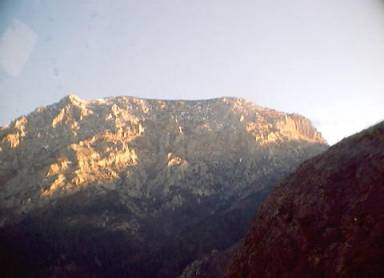
This photo is Mount Sipylus ( called here
Spil ) It is 1500 m . heights . |
|
|
In addition to its recreational character, Mount
Spil National Park, which has a special place among the Turkish National
Parks due to its morphological, archaeological and mythological features,
covers Mount Sipylus and its environs. In the Park, canyons, valleys, lakes,
caves and over 120 types of flora peculiar to the region, in addition to
animals such as rabbits, foxes and various species of birds can be seen. The tulip, which gave its name to a period in Turkish history before
theRepublic, has its origin at Mount Sipylus where hyacinths, crocuses,
cyclamen, wild carnations, poppies, daisies, and dog-roses are also found. In
the photo you can see the wild horses in the mountain. |

Among
the various trees in the Park there are larches, clusterpines, spreading oak
trees and plants such as spruces, junipers, heathers and daphnes which make up
a wealth of rich natural beauty. In Mount Sipylus National Park there are 70
kinds of herbs.
In
the park, which has a variety of animal species such as rabbits, foxes, pigs,
deer, and squirrels, we can see gray partridges and rock partridges. The park,
which shelters almost all kinds of singing birds in addition to all kinds of
eagles, vultures and hawks, is a veritable birds' paradise.
Since
the main aim is to preserve nature, infrastructure is not of great importance
in the Park and therefore narrow paths are provided for walking. The Park,
which has picnic areas and mountain bungalows, also has recreation facilities
for visitors as well as rest areas.
Reservations
are needed for the chalets which have a total capacity of 131 beds. The Park
which can be visited every season of the year also has a mountain camp.
Visitors can stay in their own tents or caravans for the night at a site
allocated for this purpose.
The
Park has no transportation problems, and thus draws the attention of people
living in and around Izmir as well as those from Manisa.
Security
and health facilities, planned to modernize the structure of the Park, are
being built. With these facilities, which will not be completed until next
season it is believed that the Park will attract more visitors.
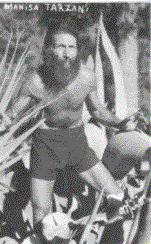

The
photo on the left is Manisa’s TARZAN which is taken in 1960’s. The other
coloured photo is Our project group with their teacher .