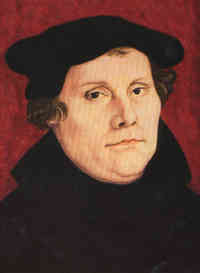
| ���������� Martin Luther was born on November 10, 1483, in Eisleben, Germany, to Hans and Margaret Luther.� The next day, St. Martin's Day, he was baptized and his parents named him after that saint.� Luther attended elementary school in Mansfeld and high school in Magdeburg and Eisenach.� At the age of seventeen he attended the University of Erfurt and graduated with a Master's Degree three years later.� His father wanted Luther to become a great jurist (lawyer).� Luther was brought up and raised in the Roman Catholic church (heretofore referred to as "the church"), which taught salvation was earned, in part, through doing good things, a doctrine referred to as works-righteousness.� Luther knew he was sinful.� It was very evident whenever his parents punished him, not to mention the Bible says, "All have sinned and fall short of the glory of God." (Romans 3:23)� Luther feared and hated God, the righteous God that punished sinners.� It was this punishment and the judgment-to-come which frightened him.� Then two events caused the cloud of fear to settle more firmly upon his tender heart.� A dear friend's death shocked him and he asked himself, "What if it had been I?� What would become of me if I were thus called away without warning?" (Petersen 39)� Within a short time, Luther traveled to visit his family.� On the way, a violent storm overtook him as he was walking through the woods.� Shelter was no where to be found and suddenly a bolt of lightning struck so close that Luther threw himself upon his knees, thinking his turn had come and that death was upon him.� Terrors of hell gripped his soul.� It was in this panic that Luther prayed to his favorite saint, "Help, dear St. Anne, and I'll become a monk." (Petersen 40) |
| ����������� Luther bid farewell to his friends and to the disappointment of his father, he entered the monastery, thinking that he would find peace for his soul.� He entered with a personal question to answer:� "What must I do to be saved?"� The Catholic church taught that salvation, in part, was due to man's own works.� Luther did everything a good monk was supposed to do.� He slept on cold, concrete floors, beat himself, and continually prayed to the saints and virgin Mary.� This did little to lift his fear.� He was haunted by the question:� "How can I be sure that I have done enough?"� He struggled with this question to the point where it almost drove him out of his mind.� Later he wrote in one of his hymns: |
| My own good works availed me not, No merit they attaining: My will against God's judgment fought, No hope for me remaining. My fears increased till sheer despair Left naught but death to be my share And hell to be my sentence. Christian Worship: A Lutheran Hymnal 377 v.3 |
| ����������� Luther was very gifted in preaching and teaching, and Dr. Staupitz, the head of the monastery, decided to send Luther to Wittenberg to teach the Bible at the new university that the Elector of Saxony had just started.� Staupitz hoped that this new assignment would keep Luther so busy that he would have little time to think about his sins, and give him more opportunity to study the Bible.� It was in this study of the Bible and God's grace that Luther found the peace he was looking for.� One day, while he was studying St. Paul's letter to the Romans, the Holy Spirit led him to see that it was not the righteousness which God demands of us that saves, but rather the righteousness that he gives us in his Son.� Luther wrote as follows: |
| �� I had indeed been captivated with an extra ardor for understanding Paul in the Epistle to the Romans.� But up till then?a single word in Chapter 1:17, "In it the righteousness of God is revealed", stood in my way.� For I hated that word "righteousness of God", which, according to the use and custom of all the teachers, I had been taught to understand philosophically regarding the formal or active righteousness, as they called it, with which God is righteous and punishes the unrighteous sinner.� Though I lived as a monk without reproach, I felt that I was a sinner before God with an extremely disturbed conscience.� I did not love, yes, I hated the righteous God who punishes sinners, and secretly, if not blasphemously, certainly murmuring greatly, I was angry with God, and said, "As if, indeed, it is not enough, that miserable sinners, eternally lost through original sin, are crushed by every kind of calamity by the law of the Ten Commandments, without having God add pain to pain by the gospel and also by the gospel threatening us with his righteousness and wrath!"� Thus I raged with a fierce and troubled conscience.� Nevertheless, I beat importunately upon Paul at that place, and most ardently desiring to know what St. Paul wanted.� At last, by the mercy of God, meditating day and night, I gave heed to the context of the words, namely, "In it the righteousness of God is revealed, as it is written, 'He who through faith is righteous shall live.' "� There I began to understand that the righteousness of God is that by which the righteous lives by a gift of God, namely by faith.� And this meaning:� the righteousness of God by the gospel, namely, the passive righteousness with which a merciful God justifies us by faith, as it is written, "He who through faith is righteous shall live."� Here I felt that I was altogether born again and had entered paradise itself through open gates.� There a totally other face of the entire Scripture showed itself to me.� Thereupon I ran through the Scriptures from memory.� I also found in other terms an analogy, as, the work of God, that is, what God does in us, the power of God, with which he makes us strong, the wisdom of God, with which he makes of wise, the strength of God, the salvation of God, the glory of God. And I extolled by sweetest word with a love as great as the hatred with which I had before hated the word "righteousness of God". Thus that place in Paul was for me truly the gate to paradise. (Luther's Works 34 336,337) |
| ����������� Luther began teaching this "new" doctrine, and many people heard it.� About this time, the current pope wanted to build St. Peter's Cathedral and to pay for it, he authorized indulgences to be sold.� An indulgence is a formal, written pardon by the Pope.� Luther got wind of this and wanted to warn people not to buy these useless pieces of paper.� So on the morning of October 31, 1517, Martin Luther walked up to the door of the Castle Church in Wittenberg and fastened a sheet of paper with 95 theses, written in Latin, on it.� These theses attacked the sale of indulgences and challenged anyone willing to a debate.� They were soon translated and printed all over Europe. |
| ����������� Selected thesis: |
| Disputation of Doctor Martin Luther on the Power and Efficacy of Indulgences October 31, 1517 |
| Out of love for the truth and the desire to bring it to light, the following proposition will be discussed at Wittenberg, under the presidency of the Reverend Father Martin Luther, Master of Arts and of Sacred Theology, and Lecturer in Ordinary on the same at that place.� Wherefore he requests that those who are unable to be present and debate orally with us may do so by letter.� In the Name of our Lord Jesus Christ.� Amen. |
| 1. Our Lord and Master Jesus Christ, when He said Poenitentiamagite, willed that the whole life of believers should be repentance. |
| 2. This word cannot be understood to mean sacramental penance, i.e., confession and satisfaction, which is administered by the priests. |
| 3. Yet it means not inward repentance only; nay, there is no inward repentance that does not outwardly work diverges mortification of the flesh. |
| 4. The penalty [of sin], therefore, continues so long as hatred of self continues; for this is the true inward repentance, and continues until our entrance into the kingdom of heaven. |
| 21. Therefore those preachers of indulgences are in errors, who say that by the pope's indulgences a man is freed from every penalty, and saved. |
| 27. They preach men who say that [as soon as the coin in the money-box clings, a soul from purgatory springs.] |
| 47. Christians are to be taught that the buying of pardons is a matter of free will, and not commandment. |
| 49. Christians are to be taught that the pope's pardons are useful, if they do not put their trust in them; but altogether harmful, if through them they lose their fear of God. |
| 50. Christians are to be taught that if the pope knew the exactions of the pardon-preachers, he would rather that St. Peter's church should go to ashes, than that it should be built up with the skin, flesh, and bones of his sheep. |
| 52. The assurance of salvation by letters of pardon is vain, even though the commissary, nay, even though the pope himself, were to stake his soul upon it. |
| 55. It must be the intention of the pope that if pardons, which are a very small thing, are celebrated with one bell, with single processions and ceremonies, then the Gospel, which is the very greatest thing, should be preached with a hundred bells, a hundred processions, a hundred ceremonies. |
| 67. The indulgences, which the preachers cry as the "greatest graces", are known to be truly such, in so far as they promote gain. |
| 68. Yet they are in truth the very smallest graces compared with the grace of God and the piety of the Cross. |
| 71. He who speaks against the truth of apostolic pardons, let him be anathema and accursed! |
| 72. But he who guards against the lust and license of the pardon-preachers, let him be blessed! |
| 79. To say that the cross, emblazoned with the papal arms, which is set up [by preachers of indulgences], is equal worth with the Cross of Christ, is blasphemy. |
| 86. Again:--"Why does not the pope, whose wealth is today greater than the riches of the richest, build just this one church of St. Peter with his own money, rather than with the money of poor believers?" |
| 89. "Since the pope, by his pardons, seeks the salvation of souls rather than money, why does he suspend the indulgences and pardons granted heretofore, since these have equal efficacy?" |
| 90. To repress these arguments and scruples of the laity by force alone, and not to resolve them by giving reasons is to expose the Church and the pope to the ridicule of their enemies, and to make Christians unhappy. |
| 91. If, therefore, pardons were preached according to the spirit and mind of the pope, all these doubts would be readily resolved; nay, they would not exist. |
| 92. Away, then, with all those prophets who say to the people of Christ, "Peace, peace," and there is no peace! |
| 93. Blessed be all those prophets who say to the people of Christ, "Cross, cross," and there is no cross! |
| 94. Christians are to be exhorted that they be diligent in following Christ, their Head, through penalties, deaths, and hell; |
| 95. And thus be confident of entering into heaven rather through many tribulations, than through the assurance of peace. (Spaeth 29-38) |
| ����������� Luther is saying that indulgences have no power to grant pardons.� These were easy to be understood by the lay man and he caused the people not to buy indulgences.� But what Luther really wanted was the sale of indulgences stopped.� He assumed that if the pope and the higher clergy knew what was transpiring with the pardon-preachers, then they would stop it.� Well, no one had the courage to enter a debate with him and no one of the church had time to even address the issue until a year later.� When they did, as Augsburg, Luther was told to say nothing but "revoco," [I recant].� He left after five days when Cardinal Cajetan gave up.� Eight years later, Emperor Charles V held a diet (meeting) as Worms.� He gathered many important men to put an end to Luther's ongoing reformation, but he figured he would give Luther a chance to defend himself.� Not in the way Luther thought, for Luther came with notes, supporters, and witnesses ready to do a debate.� When Luther arrived, though, he was again told to say nothing but "I recant."� Here, at the Diet of Worms, Emperor Charles V gathered representatives of the church, rulers, bishops, princes, and troops decked out in parade best.� After a day, Luther was asked whether he would recant.� Luther replied, "Unless I can be instructed or convinced with evidence from the Holy Scriptures--or with open, clear, distinct ground of reasoning--my conscience is captive to the Word of God.� I cannot and will not recant, because it is neither wise nor safe to go against one's conscience.� Here I stand.� God help me!� Amen." (Luther 23)� Emperor Charles V exiled him and declared him an outlaw, which anyone could kill after twenty days.� The pope excommunicated Luther and declared him a heretic.� God was watching over Luther, though, and some friends staged a kidnapping and hid him.� It was during this time that Luther wrote many books, confessions, and hymns and translated the entire Bible into the German language.� Though this studying and from the church's response, Luther believed that the pope did not care what God said.� Also, the pope and the church's doctrine did not coincide with the Bible.� The Doctrine of Justification (as taught by the church), Purgatory, Transubstantiation, and the fact that clergy are forbidden to marry, all contradict God's Word.� For example: �Gregory VII, in AD 1075, declared all clerical marriages invalid.� "Our judgment upon marriages contracted by persons of this kind [the clergy] is that they must be broken." (First Lateran Council)� The Bible says in Mark 10:9, "Therefore what God has joined together, let man not separate." Also, in I Timothy 3:2, "Now the [bishop] must be above reproach, the husband of but one wife ...".� Also, "The Spirit clearly says that in later times some will abandon the faith, and follow deceiving spirits.� They forbid people to marry and order them to abstain from certain foods which God created to be received with thanksgiving by those who believe and who know the truth." (I Timothy 4:1-3)� These are just a few of the many doctrines that Rome has perverted.� Books have been written about just that.� Theologians have argued and debated, bad feelings have been created, and parts of the world are on the brink of war because of these doctrines.� These are differences that could not be compromised.� Not to mention, God forbids us to join in fellowship with anyone who persists in mixing anything false with His Word.� "I urge you, brothers, to watch out for those who cause divisions and put obstacles in your way that are contrary to the teaching you have learned.� Keep away from them." (Romans 16:17)� Also, "Do not be yoked together with unbelievers?; 'Come out from them and be separate,' says the Lord?." "Let us purify ourselves from everything that contaminates body and spirit, perfecting holiness out of reverence for God." (II Corinthians 6:14, 17 and 7:1)� And, "Warn a divisive person once, and then warn him a second time.� After that, have nothing to do with him." (Titus 3:10)� And He says, "If anyone comes to you and does not bring this teaching, do not take him into your house or welcome him.� Anyone who welcomes him shares in his wicked work." (II John 10,11)� God wants us to do this out of love; love for the truth, love for our souls, and love for their souls.� For, "God is light; in him there is no darkness at all.� If we claim to have fellowship with him yet walk in the darkness, we lie and do not live by the truth." (I John 1:5,6)� Also, God warns us to "Watch out for false prophets.� They come to you in sheep's clothing, but inwardly they are ferocious wolves." (Matthew 7:15)� This is because "A little yeast works through the whole batch of dough." (Galatians 5:9)� God also does not want us enabling them because "They must be silenced, because they are ruining whole households by teaching things they ought not to teach." (Titus 1:11)� There are many more places that God has chosen to speak about these things, but this is a report, not a book. |
| ����������� Luther left the church for these reasons, not to mention the pope excommunicated him and declared him a heretic.� The Catholic church also officially cursed anyone teaching or believing in Luther's teachings.� The Council of Trent wrote:� "If anyone saith, that God always remits the whole punishment together with the guilt, and that the satisfaction of the penitents is no other than the faith whereby they apprehend that Christ has satisfied for them, let him be anathema [cursed]."� So, Luther was really left no other choice.� Luther excommunicated the pope and established his own church with the help of some of the German nobility.� This church is continued in the churches that bear his name and practice confessional Lutheranism.� The Wisconsin Evangelical Lutheran Synod and the Evangelical Lutheran Synod are two of the biggest in America that truly hold to the confessions found in The Book of Concord.� The Book of Concord is a book containing all the confessions that Luther and the early Lutherans wrote in response to the Catholic church and responses to their responses. In conclusion, Luther left the Roman Catholic church because he believed, being convinced from Holy Scriptures, that the pope and the church itself were teaching false doctrine. |
| Bibliography |
| The Holy Bible: New International Version.� Grand Rapids, Michigan:� Zondervan Publishing House.� 1984, selected verses. |
| Luther, Martin.� "Dear Christians, One and All, Rejoice."� Christian Worship:� A Lutheran Hymnal.� Milwaukee, Wisconsin: Northwestern Publishing House, 1994.� Hymn 377 v. 3. |
| Luther, Martin.� Disputation of Doctor Martin Luther on the Power and Efficacy of Indulgences.� Works of Martin Luther Adolph Saeth, L.D. Reed, Henry Eyster Jacobs, et Al., Trans. & Eds.� (Philadelphia: A. J. Holman Co., 1915), Vol. 1, pp.29-38. |
| Luther, Martin.� Luther's Small Catechism.� Milwaukee, Wisconsin:� Northwestern Publishing House, 1982.� p.23. |
| Luther, Martin.� Luther's Works.� Philadelphia, Pennsylvania:� Fortress Press, 1979.� American Ed. Vol. 34, pp. 336, 337. |
| Petersen, Rev. Wilhelm W.� "The Birth That Gave Rebirth to the Doctrine of Justification."� 66th Annual Convention of the E.L.S. Mankato, Minnesota:� Lutheran Synod Book Co., 1983.� pp.38-66 |
| Martin Luther: The Man by Luke Hendricks, 31 October 2001 |
| This was written when I was in tenth grade, then re-written when I was in eleventh. In my twelth grade year (2001-2002), it won third place in a Social Science fair. I hope you enjoy it! --dated 25 June 2002 ***Disclaimer: Martin Luther: The Man contains religious doctrine similar to that of the Wisconsin Evangelical Lutheran Synod (WELS) and other confessional Lutherans. However, this is not an official statement of belief. For more information concerning the WELS and their beliefs click here >>>>>> http://www.wels.net/ or check out the links that appear at the bottom of this page. |
 |
 |
 |
 |
 |
| On 26 June 2002 |
 |
 |
 |
 |
 |
 |
 |
 |
 |
 |
 |
 |
 |
 |
 |
 |
 |
 |
 |
|
|
 |
 |
 |
|
 |
 |