

Planning and Synthesis of Hyper-Redundant Manipulators.
Praveen Tayal
March, 2000
Advisor:
Dr. Bhaskar Dasgupta, IIT-Kanpur, India.
Abstract
In the recent developement of industrial robot manipulators, it is expected to add the sophisticated function of high performance motion. Hyper-redundant manipulators are one of powerful tools to realize that motion.
Robot manipulators which have more than the minimum number of degrees-of-freedom are termed as "kinematically redundant," or simply "redundant." Redundancy in manipulator design has been recognized as a means to improve manipulator performance in complex and unstructured environments. "Hyper-redundant" robots have a very large degree of kinematic redundancy, and are analogous in morphology and operation to snakes, elephant trunks, and ten-tacles. There are a number of very important applications where such robots would be advantageous.
Due to very large number of active degrees of freedom, the benifits of hyper-redundant robot include the ability to avoid obstacles, increased robustness with respect to mechanical failure, and the ability to perform new forms of robotlocomotion and grasping.
In the work presented here, first we realize the motion planning of a hyper-redundant robot amid obstacles in a defined work-cell, and then synthesized the manipulator, based on its kinematic parameters, to aid dexterity in reaching out almost all possible goal locations. The treatment has been restricted to the 2-D workspace.
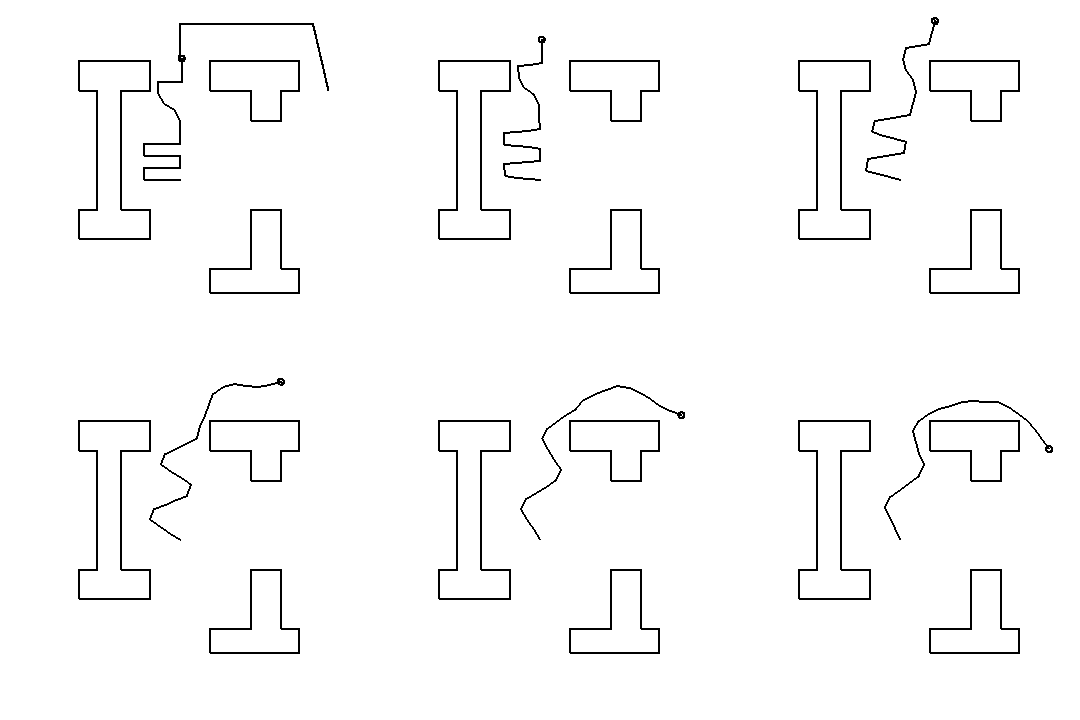
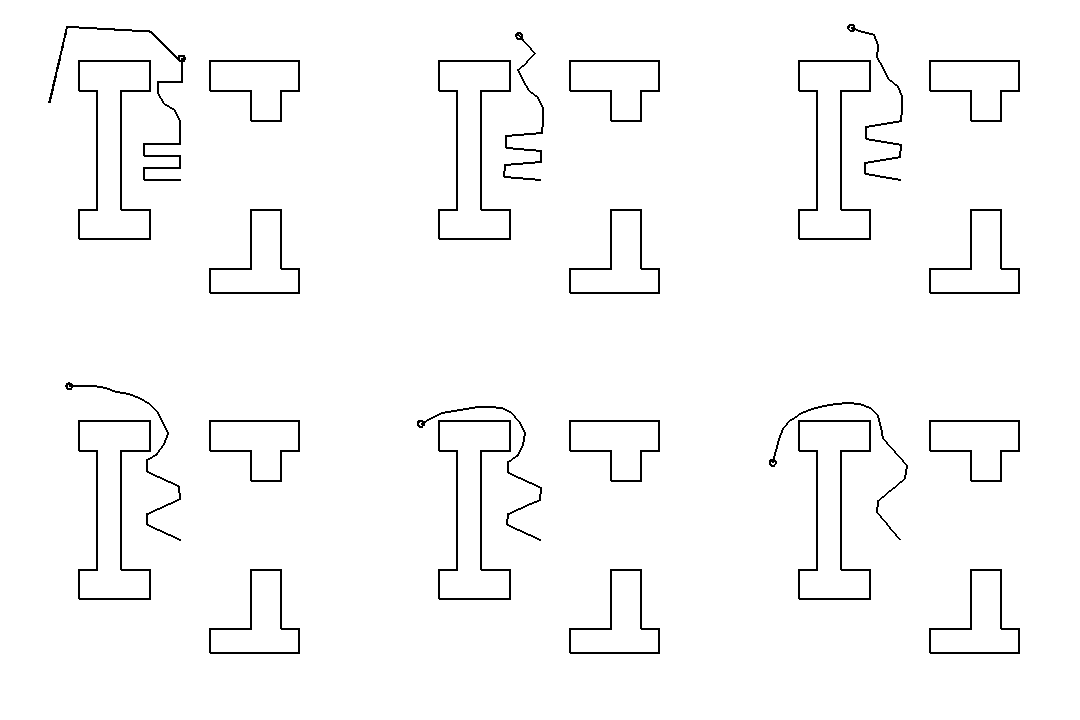
The animated scenes shown below, show the movement of a hyper-redundant robot from initial point to the goal point amid static obstacles in the 2-D work-space. The case shown in the bottom-right, puts up a tough task for the manipulator to walk through even in the thin corridors.
|
|
|
|
[Thesis List] [Robotics Home Page] [ME Home Page]
Web page uploaded by