Table of Contents
1.
Introduction: Short Message Service
2. Benefits of Short Message Service
3. Network Elements and Architecture
4. Signaling Elements
5. Mobile-Terminated Short Message Example
6. Mobile-Originated Short Message Example
Definition
Short message service (SMS) is a globally accepted wireless service that
enables the transmission of alphanumeric messages between mobile
subscribers and external systems such as electronic mail, paging, and
voice mail systems.
Overview
This tutorial provides an introduction to basic SMS concepts,
specifications, networks, and services.
1. Introduction: Short Message Service
SMS appeared on the wireless scene in 1991 in Europe, where digital
wireless technology first took root. The European standard for digital
wireless, now known as the global standard for mobiles (GSM), included
short messaging services from the outset.
In North America, SMS was initially made available on digital wireless networks built by early pioneers such as BellSouth Mobility and Nextel. In 1998, when the buildout of personal communications service (PCS) networks based on GSM, code division multiple access (CDMA), and time division multiple access (TDMA) methods was completed, SMS enjoyed full-fledged deployment.
The point-to-point SMS provides a mechanism for transmitting short messages to and from wireless handsets. The service makes use of a short message service center (SMSC), which acts as a store-and-forward system for short messages. The wireless network provides for the transport of short messages between the SMSCs and wireless handsets. In contrast to existing text message transmission services such as alphanumeric paging, the service elements are designed to provide guaranteed delivery of text messages to the destination.
A distinguishing characteristic of the service is that an active mobile handset is able to receive or submit a short message at any time, independent of whether or not a voice or data call is in progress. SMS also guarantees delivery of the short message by the network. Temporary failures are identified, and the short message is stored in the network until the destination becomes available.
SMS is characterized by out-of-band packet delivery and low-bandwidth message transfer. Initial applications of SMS focused on eliminating alphanumeric pagers by permitting two-way general-purpose messaging and notification services, primarily for voice mail. As technology and networks matured, a variety of services were introduced, including electronic mail and fax integration, paging integration, interactive banking, and information services such as stock quotes. Wireless data applications include downloading of subscriber identity module (SIM) cards for activation, debit, and profile-editing purposes.
2. Benefits of Short Message Service
In today's competitive world, differentiation is a significant factor in
the success of the service provider. Once the basic services, such as
voice telephony, are deployed, SMS provides a powerful vehicle for service
differentiation.
The benefits of SMS to the service provider are as follows:
- Increased call completion on wireless and
wireline networks by leveraging the notification capabilities of SMS.
- An alternative to alphanumeric paging
services.
- Enabling wireless data access for corporate
users.
- Provision of value-added services such as
e-mail, voice mail, and fax mail integration; reminder service; stock
and currency quotes; and airline schedules.
- Provision of key administrative services such
as advice of charge, over-the-air downloading, and service
provisioning.
All of these benefits are attainable quickly with modest incremental cost, and typical investment payback periods are less than six months.
The benefits of SMS to subscribers center around convenience, flexibility, and seamless integration of messaging services and data access. From this perspective, the benefit is to be able to use the handset as an extension of the computer. SMS also eliminates the need for separate devices for messaging, as services can be integrated into a single wireless device—the mobile terminal.
3. Network Elements and Architecture
The basic network structure of the SMS is depicted in Figure 1.
Figure 1. Network Elements and Architecture
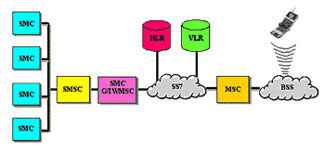
Short Messaging Entities
Short messaging entity (SME) is an entity which may receive or send short
messages. The SME may be located in the fixed network, a mobile station,
or another service center.
Short Message Service Center
Short message service center (SMSC) is responsible for the relaying and
store-and-forwarding of a short message between an SME and mobile station.
SMS–Gateway/Interworking Mobile Switching
Center
The SMS–gateway mobile switching center (SMS–GMSC) is an MSC capable
of receiving a short message from an SMSC, interrogating a home location
register (HLR) for routing information, and delivering the short message
to the visited MSC of the recipient mobile station. The SMS interworking
MSC (SMS–IWMSC) is an MSC capable of receiving a short message from the
mobile network and submitting it to the appropriate SMSC. The SMS–GMSC/SMS–IWMSC
are typically integrated with the SMSC.
Home Location Register
The HLR is a database used for permanent storage and management of
subscriptions and service profiles. Upon interrogation by the SMSC, the
HLR provides the routing information for the indicated subscriber. The HLR
also informs the SMSC, which has previously initiated unsuccessful short
message delivery attempts to a specific mobile station, that the mobile
station is now recognized by the mobile network to be accessible.
Mobile Switching Center
The MSC performs the switching functions of the system and controls calls
to and from other telephone and data systems.
Visitor Location Register
The visitor location register (VLR) is a database that contains temporary
information about subscribers. This information is needed by the MSC to
service visiting subscribers.
The Base Station System
All radio-related functions are performed in the base-station system
(BSS). The BSS consists of base-station controllers (BSCs) and the
base-transceiver stations (BTSs), and its primary responsibility is to
transmit voice and data traffic between the mobile stations.
The Mobile Station
The mobile station (MS) is the wireless terminal capable of receiving and
originating short messages as well as voice calls. The wireless network
signaling infrastructure is based on signaling system 7 (SS7). SMS makes
use of the mobile application part (MAP), which defines the methods and
mechanisms of communication in wireless networks, and uses the services of
the SS7 transaction capabilities application part (TCAP). An SMS service
layer makes use of the MAP signaling capabilities and enables the transfer
of short messages between the peer entities.
4. Signaling Elements
The MAP layer defines the operations necessary to support the SMS. Both
American and international standards bodies have defined a MAP layer using
the services of the SS7 transaction capabilities part. The American
standard is published by the Telecommunication Industry Association and is
referred to as IS–41. The international standard is defined by the
European Telecommunication Standards Institute and is referred to as GSM
MAP.
The following basic MAP operations are necessary to provide the end-to-end short message service:
- routing
information request—Before
attempting short message delivery, the SMSC must retrieve routing
information to determine the serving MSC for the mobile station at the
time of the delivery attempt. This is done by way of an interrogation
of the HLR, which is accomplished via the use of the SMSrequest and
sendRoutingInfoForShortMsg mechanisms in IS–41 and GSM,
respectively.
- point-to-point
short message delivery—The mechanism provides a means for the SMSC to transfer a short
message to the MSC that serves the addressed mobile station and
attempts to deliver a message to an MS whenever the MS is registered,
even when the MS is engaged in a voice or data call. The short message
delivery operation provides a confirmed delivery service. The
operation works in tandem with the base-station subsystem while the
message is being forwarded from the MSC to the MS. Therefore, the
outcome of the operation comprises either success (i.e., delivery to
the mobile) or failure caused by one of several possible reasons. The
point-to-point short message delivery is accomplished via the use of
the short message delivery–point-to-point (SMD–PP) and
forwardShortMessage mechanisms in IS–41 and GSM, respectively.
- short
message waiting indication—The
operation is activated when a short message delivery attempt by the
SMSC fails due to a temporary failure and provides a means for the
SMSC to request the HLR to add an SMSC address to the list of SMSCs to
be informed when the indicated mobile station becomes accessible. This
short-message waiting indication is realized via the use of the SMS
notification indicator and set message waiting data mechanisms in
IS–41 and GSM, respectively.
- service
center alert—The
operation provides a means for the HLR to inform the SMSC, which has
previously initiated unsuccessful short-message delivery attempts to a
specific mobile station, that the mobile station is now recognized by
the mobile network to be accessible. This service-center alert is
accomplished via the use of the SMS notification and alert
service-center mechanisms in IS–41 and GSM, respectively.
Service Elements
SMS comprises several service elements relevant to the reception and
submission of short messages.
- validity
period—The
validity period indicates how long the SMSC shall guarantee the
storage of the short message before delivery to the intended
recipient.
- priority—Priority
is the information element provided by an SME to indicate the priority
message.
In addition, SMS provides a time stamp reporting the time of submission of the message and an indication to the handset of whether there are more messages to send (GSM) or the number of additional messages to send (IS–41).
Subscriber Services
SMS comprises two basic point-to-point services.
- mobile-originated short message (MO–SM)
- mobile-terminated
short message (MT–SM)
MO–SMs are transported from the handset to the SMSC and can be destined
to other mobile subscribers or for subscribers on fixed networks such as
paging networks or electronic mail networks. MT–SMs are transported from
the SMSC to the handset and can be submitted to the SMSC by other mobile
subscribers via MO–SM or other sources such as voice-mail systems,
paging networks, or operators.
For MT–SM, a report is always returned to the SMSC either confirming the short-message delivery to the handset or informing the SMSC of the short-message delivery failure and identifying the reason for failure. Similarly, for MO–SM, a report is always returned to the handset either confirming the short-message delivery to the SMSC or informing the handset of the encountered failure and identifying the reason.
Depending on the access method and the encoding of the bearer data, the point-to-point SMS conveys up to 190 characters to an SME. For messages requiring immediate delivery, only one message delivery attempt is made per service request. For messages not requiring immediate delivery, one or more delivery attempts are made until an acknowledgment is received.
In GSM networks, the type of messaging service is identified by the protocol identifier information element, which identifies the higher-level protocol or interworking being used. Examples are telex, group 3 telefax, X.400 messaging, ERMES, and voice telephone.
In IS–41 networks, the service type is distinguished by use of the teleservice identifier. Basic teleservices include the following:
- cellular messaging teleservice (CMT)
- cellular paging teleservice (CPT)
- voice-mail
notification teleservice (VMN)
CMT differs from the CPT as a result of the inclusion of a reply mechanism
that enables a user or network acknowledgment to be selected on a
per-message basis. The user acknowledgment includes a response code that
paves the way for powerful interactive services between SMCs.
Many service applications can be implemented by combining these service elements. Besides the obvious notification services, SMS can be used in one-way or interactive services providing wireless access to any type of information anywhere. Leveraging emerging technologies that combine browsers, servers, and new markup languages designed for mobile terminals, SMS can enable wireless devices to securely access and send information from the Internet or intranets quickly and cost-efficiently.
A generic network infrastructure for realizing the innovative SMS services is depicted in Figure 2.
Figure 2. Network Infrastructure
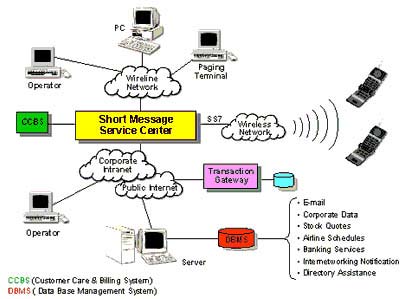
Some of the potential applications of SMS technology, utilizing both
MT–SM and MO–SM where appropriate, are as follows:
- notification
services—Notification
services are currently the most widely deployed SMS services. Examples
of notification services using SMS include the following: voice/fax
message notification, which indicates that voice mail messages are
present in a voice mailbox; e-mail notification, which indicates that
e-mail messages are present in an e-mail mailbox; and reminder
calendar service, which enables reminders for meetings and scheduled
appointments.
- e-mail
interworking—Existing
e-mail services (e.g., SMTP, X.400) can be easily integrated with SMS
to provide duplex e-mail to short messaging.
- paging
interworking—Paging
services (e.g., TAP, TNPP, TDP) integrated with SMS would allow
digital wireless subscribers to be accessible via existing paging
interfaces.
- information
services—A
wide variety of information services can be provided by the SMS,
including weather reports, traffic information, entertainment
information (e.g., cinema, theater, concerts), financial information
(e.g., stock quotes, exchange rates, banking, brokerage services), and
directory assistance.
Mobile Data Services
The SMSC also can be used to provide short wireless data. The wireless
data may be in interactive services where voice calls are involved.
Some examples of services of this nature include fleet dispatch, inventory management, itinerary confirmation, sales order processing, and customer contact management.
Customer Care and Management
The SMSC also can be used to transfer binary data which can be interpreted
by the mobile station without presentation to the customer. This
capability allows the operators to administer their customers by providing
capabilities for programming the mobile station. Examples of such services
include mobile station programming, which allows customer profiles and
subscription characteristics to be downloaded to the mobile station
(customers can be activated/deactivated based on the data downloaded), and
advice of charge, which enables the SMS to be used to report charges
incurred for the phone call (e.g., taxi pay phone).
5. Mobile-Terminated Short Message Example
Figure 3 depicts the successful MT–SM scenario. For
convenience, the GSM method is illustrated. However, the IS–41 method is
similar.
Figure 3. MT–SM Scenario
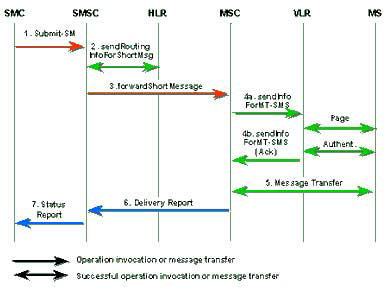
- The short message is submitted from the SME
to the SMSC.
- After completing its internal processing, the
SMSC interrogates the HLR and receives the routing information for the
mobile subscriber.
- The SMSC sends the short message to the MSC
using the forwardShortMessage operation.
- The MSC retrieves the subscriber information
from the VLR. This operation may include an authentication procedure.
- The MSC transfers the short message to the
MS.
- The MSC returns to the SMSC the outcome of
the forwardShortMessage operation.
- If
requested by the SME, the SMSC returns a status report indicating
delivery of the short message.
6. Mobile-Originated Short Message Example
Figure 4 depicts the successful MO–SM scenario. For convenience, the GSM method is shown. However, the IS–41 method is similar.
Figure 4. MO–SM Scenario
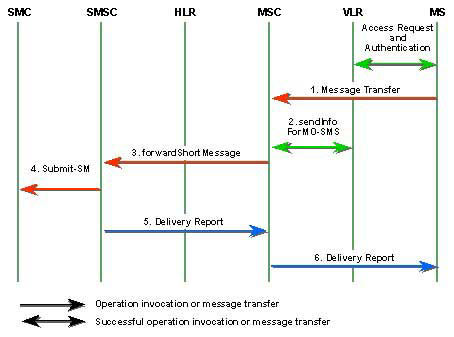
- The MS transfers the SM to the MSC.
- The MSC interrogates the VLR to verify that
the message transfer does not violate the supplementary services
invoked or the restrictions imposed.
- The MSC sends the short message to the SMSC
using the forwardShortMessage operation.
- The SMSC delivers the short message to the
SME.
- The SMSC acknowledges to the MSC the
successful outcome of the forwardShortMessage operation.
- The
MSC returns to the MS the outcome of the MO–SM operation.