|
|
|
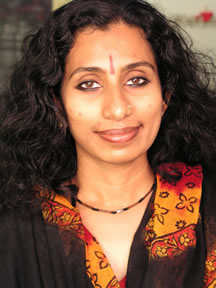
SANGEETHA
MENON
National Institute of Advanced Studies
Bangalore, INDIA 560012
[email protected]
|
Curriculum
Vitae
|
Name:
Sangeetha Menon
Affiliation & Address:
Fellow, School of Humanities
(Formerly known Culture, Cognition
and Consciousness Unit)
National Institute of Advanced Studies
Indian Institute of Science Campus,
Bangalore, India 560 012
Tel (work) 91-80-23602050; Cell 9448472700; (home) 91-80-28398443
Email <[email protected]>, <[email protected]>
URL: http://www.geocities.com/prajnana
Educational Background:
S.S.L.C. 1982
Holy Angels' Convent
1st Class
Pre-degree Science 1984
All Saints' College
1st Class
(Kerala University)
B.Sc. Zoology 1987
1st Class
(Kerala University
M.A. Philosophy 1990
Govt. Maharaja's
College for Women, Tiruvananthapuram
(Kerala University) 1st Class, 1st Rank & Gold Medal
Ph.D Philosophy 1995
Kerala University
National UGC Fellowship
Title: The Concept of Consciousness in the
Bhagavad Gita--A
Study
Selected for and Awarded National University Grants Commission
Junior and Senior Research Fellowship for five years
Career:
1990-92 University Grants Commission Junior Research Fellow
1992-1995 University Grants Commission
Senior Research Fellow
1996-2002 Associate Fellow, National Institute
of Advanced Studies, Bangalore
from 2002-- Fellow, National Institute of
Advanced Studies, Bangalore
Important Academic Distinctions:
· Selected and Awarded University Grants Commission Fellowship
and Lecturership
in National level (1990).
· 1st Rank and Gold Medal for the highest percentage of marks for M.A.
examination in State level (1989).
Awards, Distinctions and Memberships:
.
Awarded the international GPSS award (Global Perspectives on Science
and Spirituality) for 2005-2006, managed by Interdisciplinaire Universite
de Paris, Elon University and supported by Templeton Foundation.
· Awarded by Indian Council of Philosophical Research the annual national
award of
"Young Philosopher Award" for 2001-2002. The award carried
a cash prize and citation.
· Swami Pranavaananda Philosophy Trust of India National Award (one
of the
youngest recipients) for the best essay cum research paper in 1988.
· Honour and Felicitation from Bodhananda Seva Society, Kerala, for
research studies done on the Bhagavad Gita, on 7th January
1999.
· Awarded the "Gita Puraskaram" by the Cabinet Minister
for Human Resources
Development, Govt. of India, on behalf of Bharatiya Vichara Kendra
on 27
September 1998 for research studies done on Bhagavad Gita.
· Best All Rounder Shield from Govt. Maharaja's College for Women,
Trivandrum, Kerala, for excellence in multidisciplinary fields in
arts and literature in 1989.
. Member of the “Board of Distinguished Visiting Scholars”
(BDVS) of the Dharma Association of North America (DANAM).
. Advisor to the Editorial Board on developing books for University
students on Indian psychology.
. Advisor to Infinity Foundation, Princeton
. Advisor to the international committee for organising the Arts/Spirituality/Science
Reconnections Symposium in Spanish city of Melilla, jointly organised
by Leonardo/OLATS, Paris, UNESCO and Al Andalus Foundation, Spanish
Morocco
. Trustee, Bodhananda Research Foundation for Management and Leadership
Studies (BRF-ML), India.
· Invitation to write about research work and interests for The
Journal of
Transpersonal Psychology, Stanford, California, 2002
(Menon, S. 2002. Research Brief (on consciousness and self-exploration
in Indian thought)
In: Meet the Researcher series, The Journal of Transpersonal Psychology,
Stanford, Vol.34, No.1, October 2002, pp 67-71)
· Invitation to deliver annual Honors Program Lecture of 2002 at Spelman
College, Atlanta, Georgia
. Referee and Reviewer for a number of books and peer reviewed journals.
Other Distinctions:
· Appointed as a Faculty in National Institute of Advanced Studies,
Bangalore, India in January1996.
· Young Research Scholar Best Presentation Award from Indian Council
of Philosophical
Research in 1993.
· University Grants Commission national junior and senior fellowship
for doctoral
study from 1990 to 1995 and eligibility for lecturership.
· Selection and Invitation from Indian Council of Philosophical Research
for
presentation of papers in 1990, 1991, 1993 and 1995.
· M. Govindan Memorial Gold Medal for securing highest percentage
of marks in
M.A. Philosophy examination in State level in 1989.
· Sundaram Memorial Prize for securing highest percentage of marks
in M.A.
Philosophy examination in State level in 1989.
·Won several prizes in Poetry, Dance recitals, Essay writing, Elocution,
General Knowledge Quiz during 1982-1989 at school, college, district,
state and national levels.
Research Background:
I got interested in the concept of 'consciousness' during
the final year of my post-graduation (1989). With a national fellowship,
I did doctoral research (1990-1995) studying the metaphysical, epistemological,
ontological and spiritual aspects of and discussions on 'consciousness'
in the foundational text of Indian philosophy, the Bhagavad Gita,
in the larger context of phenomenological questions about activity,
attitude, freedom, happiness, meditation and spiritual growth.
Following
the completion of doctoral studies I was invited and appointed as
Faculty at the National Institute of Advanced Studies (hereafter 'NIAS'),
Bangalore, (1996 January) where I am working currently. This institute
which is a premier institution in the country (in the beautiful campus
of Indian Institute of Science) engages in multidisciplinary research,
with Faculty pursuing research activities in as diverse fields as
social anthropology, epigraphy, international studies, gender studies,
philosophy of science, consciousness studies etc. The small group
of people here interested in consciousness studies, come from different
disciplinary background such as quantum mechanics, primatology, philosophy
and linguistics.
Being
a trained philosopher and with a spiritual background, I got an opportunity
to have dialogues with my colleagues crossing disciplinary barriers
and frame questions and issues of equal importance (to any analyst
of 'consciousness'). Since my joining NIAS I had two kinds of research
activities (for consciousness studies): One, to pursue my specific
research interests in developing an integral epistemology, look at
alternative epistemological tools such as use of metaphors, imageries,
understand the basic categories of thinking framed for the analysis,
first-person approaches in Indian thought etc. Two, to organise group
activities to make possible interdisciplinary dialogues on consciousness
studies, to list a few: a regular discussion forum at NIAS to bring
people working in different areas of science, philosophy, psychology,
art, spiritual traditions etc.; national and international seminars;
facilitating exchange and dialogues.
Spiritual Background:
I got interested in asking and thinking about the so-called
metaphysical questions during my undergraduate courses (1985) doing
science, especially cytogenetics and human evolution. The unexplained
restlessness and disquiet of my mind continued until I decided to
study philosophy for graduation. I always had an unexplainable thirst
for inquiring about the mysteries of life and human mind.
I met
my spiritual guide H.H.Swami Bodhananda in 1987. Since then I am his
student, studied foundational texts of Advaita Vedanta from him over
the years and with his guidance did doctoral research on 'concept
of consciousness in the Bhagavad Gita'. I continue to have
exciting discussions with him on a variety of topics.
I am a
member of a few charity organisations.
Broad areas of research
Indian psychology, Indian philosophy, Indian dramaturgy and Spiritual
Experiences in the context of current discussions on consciousness.
New methods in the digital archiving of ancient manuscripts.
Introduction
My work has been primarily in the area of consciousness studies and
philosophical debates in recent interdisciplinary dialogues on 'consciousness'.
I try to juxtapose two discussions such as (i) the recent semantic
trends in interdisciplinary dialogues on 'consciousness', and, (ii)
perspectives on 'experience' and 'self-exploration' in Indian psychology,
Indian philosophy and Indian dramaturgy.
I have been particularly looking at the importance of the
'experiencer', which I term as the 'harder problem of consciousness'
in the context of different ways of Indian thinking, in order to understand
the intractable relationship between physical mechanisms and subjective
experiences. The hard problem of consciousness has caused a major
change in the 'method' for understanding consciousness by questioning
the source for the qualitative nature of consciousness. I hope to
develop the 'harder problem' of consciousness which I believe will
resolve the 'hard problem' to a greater extent.
I juxtapose, for this end, two seemingly unrelated ideas
but both founded on experiential level than theoretical: the being
of self in specified contexts, and the tools offered so as to integrate/transcend
the self-in-a-context to a larger self. My study looks at the 'doing
self', the 'loving self' and the 'meditating self' and understanding
them from the standpoint of a variety of states of mind, choices,
relationships and attitudes as discussed in Indian systems of philosophy,
psychology and spiritual practises.
Studies Completed and Brief Description
* Binding Experiences for a First-Person Approach: Looking at Indian
ways of Thinking (darsana) and Acting (natya)
in the Context of Current Discussions on 'Consciousness'
By following the current discussions on consciousness in the West one
gets to think that the understanding of consciousness is dependent
on the understanding of if not brain, physical processes guided by
a mechanism and having the capabilities for replicating the phenomenon
in vitro with the help of controlled experiments; secondly there is
not a consensual definition of the problem, method and the major goals
of inquiry itself; and thirdly there is insufficient recognition of
the very complexity and subjective nature of the phenomenon. All the
three features have jointly contributed towards generating vast literature,
dialogues and discussions about a variety of issues relating to consciousness,
the primary being empirical research and medical possibilities, especially
in the area of 'abnormalities'.
This study examined the importance of the following issues
in the context of two different traditions of thinking and experiencing:
Indian epistemology (pramana-prameya-prama-prayojana vyaparah) and
Indian dramaturgy (natya sastra).
(i) recognizing 'consciousness' as a complex phenomenon by itself,
(ii) understanding of 'consciousness' as an understanding of its ontology,
(iii) shifting the focus of epistemology to normal and ordinary experiences
from abnormal and transcendental experiences,
(iv) holistic definition of the problem and method,
(v) breaking 'habitual' ways of event or object oriented analysis
by experience or first person oriented understanding,
(vi) the categories of thinking formed by the analyst and his/her
world view.
* Binding Experiences: Looking at the
contributions of Adi Sankaracarya , Tunchettu Ezuttacchan
and Sri Narayana Guru in the Context of Recent Discussions
on Consciousness Studies
Brain studies, theoretical analysis, cognitive science and cultural
studies have, jointly in the last ten years, redefined the complexity
of 'consciousness' by the factorisation of otherwise considered less
important categories of analysis and understanding of the problem.
The major epistemological worry faced equally by the empirical analyst
as well as the philosopher and psychologist is based on the central
feature of 'consciousness' which is 'experience'. Prima facie, this
worry could be described as how to have a theoretical explanation
for the mutual influence of neural events and subjective experiences.
Nevertheless, it is recognised that the field of consciousness studies
is no more a school of reductionism, whether it be the case of understanding
segregated mechanisms for neural events or mystifying experiences
under unexplained 'transcendences'. Interestingly, any attempt to
understand 'experience', such as simple physical pain or much complex
psychological pain, will have to cross the epistemological barriers
of hierarchies and causal relationships, demanding a non-linear path.
The classical description of consciousness as 'unitary' has even evolved,
to accommodate the questions emerging in interdisciplinary dialogues,
to present the term 'self' which was once considered metaphysical,
but very much scientific today. The epistemological transition, however
implicit it is, is from a third-person perspective to a first-person
perspective.
This study attempted to juxtapose two discussions. The first discussion
looked at:
(i) the
recent semantic trends in interdisciplinary dialogues on 'consciousness',
(ii) how 'experience' itself is defined in these dialogues
as a problematic,
(iii) how far non-linear and integral are the categories of thinking
employed in the analysis, and
(iv) how far holistic the larger goals of these dialogues
are towards health, creativity and personal growth.
The second discussion looked at the distinctive styles
of approach and analysis engaged in by three saints from Kerala: Adi
Sankaracarya ( 8th c. A.D.), Tuncettu Ramanujan Ezuttacchan (16th
c. A.D.) and Sri Narayana Guru (19th c. A.D.) towards understanding
human mind with the following foci:
(i) alternative
epistemological tools used by them such as 'metaphors' and 'imageries'
facilitating 'transcendental thinking',
(ii) first-person and 'Self'-oriented analysis of experience,
(iii) phenomenological descriptions of ordinary and transcendental
states and experiences,
(iv) 'complexity' as not a property of the phenomenon but of the epistemological
devices needed for integral understanding of the problem,
(v) personal growth, self-healing, self-identities and relationships
as important factors in understanding the reality of the 'given' and
the possibility of the 'unknown', and
(vi) the therapeutic value of their methods of analysis and presentation.
* Binding Experiences: Looking at 'Two Faces' of Consciousness
Understanding is always of something which is 'other' than
us, to which we are not acquainted with. We intend to know the 'other'.
We understand the 'other' by means of images, ideas, words and metaphors.
In the process of understanding we also try to integrate the knowledge
we get, to a larger system of our world-view, which in turn influences,
consciously and unconsciously, our ways of responding to situations.
In study of mind and consciousness the basic duality involved
in understanding takes an interesting turn of that of integrating
the understanding of the experiencer with experience itself. Experience
itself will be a factor in the process of intending to understand
it. If definition and knowledge are to be objective, potential of
predictability and repeatability, can study of human mind and consciousness
included under classical ways of understanding? Can we define consciousness
based on pre-experiential understanding of it? Can the experience
be studied with the experiencer having minimal or no role? Conversely,
can the self/experiencer be understood with experience having minimal
or no role? In short will the definition of consciousness be exhaustive
of its complexity?
These questions were proposed as difficult or easy as asking
'can I see my face'. I can see my face as much as it is represented.
But none of the representations can replace my original face. What
we 'see' is only the reported. The being of the reported cannot be
confused with the being of the original. Whether they are two distinct
duals is of course a metaphysical theme for discussion. How ever,
I think, the most interesting issue is that though the reported and
that which is reported about could not be reduced to one, 'the reported'
and 'that which is reported about' can influence each other. I understand
and define my self based on my experiences. At the same time, my experience
depends upon the notion I have of my self . I intend to know. I also
integrate that which I know. And this mysterious power of consciousness
to intend as well as integrate is the puzzle we are all trying to
solve!
* Binding Experiences: Looking at the 'Harder Problem' of Consciousness
Being with the problem of consciousness seeks at least three
complex explanations.
These explanations are for:
i) the neuronal processes which are responsible for, from, simple
cognitive
functions to complex human behaviours and responses,
ii) the shifts and interfaces between quantitative (chemical and physical)
brain
states to qualitative (mental and subjective) states, responses and
behaviours,
iii) the
strong sense/adherence of conscious/unconscious states, behaviours,
responses to a Self which binds experiences, and which also evolves.
Though both the physical and non-physical (philosophical, transpersonal,
spiritual etc.) approaches try to address these three problems, the
starting point which is also the significant point seems to be different
for them. While the focus on one side is upon the local and generative
nature of consciousness in terms of brain processes, on the other
side the focus is on the non-local and non-causal nature of consciousness.
The first kind of focus aims at the explanation of brain processes
(for both cognitive abilities and behavioural responses) and thereby
the replication/simulation of related subjective experiences. The
second kind of focus aims at the resolution and integration of individual
subjective feelings, thoughts, world views and experiences through
spiritual practices and philosophical theorisations.
In both the approaches, in spite of the basic difference in the focus
of the problem, the evading issue is the 'experience' of an enduring
'I-ness'. Also, both the top-down and bottom-up approaches at the
some point of the explanation recognize the elusive nature of a factor
which paradoxically is the beginning and also the endpoint for understanding
consciousness, namely the subjective nature of experience. The 'hard
problem' of consciousness, which is how discrete neural functions
are bound to give unitary subjective experiences, might eventually
be a 'easy problem' with the advancement in brain studies. But the
'harder problem' of consciousness is of the irreducible 'I-ness' where
we begin with to understand consciousness and also might be the endpoint.
This study presented some of these issues in the context of, the 'harder'
problem of consciousness.
* Binding Experiences: Looking at Being of Self and Self-Transcendences
in the Context of a Discussion on Transpersonal Psychology of the
Bhagavad Gita
(ongoing study)
Two seemingly unrelated
ideas but both founded on experiential level than theoretical are
juxtaposed: the being of self in specified contexts, and the tools
offered so as to integrate/transcend the self-in-a-context to a larger
self. The study focuses on the 'doing self', the 'loving self' and
the 'meditating self'; understanding them from the standpoint of a
variety of states of mind, choices, relationships and attitudes, suggested
in the Gita.
For the second part of this study, 'self-transcendences', an integral
framework woven of 'epistemological tools', 'artistic tools', 'meditative
tools', 'eschatological tools', 'interpersonal tools' and 'transpersonal
tools' will be presented to look at 'when' and 'how' transcendences
happen and what their nature are.
* Spiritual Experiences and Rare Ritual
Art Performers of North Kerala
Ritual-art forms of Kerala are a class of its kind with
equal significance if not more along with the classical and folklore
traditions. Most of the ritual-art forms are associated with particular
communities, specific time of the calendar, observances, staging etc.
Though a significant number of the ritual-art forms are documented,
there are fast-disappearing forms of “ritual-arts” of
Malabar (North Kerala) which are yet to be documented in print/video.
Many subclasses of ritual-art forms have not been recorded due to
various reasons such as lack of public information, disagreement from
the ‘performers’ for the event to be publicly shown. It
is also startling that the number of performers of certain complex
ritual-art forms is fast declining and some of the performances are
completely unknown since they were never documented in a systematic
manner.
These ritual-art forms constitute
integrated holistic experiences, of a community of people, which could
be considered transpersonal. All the ritual-art forms have some kind
of a spiritual component inbuilt in them though they differ in their
usage of the nuances of color, space, sound, movements and make-up
for the body. Another interesting feature is that how much these ritual-arts
are connected with the daily living of the particular community of
the people.
This
project completed a video documentation and photostory of the ‘Rare
Ritual Arts of North Kerala’.
Major Conferences Organised
* First
National Conference on "Scientific and Philosophical Studies
on Consciousness" held from 8-13 February 1999 at
NIAS. The conference was supported by Department of Science and Technology,
Department of Biotechnology, Govt. of India, and, Jawaharlal Nehru
Centre for Advanced Scientific Research, Bangalore.
A volume was published with selected
papers presented at the conference: 1999. Scientific and Philosophical Studies on Consciousness, Eds.
Sangeetha Menon, BV Sreekantan, Anindya Sinha and MG Narasimhan,
Bangalore: National Institute of Advanced Studies, Bangalore.
* International
Seminar on "Science and Metaphysics: A Discussion
on Consciousness and Genetics" at NIAS, from 24-27 June, 2001.
The conference was supported by Indian Council of Philosophical Research
and Templeton Foundation.
A volume was published with selected
papers presented at the conference:2002. Science and Metaphysics: A Discussion on Consciousness and
Genetics, Eds. Sangeetha Menon, BV Sreekantan and Anindya
Sinha, Bangalore: National Institute of Advanced Studies,
Bangalore.
* International
Symposia on “Science and Beyond: Consciousness,
Cosmology and Technology in the Indic traditions” as part
of the Science and Spiritual Quest series at NIAS, from 8-11 January
2003. This Symposium was the fourth and last in the SSQ II series
and international programme at the Centre for Theology and the Natural
Sciences in Berkeley. The conference was organised by NIAS and Templeton
Foundation, and supported by Infinity Foundation, Indian Council of
Philosophical, Centre for Studies in Civilisations and Universite
Interdisciplinaire de Paris.
A volume was published with selected
papers presented at the conference: 2004. Science and Beyond: Consciousness, Cosmology and Technology
in the Indic traditions, Eds. Sangeetha Menon, BV Sreekantan, Anindya
Sinha, Philip Clayton and R Narasimha, Bangalore: National
Institute of Advanced Studies, Bangalore.
Other Responsibilities at NIAS:
* Course Director for the annual NIAS Course for Senior
Executives from private and public sector on “An integrated
approach to knowledge and information”, since 2005. This is
one of the major courses being organised by NIAS since its inception.
* Organiser of the in-house seminars for the "NIAS-Discussion
Forum on Consciousness"
* Organiser of the weekly NIAS faculty and guest presentations for
"Wednesday Discussion Meetings".
* In-charge of NIAS Publications. Coordinated and oversaw the
publication of the major lectures given at the 19th NIAS Course for
Senior Executives, the one day meeting entitled Six months after Tsunami
, Lectures given at NIAS Forum for Consciousness, in professional
DVD format, and other NIAS publications in print format (all available
in the NIAS Library).
* Was the PI of three national projects (1999--sponsored by Infosys
Ltd. ; 2001--Dept of Science and Technology, and Ministry of Culture,
Govt. of India; 2003- National Board of Higher Mathematics) on digital
archiving of ancient manuscripts and establishing low cost digital
archiving units at various institutions. CD titles were published
with the results of these projects.
Most Recent Publications:
Papers and Chapters
Menon, S. 2006. What is Indian Psychology: Transcendence in and while
Thinking(forthcoming)
The Journal of Transpersonal Psychology, Stanford
Menon,
S. 2006. Hinduism and Science (forthcoming)
In The Oxford Handbook of Religion
and Science, Ed. Philip Clayton
Menon, S. 2006. Advaita Vedanta (forthcoming)
Internet Encyclopedia of Philosophy
Menon, S. 2006. Basics of ‘Spiritual Altruism’
(forthcoming)
In Cross-cultural perspectives on altruism, SETI, Ed. Douglas
Wakoch
Menon, S. 2006. Cognition, Consciousness & Experience: Towards a new Epistemology
(forthcoming)
In History and Philosophy of Science PHISPC-CONSSAVY
/ Volume 2, Part VI, Indian Council of Philosophical Research
Menon,
S. 2006. Transpersonal Psychology of the
Bhagavad Gita: Consciousness, Meditation, Work and Love: (forthcoming)
In Indian Psychology series for University students, Institute
for Human Services, India
Menon,
S. 2006. The Puzzle of Experiential Primacy
and Consciousness
Centre for Behavioural and Cognitive Sciences, Allahabad (forthcoming)
Menon,
S. 2005. Understanding the 'what' and 'where'
of consciousness: Revisiting the Bhagavad Gita to ask a few more questions,
Omega: Indian Journal of Science and Religion, IV:2, 88-99
Menon,
S. 2005. Experience of _Expression: Instances
from Indian dramaturgy and a discussion on 'consciousness' (Summary)
Leonardo Electronic Almanac Volume 13, Number
9, September 2005
http://lea.mit.edu, The MIT Press
Menon, S. 2005. Spiritual Healing
Heritage Amruth, magazine pulished
by Foundation for Revitalisation of Local Health Traiditions
Vol1. April 2005 pp 38-40
Menon,
S. 2005. Book Review of Psychology of Human
and Social Development: Lessons from Diverse Cultures
(Eds. John W Berry, RC Mishra and RS Tripathi, Sage Publications,
2004) Summerhill: IIAS Review Vol. X No.1 & 2, pp 95-98
Menon, S. 2005. Book Review of ‘Cit: Consciousness (Bina Gupta,
2003)
Journal of Indian Council of Philosophical Research, XXI.1 pp
279-287
Menon, S. 2005. Self and self-transcendences in the Bhagavad
Gita
In Self, Society and Science: Theoretical
and Historical Perspectives Vol XI
Part 2 of ‘History of Science, Philosophy and Culture in Indian
Civilization, Ed. DP Chattopadhyaya, Centre for Studies in Civilizations,
New Delhi, pp217-229
Menon, S. 2005. Being and wellbeing in the Upanishadic
literature. In K Ramakrishna Rao, & Sonali Bhatt Marwaha (Eds.),
Towards a spiritual psychology (pp. 72-96). Delhi: Samvad India Foundation.
Menon,
S. 2005, R. Narasimha, Sangeetha Menon, Papiya Bhattacharya and M.
B. Rajani,
Six months after the tsunami, Current Science, Vol. 89, No. 9, 10
November 2005, pp 1459-1461
Menon, S. 2004. Experience
of Expression: Instances from Indian dramaturgy and
a discussion on ‘consciousness’
http://mitpress2.mit.edu/e-journals/Leonardo
Menon, S. 2004. Beyond what and what is beyond?
In: Science and Beyond: Consciousness, cosmology and technology in
Indic traditions
Eds. S. Menon, , A.Sinha, B.V.Sreekantan, R Narasimha and Philip Clayton
National Institute of Advanced Studies, Bangalore, 2004, pp 185-190
Menon, S. 2003. Getting digital manuscripts: New technologies for digital
preservation and publication
In: The Indian Archives, Special Number: Information Technology
and Preservation, National Archives of India, Vol XLIX, Numbers 1-2,
pp 41-44
Menon, S. 2003. Being Free: 'Consciousness' and 'freedom' according to
the Bhagavad Gita
In: 'Applications of oriental philosophical thought in mental
health', Ed JP Balodhi, National Institute of Mental Health and Neurosciences
(NIMHANS), Bangalore, NIMHANS Publication No 47, pp 43-49
Menon S. 2003. Binding experiences for a first person approach: Looking
at Indian ways of thinking (darsana) and acting (natya)
in the context of current discussions on 'consciousness'.
In: On Mind and Consciousness (eds Chhanda Chakraborti,
Manas K Mandal and Rimi B Chatterjee),Indian Institute of Advanced
Study, Shimla and Department of Humanitiees and Social Sciences IIT
Kharagpur, pp 90-117
Menon, S. 2002. Research Brief (on consciousness and self-exploration in
Indian thought)
In: Meet the Researcher series, The Journal of Transpersonal
Psychology, Stanford, Vol.34, No.1, October 2002, pp 67-71
Menon, S. 2002. The Selfish Meme and the Selfless Atma
Sophia: International journal for philosophy of religion,
metpahysical theology and ethics, Ashgate Publishing Ltd., 41.1, May
2002, pp 83-88
Menon, S. 2002. Structure of Mind and Structured Mind
Indian Philosophical Quarterly, 29:2-3, April-July 2002,
pp 334-344
Menon, S. 2002. The ontological pragmaticity of karma in the Bhagavad
Gita: A mind to meditate and the meditative mind.
In: Perspectives on Indigenous Psychology (eds. G Mishra
and A K Mohanty), Advances in Psychological Research in India - Series
3, Concept Publishing Company, New Delhi, pp 326-338
Menon S. 2002. Beside the intender and the integrator": Looking at
two "faces" of consciousness.
In: Science and Metaphysics: A Discussion on Consciousness
and Genetics (eds S Menon, A Sinha and B V Sreekantan), National Institute
of Advanced Studies, Bangalore, pp. 164-177
Books:
Science and
Beyond: Cosmology, consciousness and technology in Indic traditions
Eds. S. Menon, B.V.Sreekantan, Anindya Sinha, Philip Clayton,
R Narasimha, National Institute of Advanced Studies, Bangalore, 2004
Binding Experiences: Looking at the Contributions of Adi Sankaracarya,
Tuncettu Ezuttacchan and Sri Narayana Guru in the Context of Recent
Discussions on Consciousness Studies
Monograph published under the program Knowledge Dissemination
series, Indian Institute of Advanced Study, Shimla, 2002
Dialogues: Philosopher meets the seer
Menon S. and Swami Bodhananda, BlueJay Books, New Delhi,
2002
From Shelves to Digital Media: On digital archiving and publication
R1-2002, National Institute of Advanced Studies, Bangalore,
2002
Binding Experiences for a First-Person Approach: Looking at Indian
Ways of Thinking (darsana) and Acting (natya) in the
Context of Current Discussions on 'Consciousness'
WP1-2002, National Institute of Advanced Studies, Bangalore,
2002.
Science and Metaphysics: A discussion on consciousness and genetics
Eds. S. Menon, M.G.Narasimhan, A.Sinha, B.V.Sreekantan,
National Institute of Advanced Studies, Bangalore, 2002
Scientific and Philosophical Studies on Consciousness
Eds. S. Menon, M.G.Narasimhan, A.Sinha, B.V.Sreekantan,
National Institute of Advanced Studies, Bangalore, 1999
Recent Lectures and Presentations:
.
Brain and Being
Lecture at the national conference on "Consciousness, Experience
and Ways of Knowing: Perspectives from Science, Philosophy and the
Arts",
National Institute of Advanced Studies, 6-7 February 2006.
. Brain
and Consciousness: Views and Challenges
Lecture for the National Institute of Advanced Studies-UGC Teachers'
Course, 12 January 2006.
. The
Rain clouds of Mental Limitations and the Shower of Transcendence:
Yoga and Samadhi in Patanjali Yoga Sutra
Invited Lecture at the International Conference on "Yoga and
Parapsychology", Andhra University and the Institute for Human
Sciences and Services, 3-6 January 2006.
. Cognitive and Experiential Foundations of Consciousness and ‘Spiritual
Agency’: Towards a New Epistemology
Invited Lecture at the National Seminar on History Of Science And
Philosophy Of Science Conference Room,
Indian Council of Philosophical Research, New Delhi, 8-9 November
2005
. Consciousness, Karma and Wellbeing
Invited Lecture for Sri Aurobindo Aradhana Trust, 26 October
2005, Bangalore.
. Consciousness, Experience and Wellbeing:
Classical Indian views and Current Discussions in Science
Invited Plenary Lecture for the National symposium at Dayalbagh
Educational Institute deemed University, Agra,
on “Education for better worldliness” October 1-2, 2005.
. Ways of Knowing and Being
Foundation Course Lecture for NIAS
PhD Students 18 August 2005, National Institute of Advanced Studies,
Bangalore
. The Place of Philosophy and Psychology in Multidisciplinary Research
in the context of consciousness studies
Foundation Course Lecture for NIAS
PhD Students 19 August 2005, National Institute of Advanced Studies,
Bangalore
. Brain and Being: The Science and Spirituality of Consciousness
Invited Lecture for the International
meet of the Awardees of the 'Global Perspectives on Science and
Spirituality Award' programme, Mont Royal Chateau, Paris, organised
by the Interdisciplinary University of Paris,
Elon University and supported by Templeton Foundation, 14-18 July
2005.
. By the Consciousness Couch: Odd, Regular and Inexplicable
Experiences
Lecture for the 'NIAS Wednesday
Discussion Meeting', 31 May 2005, National Institute
of Advanced Studies, Bangalore
. Beside the Stream of Consciousness: A Survey of Old
and Recent Bridges
Lecture for the 'NIAS Discussion
Forum for Consciousness', 31 May 2005, National Institute of Advanced Studies, Bangalore
. Blind Dancer and the Stunned Onlooker: Nature, Consciousness
and Two Ways
of Knowing in Samkhya-Yoga
Invited Lecture for the National
Seminar on Nature and Culture, Discussion Meeting of History of Indian
Science,
Philosophy and Culture 5-6 May, 2005 National
Institute of Advanced Studies, Bangalore
. How much can we 'talk' about 'mind': Some conceptual
puzzles
Invited Lecture for the National
Seminar on Language and Mind in Classical Indian Philosophical Traditions,
3-5 March, 2005 University of Hyderabad
. Ways of Knowing and Indian philosophy
Course Lectures for NIAS Doctoral Students, National Institute of Advanced Studies Bangalore
February 2005
. Mind and Consciousness
Course Lecture for NIAS-UGC Teachers Course, Bangalore
14 February 2005
. Two Rationalities for One Consciousness: Exploring the Scientific
and Mystical Mind
Invited lecture at the international
symposium on ‘Science and Mysticism: East-West Dialogue’,
Indian Institute for Science and Religion, Poona, 2-6 January 2005
. Grief and Hope
Invited lecture at the
Sri Aurobindo Aradhana Trust, Bangalore, 12 Jan 2005
Persisting Puzzles of Consciousness
Invited lecture at the ICPR panel
on ‘Consciousness’ at the University of Agricultural Sciences,
Bangalore, 1st January 2005
. Is Experience the Puzzle for Consciousness?
Invited Lecture at the international
conference on cognitive science at Centre for Behavioural and Cognitive
Sciences, University of Allahabad, 16-18 December 2004
. Healing through love, debate and just being: Instances from Indian
traditions
Invited Lecture at the national
conference on Indian Psychology 9-13 December 2004.
. Experience of Expression: Instances from Indian dramaturgy and
a discussion on ‘consciousness’
Invited Lecture in the Spanish city of Melilla on
“” at the international conference on Re-connecting Art
Science and Spirituality, 18-21 July 2004.
. Series of lectures for Centre for Behavioural and Cognitive Sciences,
Allahabad University, April 2004
. Psychology of the Narrative of Adi
Sankaracarya and Psychotherapy
Lecture
at the UGC refresher course for University teachers held at Academic
Staff College, Andhra University, Vizakhapatnam, Dec 15, 2003
. Psychology of Spirit and Wellbeing in the Bhagavad Gita
Lecture
at the UGC refresher course for University teachers held at Academic
Staff College, Andhra University, Vizakhapatnam, Dec 15, 2003
. Psychology of Emotions in
the Bhagavad Gitaand Arjuna’s Depression
Lecture
at the UGC refresher course for University teachers held at Academic
Staff College, Andhra University, Vizakhapatnam, Dec 12, 2003
. Being and Well-being in the Upanishadic literature
Invited lecture at the national conference on “Self
and personality in Yoga and Indian psychology”, Institute for
Yoga and Consciousness, Andhra University and Institute for Human
Science and Service, The Park Hotel, Visakhapatnam, December 9, 2003
. What is and What is not Indian psychology?
Invited lecture at the Editor’s meet, “Indian psychology”
series,The Park Hotel, Vizakhapatnam, Dec 8, 2003
. Beginning with fundamental questions about consciousness
Invited lecture at the national seminar on "Consciousness, Society
and Values, organised by Dept. of Philosophy, Goa University and Institute
of Advanced Study, Simla, International Centre, Goa, January 17 2003
. Beyond ‘what’ and what is ‘beyond’
Lecture at the Sceince and Spritiual
Quest-3 International symposium on “Science and Beyond, Consciousness,
cosmology and technology in Indic traditions”, National Institute
of Advanced Studies, Bangalore, January 2003
. Samvaada: Psychology of Dialoguing
in Indian thought
Lecture at the NIAS-UGC course for University teachers, National Institute
of Advanced Studies, Bangalore, November 10, 2003
. Being Self-aware: Some interesting ideas from Atmabodha of Sankaracarya
Invited Lecture at the Sri Aurobindo Aradhana Trust, Bangalore, September 9, 2003.
. Where did the snake and the silver disappear: Instances from Indian
epistemology
Lecture at the NIAS Wednesday
Discussion Meeting, September 17, 2003.
. Bring the
Best: Challenges and Possibilities for Self-development
Invited lecture for Indian Association of Secretaries and
Administrative Professionals, Bangalore, July 19, 2003
. Basics, trends and goals of consciousness studies: Current discussions
and Indian traditions
Invited talk at Indian Institute of Advanced Study, Shimla,
May 15, 2003
· Foundations of Indian thought
Invited lecture at Bharatiya Vidya Bhavan organised by District
Lions club and Bharatiya Vidya Bhavan, Palakkad, Kerala, February
9 2003
· Bridging traditions
Panel talk at the VK Krishna Menon memorial lecture on "Science
, technology and social change", TKM Hall, Palakkad, February
8 2003
· Beginning with fundamental questions about consciousness
Invited lecture at the national seminar on "Consciousness,
Society and Values, organised by Dept. of Philosophy, Goa University
and Institute of Advanced Study, Simla, International Centre, Goa,
January 17 2003
· Basics of Consciousness: Asking fundamental questions
Talk at the NIAS Discussion Forum for consciousness, NIAS,
January 13 2003
· Consciousness Studies: Interdisciplinary Discussions and Indian
thinking
Annual Honors Program Lecture at Spelman College, Atlanta,
Georgia, 10 October 2002
· Self-exploration and consciousness in classic Hindu thought
Public Lecture at Western Michigan University, Kalamazoo,
Michigan, 7 October 2002
· Blossoms of the beyond: Indian ways of thinking, acting and experiencing,
in the context of current discussions on 'consciousness'
Invited seminar at Centre for India Studies, State University
of New York, Stony Brook, New York, 30 September 2002
· Being with Transcendence: Experiencing the Bhagavad Gita
Invited seminar at Centre for India Studies, State University
of New York, Stony Brook, New York, 28 September 2002
· Binding experiences and the 'explanatory gap': Recent multidisciplinary
discussions on 'consciousness'
Invited seminar at Spelman College, Atlanta, Georgia, 26
September 2002
· Love, wisdom and self-realisation in Indian spiritual literature
Public lecture at West Chester, Ohio, 14 September 2002
· Being and BEING: Current discussions on 'consciousness' and Yoga
traditions
Plenary talk at the thirteenth International Congress of
Vedanta, held at Miami University, Oxford, Ohio, 13th September, 2002
· Binding
experiences and epistemologies: Instances from Indian philosophy (darsana
sastra), Indian psychology (moksa sastra) and Indian dramaturgy (natya
sastra) in the context of recent discussions on consciousness
Invited talk at the inaugural conference on Completing the
Global Renaissance: The Indic contributions as a part of the series
entitled Global Renaissance Series organized by the Columbia Center
for Buddhist Studies, Columbia University, and the Infinity Foundation,
Princeton, held at Menla Foundation, Woodstock, New York, 28th July
2002
· Binding experiences: Looking at being of self and self-transcendences
in the context of a discussion on transpersonal psychology of the
Bhagavad Gita
Invited talk at the symposium on Bhagavad Gita at
the 4th biennial conference of 'World Association for Vedic Studies'
held at University of Massachusetts, Dartmouth, Massachusetts, 13th
July 2002
· Being of and Being with consciousness: Essential differences between
Indian and contemporary approaches
Invited talk at the symposium on Indian theories and approaches
to consciousness at the 4th biennial conference of 'World Association
for Vedic Studies' held at University of Massachusetts, Dartmouth,
Massachusetts, 12th July 2002
· Being with BEING: Knowing Advaita
Vedanta with focus on 'consciousness'
Invited talk at the Banaglore Chapter of Institute of Noetic
Sciences (IONS), Bangalore, May 5 2002
. Binding Epistemologies and Experiences
Invited Lecture at Indian Institute of Science, Bangalore,
at the symposium on 'Consciousness', organised by Indian Institute
of Advanced Study (Shimla), 18 February 2002
. Love and Relationship in the Naradabhakti Sutras and the Bhagavad
Gita
Invited Lecture at Sri Aurobindo Aradhana Trust, Bangalore,
13 February 2002
. Binding Experiences: Self and Self-transcendences in Indian thought
in the context of reecent discussions on 'consciousness'
Invited Lecture atthe interdisciplinary seminar on "Self,
Society and Science: theoretical and historical perspectives"
organised by Centre for Studies in Civilisations, New Delhi, 24-26
March 2002
. Binding the Beyond: Puzzles about consciousness and experience
Invited Lecture at the National Workshop on "Puzzles
of Perception", Dept. of Psychology, University of Delhi, 14-16
March, 2002
. Binding Experiences for a First-Person Approach: Looking at Indian
Ways of Thinking (darsana) and Acting (natya) in the
Context of Current Discussions on 'Consciousness'
Infinity Foundation Lecture at the international conference
on "Mind and Consciousness:Various Approaches", Indian Institute
of Technology, Kharagpur, India, 9-11 January 2002
. Binding Experiences: Revisiting the Bhagavad Gita to look
at 'conscious experience' and the 'conscious experiencer' in the context
of recent discussions on 'consciousness'
Invited Lecture at the international conference on "Scientific
and philosophical Studies on consciousness: Toward a systematic theory",
Centre for Advanced Study in Philosophy, Jadavpur University, Kolkata,
India, 2-4 January 2002
Recent
Conference/Seminar Abstracts:
Brain and Being
Lecture at the national conference on "Consciousness, Experience
and Ways of Knowing: Perspectives from Science, Philosophy and the
Arts", National Institute of Advanced Studies, 6-7 February 2006.
The Rain clouds of
Mental Limitations and the Shower of Transcendence: Yoga and Samadhi
in Patanjali Yoga Sutra
Invited Lecture at the International Conference on "Yoga and
Parapsychology", Andhra University and the Institute for Human
Sciences and Services, 3-6 January 2006.
Cognitive and Experiential
Foundations of Consciousness and 'Spiritual Agency': Towards a New
Epistemology
Invited Lecture at the National Seminar on History Of Science And
Philosophy Of Science Conference Room, Indian Council of Philosophical
Research, New Delhi, 8-9 November 2005
Consciousness, Experience and Wellbeing: Classical Indian views and
Current Discussions in Science
Invited Plenary Lecture for the National symposium at Dayalbagh Educational
Institute deemed University, Agra, on "Education for better worldliness"
October 1-2, 2005.
Blind Dancer and the Stunned Onlooker: Nature, Consciousness and Two
Ways
of Knowing in Samkhya-Yoga
Invited Lecture for the National Seminar on Nature and Culture, Discussion
Meeting of History of Indian Science, Philosophy and Culture 5-6 May,
2005 National Institute of Advanced Studies, Bangalore
How much can we 'talk' about 'mind': Some conceptual puzzles
Invited Lecture for the National Seminar on Language and Mind in Classical
Indian Philosophical Traditions, 3-5 March, 2005 University of Hyderabad
Two Rationalities for One Consciousness: Exploring the Scientific
and Mystical Mind
Invited lecture at the international symposium on ·Science
and Mysticism: East-West Dialogue, Indian Institute for Science and
Religion, Poona, 2-6 January 2005
The Puzzle of Experiential
Primacy and Consciousness
Centre for Behavioural and Cognitive Sciences, Allahabad, (Invited
Lecture at the international conference on cognitive science at Centre
for Behavioural and Cognitive Sciences, University of Allahabad, 16-18
December 2004
Other Publications:
· Concepts
of consciousness and materiality in Bhagavad Gita
Encyclopedia of Indian Culture, Vol. 8.on Science and Society,
Bharatiya Samskrti Samsad, Calcutta , 1997
· The ontological pragmaticity of Karma in the Bhagavad Gita
Journal of Indian Psychology, Andhra University, January 1998
· Novel, Cost-effective Methods of Archiving Manuscripts
Current Science,Vol.76, No.10, May 1999
· Towards a Sankarite approach to consciousness studies: A discussion
in the context of recent interdisciplinary scientific perspectives
Journal of Indian Council of Philosophical Research Vol. XVIII, No.1,
2001
· The ontological pragmaticity of karma in the Bhagavad
Gita: A mind to meditate and the meditative mind.
In: Perspectives on indigenous psychology, eds. G Mishra and A K Mohanty,
Advances in Psychological Research in India-series 3, Concept Publishing
Company, New Delhi, 2001
· Beside two faces of consciousness: Looking at the 'intentor' and
the 'integrator'.
In: Consciousness and its transformations, Ed. Matthijs Cornelissen,
Sri Aurobindo International Centre for Eductaion, Pondicherry, 2001
· Understanding the 'what' and 'where' of Consciousness: Revisiting
the Bhagavad
Gita to ask a few more questions
(monograph): published by National Institute of Advanced Studies,
Bangalore, 1999
Other Presentations, Papers and Abstracts:
1. Life, Death
and Metempsychosis -- an Enigma
University Grants Commission sponsored magazine published
by Govt. Maharaja's
College for Women, Thiruvananthapuram in 1989.
2. Consciousness--the revealed enigma
Abstract of papers, Indian philosophical congress, Annamalai
University, 1990.
3. Philosophy and Social Studies
Presented at Indian Council of Philosophical Research Young
Scholars' Meet at
Lucknow in 1991.
4.The Gita way of creative living --
an excalator to encompassing consciousness
'Rishi Vision' souvenir of Bodhananda seva society, 1992.
5. Man-making
Education
Presented at Shri Ramakrishna Ashram at Thiruvananthapuram
in January1992
6. The Gita way of Creative Living
Abstract of Papers, Indian Philosophical Congress at Thiruvananthapuram
in 1993.
7. Philosophical Foundations of Indian Culture
Presented at Indian Council of Philosophical Research Young
Scholars' Meet at
Thiruvananthapuram in 1995.
8. Intentionality and Integrality in Bhagavad Gita:
A phenomenologico-existential study
Presented at seventh International Vedanta Congress at Madras
in
January1996 and appeared in Abstract of Papers.
9. The concept of consciousness in Bhagavad Gita
Lecture to the Faculty of National Institute of Advanced
Studies, Bangalore,
January 1996.
10. Bhagavad Gita on the nature and methodology of consciousness
Published in NIAS ( National Institute of Advanced Studies)
News-
letter,Bangalore, July 1996.
11. Work dynamics
and Meditation in Bhagavad Gita
Lecture at Veda Adhyayana Kendra, Bangalore, August 1996.
12. Vedic and Darsana tradition of knowledge communication and methodology
Lecture to the participants of University Grants Commission
Teachers' Course,
Bangalore,October 1996.
13. Is philosophy of religion scientific?
Lecture at Seminar on Science and Religion, for the project
on History and
philosophy of Science, Indian Institute of World Culture, Bangalore,
December, 1996.
14. What is consciousness?
Published in NIAS ( National Institute of Advanced Studies)
News-
letter,Bangalore, January 1997.
15. The ontological
pragmaticity of Karma in Bhagavad Gita
Presented at 10th World Sanskrit Conference and appeared
in Abstract of
Papers, at Bangalore in January1997.
16. An existential approach to two levels of consciousness with special
reference to the Bhagavad Gita pragmatics
Presented at the conference on Two faces of Consciousness
,Institute for Yoga
and Consciousness & Department of psychology and parapsychology,
Andhra
University, Visakh, October 1996.
17. The Concept of Consciousness in Bhagavad Gita
Presented (as Resource Person) at the conference on Two
faces of
Consciousness , Institute for Yoga and Consciousness & Department
of
psychology and parapsychology, Andhra University, Visakh, October
1996.
18. Karma in Bhagavad Gita
Presented at World philosophers' Meet, Poona, November,1996.
19. Ancient Values from Bhagavad Gita
Lecture at National College, Bangalore, January 1997.
20. Is consciousness
intentional? A discussion in the context of Indian thought
Lecture for the Faculty of National Institute of Advanced
Studies, Bangalore, April
1997.
21. Towards a Sankarite approach to consciousness: A discussion in
the context
of recent interdisciplinary scientific perspectives
Presented (panel on consciousness and science) at the International
Vedanta
Congress organised by Miami University and Rishikesh, July 1997.
22. Evolution of mind and consciousness in Indian thought
Lecture at National Institute of Advanced Studies for the
University Teachers'
Course ,Bangalore, October 1997.
23. Concepts of consciousness and materiality in Bhagavad Gita
Published in the 8th volume on Science and Society, Encyclopedia
of Indian
Culture, Bharatiya Samskrti Samsad, Calcutta , 1997.
24. The ontological pragmaticity of Karma in the Bhagavad Gita
Journal of Indian Psychology, Andhra University, January
1998.
25. The 'hard' and 'harder' problem of consciousness
Faculty lecture at NIAS , Bangalore, February 1998.
26. Looking into the myth and meaning of 'panchakanya' or the Hindu
notion of ideal women
Lecture at the American Academy of Religion Meet in Claremont,
California ,March 1998.
29. Towards a Vedantic Approach to Consciousness: The 'hard problem'
revisited
Presentation for 'Towards a Science of Consciousness', Tucson
III Meet ,
Tucson, Arizona , U.S., April 1998.
30. Consciousness-What?
Where?--- An overview
Panel lecture for the Symposium on "Vedanta, Ancient
Insights and Modern
Science" at R.V Teacher's college, Bangalore ,May 1998.
31 Consciousness Studies--Current Status of Discussions
Lecture on the Award ceremony Function of the "Gita
Puraskaram" Organised
by Bharatiya Vichara Kendra, Thiruvananthapuram, Kerala, September
1998.
32. Understanding the 'What' and 'Where' of Consciousness: Revisiting
the Bhagavad Gita to ask a Few more Questions
Lecture at the First National Conference on "Scientific
and Philosophical Studies on Consciousness" at NIAS, 11th February
1999.
33. Consciousness:
the past and the present
Lecture at Ma Anandamayi Hall, Bangalore, organised by Veda
Adhyayana
Kendra, March 6th 1999.
34. Consciousness:
Adi Sankaracharya's View
Centre for the Foundations of Philosophy and Science , New
Delhi, 13th May 1999
35. Novel, Cost-effective Methods of Archiving Manuscripts
Current Science( Journal published by Indian Academy of
Sciences), Vol.76, No.10, May 1999-the first version of this paper
was published as a NIAS Report and released by K.R. Narayanan, the
President of India, in 1998.
36. The Selfish Meme and The Selfless Atma: On Self, Selfishness and
Selflessness
Lecture at NIAS on 23rd June 1999.
37. The Bhakta and the Mind of the Bhakta in the Bhagavad Gita
and Narada Bhakti Sutras
International Congress on Vedanta( Theistic Systems and
Bhakti Traditions) in
Hyderabad , August 9-12, 1999.
38. Twenty Seven Descriptions of the Gurupaduka
'Upasana', Souvenir published by Sambodh Foundation, Palakkad
Kendra, November 1999.
39. Scope of NIAS Digital Archiving Method
Presentation at NIAS, 5th November 1999
40. Structure of Mind and Structured Mind
Presentation at the national Seminar organised by Indian
Council of Philosophical
Research, in Jaipur/ New Delhi, February 2000.
41. Understanding the 'what' and 'where' of consciousness: Revisiting
the Bhagavad Gita to ask a few more questions
in Scientific and Philosophical Studies on Consciousness,
Eds. S. Menon,
M.G.Narasimhan, A.Sinha, B.V.Sreekantan, published by National Institute
of
Advanced Studies, Bangalore, 1999, pp 380-392
42. Unchanging Answers and Changing Questions: On Philosophical Thinking
Lecture at National Institute of Advanced Studies, 29th
March 2000
43. Behind the Eluding: Tracing the 'known' and the 'unknown'
Lecture at Indian Institute of Advanced Study,Shimla, at
the summer school on "Working of
Mind" on 21st June 2000
44. A Digital Panorama: Selections from the Manuscripts Collection
of National Museum and National Archives
Presentation of the CD Title(as above), at National Institute
of Advanced Studies on
10th August 2000
45. Looking at Mind: Thoughts from Indian Philosophy
Lecture at Choksy Hall, Indian Institute of Science, Bangalore,
on 19th October 2000.
46. Beside the 'Intentor' and the 'Integrator': Looking at the Two
'Faces' of Consciousness
Invited Lecture at the Second International Conference on
Integral Psychology, Sri Aurobindo
Ashram, Pondicherry, 6th January 2001 (paper forthcoming in the Proceedings
of the
conference)
47. Revisiting the Bhagavad Gita: Love, Wisdom and Self-realisation
Lecture at the Nightingale Centre for the Elderly, Bangalore
Nov24th 2001
48. A few
more questions about 'consciousness'
NIAS NEWS, Newsletter of National Institute of Advanced
Studies, Bangalore, Vol10.No.1, January 2001
49. Binding Experiences:
The Harder Problem of Consciousness
Presentation at the international seminar on "Science
and Metaphysics: A discussion on consciousness and genetics",
organised by National Institute of Advanced Studies, Indian Council
of Philosophical Research and Templeton Foundation, 2001
50. By the ways of looking at 'consciousness'
Lecture at the Vivekananda Kendra Institute Bangalore at
the seminar on Quantum Mechanics and Consciousness, August 2001
51. From Shelves to Digital Media: New methods on digital archiving
NIAS Report on the Dept. of Science and Technology and Ministry
of Culture, Govt. of India Project on setting up of Digital Archives,
September 2001
52.Binding Experiences: Looking at the Contributions of Adi Sankaracarya,
Tuncettu Ezuttacchan and Sri Narayana Guru in the Context of Recent
Discussions on Consciousness Studies
Invited Lecture at 12th Annual Conference of National Academy
of Psychology entitled "Psychology in India: Past, Present and
Future" held from October 22-24, 2001 at Fatima Mata National
College, Kollam, Kerala
53. Participated in the national seminar on "Rethinking Modernity"
as a commentator, held at Sri Sankaracharya Sanskrit University,
Kalady, Kerala from 16-18 November 2001
54. Binding Experiences: Revisiting the Bhagavad Gita to look
at 'conscious experience' and the 'conscious experiencer' in the context
of recent discussions on 'consciousness'
Invited Lecture at the international conference on "Scientific
and philosophical Studies on consciousness: Toward a systematic theory",
Centre for Advanced Study in Philosophy, Jadavpur University, Kolkata,
India, 2-4 January 2002
55. Binding Experiences for a First-Person Approach: Looking at Indian
Ways of Thinking (darsana) and Acting (natya) in the
Context of Current Discussions on 'Consciousness'
Infinity Foundation Lecture at the international conference
on "Mind and Consciousness:Various Approaches", Indian Institute
of Technology, Kharagpur, India, 9-11 January 2002
56. Love and Relationship in the Naradabhakti Sutras and the Bhagavad Gita
Invited Lecture at Sri Aurobindo Aradhana Trust, Bangalore,
13 February 2002.
57. Binding Epistemologies and Experiences
Invited Lecture at Indian Institute of Science, Bangalore,
at the symposium on 'Consciousness', organised by Indian Institute
of Advanced Study (Shimla), 18 February 2002
58. Binding the Beyond: Puzzles about consciousness and experience
Invited Lecture at the National Workshop on "Puzzles
of Perception", Dept. of Psychology, University of Delhi, 14-16
March, 2002
59. Binding Experiences: Self and Self-transcendences in Indian thought
in the context of reecent discussions on 'consciousness'
Invited Lecture at the interdisciplinary seminar on "Self,
Society and Science: theoretical and historical perspectives"
organised by Centre for Studies in Civilisations, New Delhi, 24-26
March 2002
60. Being with BEING: Knowing Advaita Vedanta with focus on
'consciousness'
Invited talk at the Banaglore Chapter of Institute of Noetic
Sciences (IONS), 21, 17th Cross, Malleswaram, Bangalore, 5th May 2002
Papers online:
1. Beside two faces of consciousness: Looking at the 'intentor' and
the
'integrator'.
http://www.infinityfoundation.com/ECITtwofacesframeset.htm
2. Understanding the 'what' and 'where' of consciousness: Revisiting
the
Bhagavad Gitato ask a few more questions.
http://www.infinityfoundation.com/ECITgitamenonframeset.htm
3. Towards a Sankarite approach to consciousness
studies: A discussion in
the context of recent interdisciplinary scientific perspectives.
http://www.infinityfoundation.com/ECITsankariteframeset.htm
4. Binding Experiences: Looking at the contributions of Adi Sankaracarya,
Tuncettu Ezuttacchan and Sri Narayana Guru in the context of current
discussions on 'consciousness'
http://www.infinityfoundation.com/mandala/i_pr/i_pr_ker_menon_frameset.htm
5. Binding Experiences for a First-Person Approach: Looking at Indian
Ways of Thinking (darsana) and Acting (natya) in the
Context of Current Discussions on 'Consciousness'
http://www.infinityfoundation.com/mandala/i_pr/i_pr_menon_paper_frameset.htm
Other Interests:
· I am interested in developing new methods for digital archiving
of ancient paper and palm leaf manuscripts. I was the principal investigator
of three national projects for setting up digital archives/databases.
One of these projects was responsible for the setting up of digital
archiving, using low cost photography, in four major museums of India.
·
I am a keen photographer, especially interested in 'digital
photography'. Sometime back, I had held an exhibition of a set of
digital photographs entitled 'Lilies' which was a theme I developed,
based on the pictures I took, of the blue lilies in a small pond in
my institute (NIAS), watching them through the twelve months of the
year and also under different natural light exposures. These pictures
were later published to a CD-ROM.
Another significant photostory (also in CD-ROM) I made was
early this year entitled ‘Forms and Faces’. This photostory
was based on a stay in a village called Suryagaon in the Himalayas.
I spent a
fortnight in this village essentially working with a group interacting
with the villagers on welfare programmes. During this time I could
take pictures of captivating human faces, children, women and ofcourse
the natural colors of the village. I personally see these pictures
as representing the emotions and passions of the mountain people.
The content of these pictures include many cultural components expressed
through body language, dress, make-up, nature-spaces, and innocent
smiles.
· I am particularly
fascinated to look at the different patterns of thinking, symbolism
and creativity in Indian epistemology and dramaturgy, also because
of my interest in classical Indian dance.
·
I paint
(poster and oil). I like to use more unconventional media like clay
and wood.
·
I write
poetry (in English and, my mother-tongue, Malayalam), short stories
and short plays.
·
I am interested
in digital design, web design and work on most of the products of
'macromedia' and 'adobe'. Some of the sites I have designed are:
www.geocities.com/prajnana), www.sambodh.org, www.bodhini.com
· I conduct
'Satsangs' (small gatherings for spiritual talks, discussions etc.)
and give (popular and technical) lectures on a variety of topics relating
to Indian philosophy, mind studies and spiritual literature.
LAST
UPDATED ON 17 FEBRUARY 2006
|