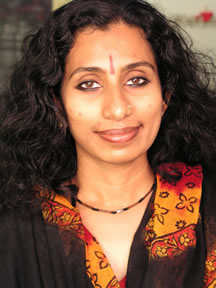
 |
|
|
National Institute of Advanced Studies Bangalore, INDIA 560012 [email protected] |
Research
Background
|
I got interested in the concept of 'consciousness' during
the final year of my post-graduation (1989). With a national fellowship,
I did doctoral research (1990-1995) studying the metaphysical, epistemological,
ontological and spiritual aspects of and discussions on 'consciousness'
in the foundational text of Indian philosophy, the Bhagavad Gita,
in the larger context of phenomenological questions about activity, attitude,
freedom, happiness, meditation and spiritual growth.
Following the completion of doctoral studies I
was invited and appointed as Faculty at the National Institute of Advanced
Studies (hereafter 'NIAS'), Bangalore, (1996 January) where I am working
currently. This institute which is a premier institution in the country
(in the beautiful campus of Indian Institute of Science) engages in multidisciplinary
research, with Faculty pursuing research activities in as diverse fields
as social anthropology, epigraphy, international studies, gender studies,
philosophy of science, consciousness studies etc. The small group of people
here interested in consciousness studies, come from different disciplinary
background such as quantum mechanics, primatology, philosophy and linguistics.
Being a trained philosopher and with a spiritual
background, I got an opportunity to have dialogues with my colleagues
crossing disciplinary barriers and frame questions and issues of equal
importance (to any analyst of 'consciousness'). Since my joining NIAS
I had two kinds of research activities (for consciousness studies): One,
to pursue my specific research interests in developing an integral epistemology,
look at alternative epistemological tools such as use of metaphors, imageries,
understand the basic categories of thinking framed for the analysis, first-person
approaches in Indian thought etc. Two, to organise group activities to
make possible interdisciplinary dialogues on consciousness studies, to
list a few: a regular discussion forum at NIAS to bring people working
in different areas of science, philosophy, psychology, art, spiritual
traditions etc.; national and international seminars; facilitating exchange
and dialogues.
Spiritual Background:
I got interested in asking and thinking about the so-called
metaphysical questions during my undergraduate courses (1985) doing science,
especially cytogenetics and human evolution. The unexplained restlessness
and disquiet of my mind continued until I decided to study philosophy
for graduation. I always had an unexplainable thirst for inquiring about
the mysteries of life and human mind.
I met my spiritual guide H.H.Swami Bodhananda
in 1987. Since then I am his student, studied foundational texts of Advaita
Vedanta from him over the years and with his guidance did doctoral research
on 'concept of consciousness in the Bhagavad Gita'. I continue
to have exciting discussions with him on a variety of topics.
I am a member of a few charity organisations.
Indian psychology, Indian philosophy, Indian dramaturgy and Spiritual
Experiences in the context of current discussions on consciousness.
New methods in the digital archiving of ancient manuscripts.
Introduction
My work has been primarily in the area of consciousness studies and philosophical
debates in recent interdisciplinary dialogues on 'consciousness'. I try
to juxtapose two discussions such as (i) the recent semantic trends in
interdisciplinary dialogues on 'consciousness', and, (ii) perspectives
on 'experience' and 'self-exploration' in Indian psychology, Indian philosophy
and Indian dramaturgy.
I have been particularly
looking at the importance of the 'experiencer', which I term as the 'harder
problem of consciousness' in the context of different ways of Indian thinking,
in order to understand the intractable relationship between physical mechanisms
and subjective experiences. The hard problem of consciousness has caused
a major change in the 'method' for understanding consciousness by questioning
the source for the qualitative nature of consciousness. I hope to develop
the 'harder problem' of consciousness which I believe will resolve the
'hard problem' to a greater extent.
I juxtapose, for this
end, two seemingly unrelated ideas but both founded on experiential level
than theoretical: the being of self in specified contexts, and the tools
offered so as to integrate/transcend the self-in-a-context to a larger
self. My study looks at the 'doing self', the 'loving self' and the 'meditating
self' and understanding them from the standpoint of a variety of states
of mind, choices, relationships and attitudes as discussed in Indian systems
of philosophy, psychology and spiritual practises.
Studies Completed and Brief Description
* Binding Experiences for a First-Person Approach: Looking
at Indian ways of
By following the current
discussions on consciousness in the West one gets to think that the understanding
of consciousness is dependent on the understanding of if not brain, physical
processes guided by a mechanism and having the capabilities for replicating
the phenomenon in vitro with the help of controlled experiments; secondly
there is not a consensual definition of the problem, method and the major
goals of inquiry itself; and thirdly there is insufficient recognition
of the very complexity and subjective nature of the phenomenon. All the
three features have jointly contributed towards generating vast literature,
dialogues and discussions about a variety of issues relating to consciousness,
the primary being empirical research and medical possibilities, especially
in the area of 'abnormalities'.
This study examined
the importance of the following issues in the context of two different
traditions of thinking and experiencing: Indian epistemology (pramana-prameya-prama-prayojana
vyaparah) and Indian dramaturgy (natya sastra).
(i) recognizing 'consciousness' as a complex phenomenon by itself,
(ii) understanding of 'consciousness' as an understanding of its ontology,
(iii) shifting the focus of epistemology to normal and ordinary experiences
from abnormal and transcendental experiences,
(iv) holistic definition of the problem and method,
(v) breaking 'habitual' ways of event or object oriented analysis by experience
or first person oriented understanding,
(vi) the categories of thinking formed by the analyst and his/her world
view.
* Binding Experiences: Looking at the contributions of Adi
Sankaracarya ,
Brain studies, theoretical
analysis, cognitive science and cultural studies have, jointly in the
last ten years, redefined the complexity of 'consciousness' by the factorisation
of otherwise considered less important categories of analysis and understanding
of the problem. The major epistemological worry faced equally by the empirical
analyst as well as the philosopher and psychologist is based on the central
feature of 'consciousness' which is 'experience'. Prima facie, this worry
could be described as how to have a theoretical explanation for the mutual
influence of neural events and subjective experiences. Nevertheless, it
is recognised that the field of consciousness studies is no more a school
of reductionism, whether it be the case of understanding segregated mechanisms
for neural events or mystifying experiences under unexplained 'transcendences'.
Interestingly, any attempt to understand 'experience', such as simple
physical pain or much complex psychological pain, will have to cross the
epistemological barriers of hierarchies and causal relationships, demanding
a non-linear path. The classical description of consciousness as 'unitary'
has even evolved, to accommodate the questions emerging in interdisciplinary
dialogues, to present the term 'self' which was once considered metaphysical,
but very much scientific today. The epistemological transition, however
implicit it is, is from a third-person perspective to a first-person perspective.
This study attempted
to juxtapose two discussions. The first discussion looked at:
(i) the recent semantic trends in interdisciplinary
dialogues on 'consciousness',
(ii) how 'experience'
itself is defined in these dialogues as a problematic,
(iii) how far non-linear and integral are the categories of thinking employed
in the analysis, and
(iv) how far holistic
the larger goals of these dialogues are towards health, creativity and
personal growth.
The second discussion
looked at the distinctive styles of approach and analysis engaged in by
three saints from Kerala: Adi Sankaracarya ( 8th c. A.D.), Tuncettu Ramanujan
Ezuttacchan (16th c. A.D.) and Sri Narayana Guru (19th c. A.D.) towards
understanding human mind with the following foci:
(i) alternative epistemological tools used by
them such as 'metaphors' and 'imageries' facilitating 'transcendental
thinking',
(ii) first-person and 'Self'-oriented analysis of experience,
(iii) phenomenological descriptions of ordinary and transcendental states
and experiences,
(iv) 'complexity' as not a property of the phenomenon but of the epistemological
devices needed for integral understanding of the problem,
(v) personal growth, self-healing, self-identities and relationships as
important factors in understanding the reality of the 'given' and the
possibility of the 'unknown', and
(vi) the therapeutic value of their methods of analysis and presentation.
* Binding Experiences: Looking at 'Two Faces' of Consciousness
Understanding is always
of something which is 'other' than us, to which we are not acquainted
with. We intend to know the 'other'. We understand the 'other' by means
of images, ideas, words and metaphors. In the process of understanding
we also try to integrate the knowledge we get, to a larger system of our
world-view, which in turn influences, consciously and unconsciously, our
ways of responding to situations.
In study of mind and
consciousness the basic duality involved in understanding takes an interesting
turn of that of integrating the understanding of the experiencer with
experience itself. Experience itself will be a factor in the process of
intending to understand it. If definition and knowledge are to be objective,
potential of predictability and repeatability, can study of human mind
and consciousness included under classical ways of understanding? Can
we define consciousness based on pre-experiential understanding of it?
Can the experience be studied with the experiencer having minimal or no
role? Conversely, can the self/experiencer be understood with experience
having minimal or no role? In short will the definition of consciousness
be exhaustive of its complexity?
These questions were
proposed as difficult or easy as asking 'can I see my face'. I can see
my face as much as it is represented. But none of the representations
can replace my original face. What we 'see' is only the reported. The
being of the reported cannot be confused with the being of the original.
Whether they are two distinct duals is of course a metaphysical theme
for discussion. How ever, I think, the most interesting issue is that
though the reported and that which is reported about could not be reduced
to one, 'the reported' and 'that which is reported about' can influence
each other. I understand and define my self based on my experiences. At
the same time, my experience depends upon the notion I have of my self
. I intend to know. I also integrate that which I know. And this mysterious
power of consciousness to intend as well as integrate is the puzzle we
are all trying to solve!
* Binding Experiences: Looking at the 'Harder
Problem' of Consciousness
Being with the problem of consciousness seeks
at least three complex explanations.
These explanations are for:
i) the neuronal processes which are responsible for, from, simple cognitive
functions to complex human behaviours and responses,
ii) the shifts and interfaces between quantitative (chemical and physical)
brain
states to qualitative (mental and subjective) states, responses and behaviours,
iii) the strong sense/adherence of conscious/unconscious
states, behaviours,
responses to a Self which binds experiences, and which also evolves.
Though both the physical and non-physical (philosophical, transpersonal,
spiritual etc.) approaches try to address these three problems, the starting
point which is also the significant point seems to be different for them.
While the focus on one side is upon the local and generative nature of
consciousness in terms of brain processes, on the other side the focus
is on the non-local and non-causal nature of consciousness. The first
kind of focus aims at the explanation of brain processes (for both cognitive
abilities and behavioural responses) and thereby the replication/simulation
of related subjective experiences. The second kind of focus aims at the
resolution and integration of individual subjective feelings, thoughts,
world views and experiences through spiritual practices and philosophical
theorisations.
In both the approaches, in spite of the basic
difference in the focus of the problem, the evading issue is the 'experience'
of an enduring 'I-ness'. Also, both the top-down and bottom-up approaches
at the some point of the explanation recognize the elusive nature of a
factor which paradoxically is the beginning and also the endpoint for
understanding consciousness, namely the subjective nature of experience.
The 'hard problem' of consciousness, which is how discrete neural functions
are bound to give unitary subjective experiences, might eventually be
a 'easy problem' with the advancement in brain studies. But the 'harder
problem' of consciousness is of the irreducible 'I-ness' where we begin
with to understand consciousness and also might be the endpoint.
This study presented some of these issues in the
context of, the 'harder' problem of consciousness.
* Binding Experiences: Looking at Being of Self
and Self-Transcendences in the Context of a Discussion on Transpersonal
Psychology of the Bhagavad Gita
(ongoing study)
Two seemingly unrelated ideas
but both founded on experiential level than theoretical are juxtaposed:
the being of self in specified contexts, and the tools offered so as to
integrate/transcend the self-in-a-context to a larger self. The study
focuses on the 'doing self', the 'loving self' and the 'meditating self';
understanding them from the standpoint of a variety of states of mind,
choices, relationships and attitudes, suggested in the Gita.
For the second part of this study, 'self-transcendences',
an integral framework woven of 'epistemological tools', 'artistic tools',
'meditative tools', 'eschatological tools', 'interpersonal tools' and
'transpersonal tools' will be presented to look at 'when' and 'how' transcendences
happen and what their nature are.
* Spiritual Experiences and Rare Ritual Art Performers of
North Kerala
Ritual-art forms of Kerala are a class of its
kind with equal significance if not more along with the classical and
folklore traditions. Most of the ritual-art forms are associated with
particular communities, specific time of the calendar, observances, staging
etc. Though a significant number of the ritual-art forms are documented,
there are fast-disappearing forms of “ritual-arts” of Malabar (North Kerala)
which are yet to be documented in print/video. Many subclasses of ritual-art
forms have not been recorded due to various reasons such as lack of public
information, disagreement from the ‘performers’ for the event to be publicly
shown. It is also startling that the number of performers of certain complex
ritual-art forms is fast declining and some of the performances are completely
unknown since they were never documented in a systematic manner.
These ritual-art forms constitute
integrated holistic experiences, of a community of people, which could
be considered transpersonal. All the ritual-art forms have some kind of
a spiritual component inbuilt in them though they differ in their usage
of the nuances of color, space, sound, movements and make-up for the body.
Another interesting feature is that how much these ritual-arts are connected
with the daily living of the particular community of the people.
This project completed a video documentation
and photostory of the ‘Rare Ritual Arts of North Kerala’.
Major Conferences Organised
A volume was published with selected papers presented at the conference:
* International Seminar on "Science and Metaphysics: A Discussion on Consciousness and
Genetics" at NIAS, from 24-27 June, 2001. The conference
was supported by Indian Council of Philosophical Research and Templeton
Foundation.
A volume was published with selected papers presented at the conference:
* International Symposia on “Science and Beyond: Consciousness, Cosmology and Technology in
the Indic traditions” as part of the Science and Spiritual Quest
series at NIAS, from 8-11 January 2003. This Symposium was the fourth
and last in the SSQ II series and international programme at the Centre
for Theology and the Natural Sciences in Berkeley. The conference was
organised by NIAS and Templeton Foundation, and supported by Infinity
Foundation, Indian Council of Philosophical, Centre for Studies in Civilisations
and Universite Interdisciplinaire de Paris.
A volume was published with selected papers presented at the conference:
Other Responsibilities at NIAS:
* Course Director for the annual NIAS Course for Senior Executives
from private and public sector on “An integrated approach to knowledge
and information”. This is one of the major courses being organised by
NIAS since its inception.
* Organiser of the in-house seminars for the "NIAS-Discussion
Forum on Consciousness"
* Organiser of the weekly NIAS faculty and guest
presentations for "Wednesday Discussion Meetings".
* In-charge of NIAS
Publications.
* Was the PI of three
national projects (1999--sponsored by Infosys Ltd. ; 2001--Dept of Science
and Technology, and Ministry of Culture, Govt. of India; 2003- National
Board of Higher Mathematics) on digital archiving of ancient manuscripts
and establishing low cost digital archiving units at various institutions.
CD titles were published with the results of these projects.
Other Interests:
· I am interested
in developing new methods for digital archiving of ancient paper
and palm leaf manuscripts. I was the principal investigator of three national
projects for setting up digital archives/databases. One of these projects
was
responsible for the setting up of digital archiving, using low cost photography,
in four major museums of India.
· I am a keen photographer, especially interested
in 'digital photography'. Sometime back, I had held an exhibition of a
set of digital photographs entitled 'Lilies' which was a theme I developed,
based on the pictures I took, of the blue lilies in a small pond in my
institute (NIAS), watching them through the twelve months of the year
and also under different natural light exposures. These pictures were
later published to a CD-ROM.
Another significant photostory (also in
CD-ROM) I made was in 2004 entitled ‘Forms and Faces’. This photostory
was based on a stay in a village called Suryagaon in the Himalayas. I
spent
a fortnight in this village essentially working with a group interacting
with the villagers on welfare programmes. During this time I could take
pictures of captivating human faces, children, women and ofcourse the
natural colors of the village. I personally see these pictures as representing
the emotions and passions of the mountain people. The content of these
pictures include many cultural components expressed through body language,
dress, make-up, nature-spaces, and innocent smiles.
·
I am particularly fascinated to look at the different patterns of
thinking, symbolism
and creativity in Indian epistemology and dramaturgy, also because of
my
interest in classical Indian dance.
· I paint (poster and oil). I like to use
more unconventional media like clay and wood.
· I write poetry (in English and, my mother-tongue,
Malayalam), short stories and short plays.
· I am interested in digital design, web
design and work on most of the products of 'macromedia' and 'adobe'. Some
of the sites I have designed are:
www.geocities.com/prajnana), www.sambodh.org, www.bodhini.com
· I conduct 'Satsangs' (small gatherings for spiritual talks, discussions
etc.) and give (popular and technical) lectures on a variety of topics
relating to Indian philosophy, mind studies and spiritual literature.