
What is Y Wladfa?
or, How the Welsh ended up in Patagonia
The 1860s were not good years in Wales. Workers were being laid off in the slate mines in the North, the coal mines in the Valleys of the south. Rain had caused bad harvests for the small tenant hill farmers, but the rents of the farms still had to be paid. The big landowners - English or Anglicised - could dictate the way their tenants voted, worshipped, even what language they spoke. Or what language they were not allowed to speak. In their own country, Welsh people were forbidden to speak Welsh anywhere except at home. For many of them, emigration seemed a reasonable way out of hereditary poverty and bondage. Almost the only chance a tenant farmer had ever to be his own master and work his own land was to seek it somewhere across the ocean, in America or Australia.
Ever since the 1846 report of the Royal Commission on the State of Education in Wales (known throughout Wales today as Brad a Llyfrau Gleision, 'The Treason of the Blue Books'), a lot of English and some Welsh people had been calling for more 'enlightenment' to be brought to the Principality. As The Times put it in 1865, 'The Welsh language is the curse of Wales.' English education and Anglicanism, it was widely felt - especially in England - would be the salvation of the backwards Welsh. A nationalist movement of sorts had sprung up in the Principality to defend the Welsh way of things, but most people's energy was poured into religious channels, the Chapels and the Nonconformist movements, not into direct politics.
There were exceptions. Whilst The Times did the Welsh language down, in Bala the Rev. Michael Jones thundered: 'The Welsh are a conquered people in their own country!' But even he didn't see much hope for a revolution in Wales. Instead, he proposed a New Wales somewhere else, a fresh start far away from England. This had been tried before, once in Tennessee and another time in Brazil, but without success. The Rev. Michael Jones thought he knew why: those other ventures had been founded on ideas of economic independence alone. What they lacked was soul, a moral dimension. He dreamed of a place where Welsh judges would administer Welsh law, where Welsh people could take pride in the Welsh language, in Welsh history and literature and Nonconformist Christianity.
There will be a chapel, he wrote, a school and an assembly, and the Old Tongue will be the medium of worship, commerce, science, education and government. We will make a strong and self-sustaining nation grow within a Welsh colony.
What he really wanted was a free Welsh state, a little Wales beyond the ocean, far away from England. Y Wladfa Gymreig, the Welsh Colony, was the name given to the mad venture. All the available land on the globe had already been claimed by other countries. However, far-away Patagonia was not yet settled - that is, not settled by Europeans. There were people living there, of course, the nomadic Aónikenk or Tehuelche and, further to the west, the warlike Araucanians, the Mapuche. But in European eyes - even in the minds of the enlightened Welsh - they did not own their own land. So the Rev. Jones' searching gaze fell upon 'empty' Patagonia. Argentina claimed all land south of Buenos Aires and east of the Andes mountain range as its own territory, although it didn't have much in the way of population there to back this claim up, and was therefore delighted by the plans of the Welsh to go and live in the pampas. They made a deal: the Welsh would settle the inhospitable south. They could administer their land, if not as a state, as an autonomous province where they could govern themselves, teach whatever subjects in whichever language they pleased and worship in their own way. In return, they would declare the land Argentinean.
It was a mad scheme, but the Rev. Jones was a convincing orator, and there were enough dreamers in Wales in the mid-nineteen hundreds to fill a boat, several even. The first boat bound for Patagonia, the Mimosa, sailed on 28 May 1865 from Liverpool with 153 Welsh men, women and children on board.
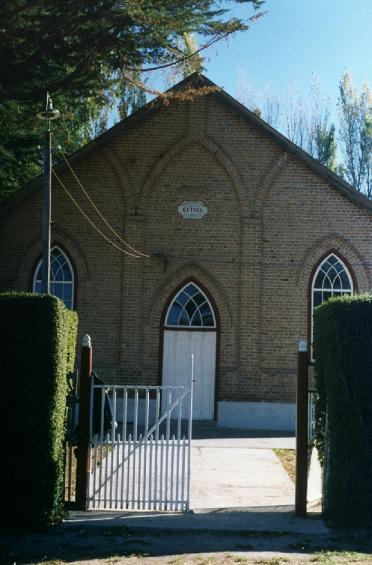
Capel Bethel in Gaiman, Patagonia
