| BIO-SAFETY |
 |
| LINKS |
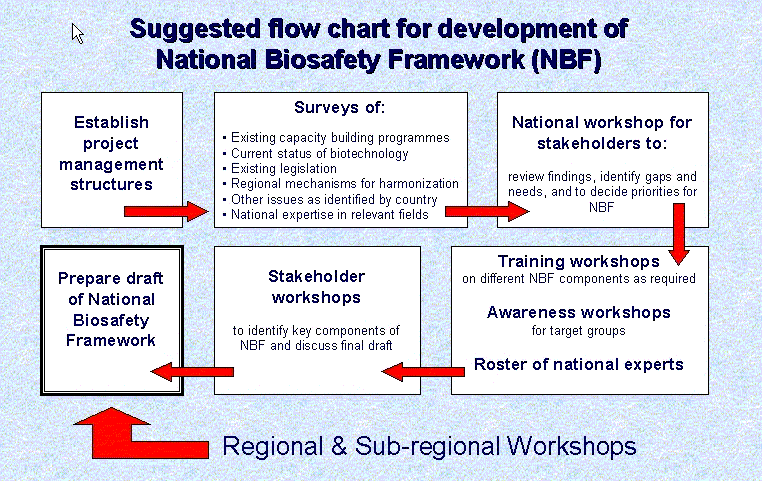
| UNEP-GEF Project on Development of National Biosafety Frameworks The UNEP-GEF global project on the development of National Biosafety Frameworks began in June 2001. This three year project is designed to assist up to 100 countries to develop their National Biosafety Frameworks so that they can comply with the Cartagena Protocol on Biosafety. The project will also promote regional and sub-regional cooperation on biosafety. What will the project do? The UNEP/GEF global project will: 1) Assist up to 100 eligible countries to prepare their National Biosafety Frameworks. Using a country-driven process, the global project will help each participating country to set up a framework for management of living modified organisms (LMOs) at the national level, allowing them to meet the requirements of the Cartagena Protocol. 2) Promote regional and sub-regional collaboration and exchange of experience on issues of relevance to the National Biosafety Frameworks. This will help to make efficient use of financial and human resources, establish regional and sub-regional networks, and promote harmonization of risk assessment procedures and regulatory instruments. 3) Provide advice and support to countries throughout the development of their National Biosafety Frameworks. How can countries join? To join the project, countries need to meet the GEF eligibility requirements: 1) They must sign or ratify the Cartagena Protocol on Biosafety; 2) They are eligible for GEF funding; 3) They have not received assistance previously from the UNEP-GEF Pilot Project on Biosafety; 4) Their national GEF Focal Point has formally expressed the country's interest in participating in the Project. Project components Development of Frameworks will include... 1) Information gathering 2) Analysis, consultation, training 3) Preparation of a draft NBF (draft legal instruments, administrative systems, risk assessment procedures, systems for public participation and information). Regional workshops to... Increase understanding of the Cartagena Protocol on Biosafety Assess implications for risk assessment and decision-making at national levels. Sub-regional workshops to identify... 1) Priorities for capacity building 2) Opportunities for collaboration 3) Mechanisms for sharing of risk assessment and management experiences 4) Ways to coordinate capacity building actvities 5) Networking to share lessons and experiences. |
| Background The Cartagena Protocol on Biosafety aims: "to contribute to ensuring an adequate level of protection in the field of the safe transfer, handling and use of living modified organisms resulting from modern biotechnology that may have adverse effects on the conservation and sustainable use of biological diversity, taking also into account risks to human health, and specifically focusing on transboundary movements". The UNEP-GEF Biosafety Project is part of the GEF "Initial Strategy for assisting countries to prepare for the entry into force of the Cartagena Protocol on Biosafety"(GEF/C.16/4). The main objectives of this strategy are to: 1) assist countries to establish their national biosafety frameworks; 2) promote information sharing and collaboration, especially at the regional and sub-regional level; and 3) promote collaboration with other organizations to assist capacity-building for the implementation of the Cartagena Protocol on Biosafety. The global project is designed to help countries comply with the Cartagena Protocol, and takes into account the lessons learned from the UNEP-GEF Pilot Project on Development of National Biosafety Frameworks. How is the project funded? The total cost of the UNEP-GEF Biosafety Project is $38.4 million. This is funded by a contribution of $26.1 million from the Global Environmental Facility (GEF), with co-financing of $12.3 million from UNEP and participating countries. These countries will contribute one third of the costs of their national projects, in cash and/or in kind. |
 |
| For the first time ever?, a Ministry and Department in Nevis is being proposed to assume the lead role in a Federal Project. The Department of Physical Planning, Natural Resources and Environment, in the Ministry of Physical Planning, Infra-structural Development, Natural Resources and Environment will be responsible for the coordination of a Federal project - Development of National Biosafety Frameworks. The project will be submitted to the United Nations Environmental Program (UNEP) and the Global Environmental Facility (GEF), for funding. This novel arrangement was agreed with the Department and Ministries of Planning and Environment in St. Kitts, who will have an oversight role during the Project. Further details will be posted shortly. |