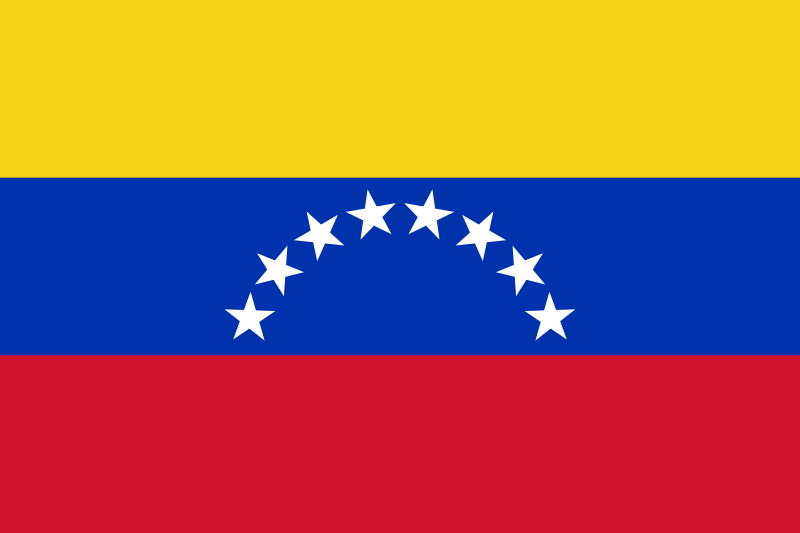

Venezuela, officially called the Bolivarian Republic of Venezuela, 10 n 6 is a country located in the septentrión America South America, consisting of a mainland and a large number of small islands and islets in the Caribbean Sea, its capital and largest conurbation is the city of Caracas. It has an area of 916 445 km ². The mainland bordering the Caribbean Sea to the north, with Colombia to the west, with Brazil to the south and Guyana to the east. With the latter, the Venezuelan government maintains a claim for the territory of Guyana Essequibo over an area of 159 542 km ² .11 its maritime areas, has sovereignty over 71 295 km ² of territorial waters, December 22 224 km ² within their contiguous zone , 12,471,507 km ² of the Caribbean Sea and the Atlantic Ocean on the concept of the exclusive economic zone, 13 14 15 and 99 889 km ² of marine platform continental.15 This area borders the thirteen Estados.16
Its territory was home to important Amerindian tribal groups such as the Caribs. It was first sighted by Christopher Columbus in 1498. Soon after he began the colonization and cultural mixing process. Venezuela was the first South American country to declare its independence from the Spanish Empire, a process which was consolidated with the Battle of Carabobo and the subsequent naval Battle of Lake Maracaibo in 1823 with the final expulsion of the Spanish troops. After a long chapter of civil conflict, the Republic found its way to modernization of the labor notoriously authoritarian governments. A mid-twentieth century began the struggle for a democratic system that took hold after the overthrow of General Marcos Perez Jimenez in 1958. Due to the oil boom, Venezuela experienced a period of high economic growth, which was interrupted by the energy crisis of the 1980s, leading to a period of political instability and social alternating with financial ups and downs.
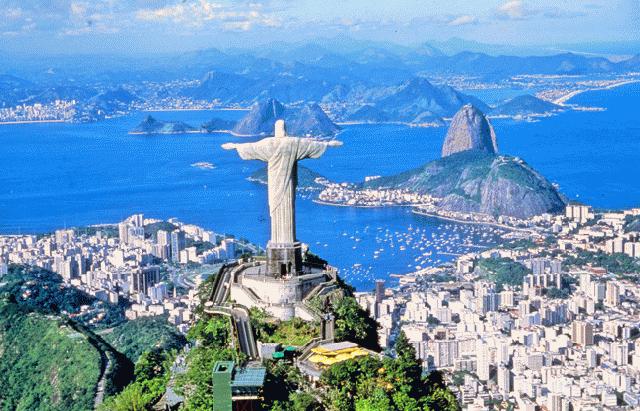
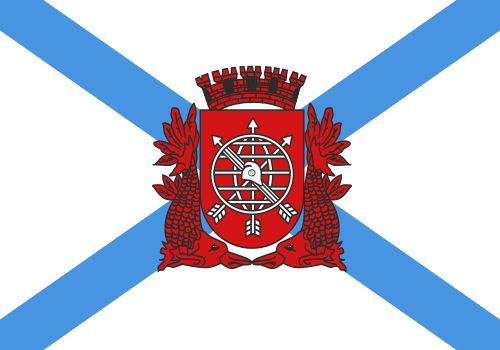
Janeiro1 River in Brazilian Portuguese cult, founded as Sao Sebastiao do Rio de Janeiro, "San Sebastian River of January") or popularly just called Rio is the capital of the state of Rio de Janeiro, located in southeastern Brazil. It was the capital of the Empire of Brazil since 1822, when the nation declared its independence from Portugal and retained that rank until the inauguration of Brasilia in 1960. It is the second most populous city in Brazil, 3 has the highest international tourist traffic of the country and is the first Olympic city in South America.It is one of the major economic, cultural and financial resources of the country and is known internationally for its cultural icons and landscapes, as the Sugar Loaf, the statue of Christ the Redeemer (one of the seven wonders of the modern world), the beaches of Copacabana and Ipanema, the Maracana stadium, the Tijuca National Park (the largest urban forest in the world), the Quinta da Boa Vista, Paqueta Island, the Festival of New Year in Copacabana and the celebration of Carnival.Represents the second largest GDP in the country and 30th largest in the world, besides being home to two of the most important Brazilian company Petrobras and Vale do Rio Doce, now privatized, and major oil companies and telephony, as well as the largest conglomerate of media and communications companies in Latin America. [citation needed] It is the second largest center of research and development in Brazil, reaching 17% of national scientific production (data from 2005).Rio de Janeiro is considered a global city by the inventory Beta 2008 Loughborough University (GaWC) .4It is known worldwide as the "Marvelous City" (Cidade Maravilhosa, in Portuguese). During the next few years will attract media attention around the world, hosting major events such as the 2013 Confederations Cup, the World Youth Day 2013, the World Cup 2014 and 2016 Olympics.
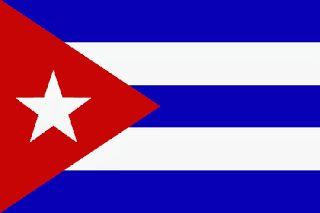
The Republic of Cuba is a country nestled in an archipelago of the Caribbean Sea, also known as the Caribbean Sea. Its main island known as Isla de Cuba is the largest of the Greater Antilles and has orogenic origin. Also part of the archipelago, the Isla de la Juventud, and a multitude of keys or small islands around the aforementioned, among these keys are: Cayo Coco, Cayo Guillermo, Cayo Largo del Sur, Cayo Jutía, among others. To the north are the United States and the Bahamas, west Mexico, Cayman Islands to the south and southeast Jamaica and the island of Spanish.Cuba is ranked 51 in the "Human Development Index" prepared by the United Nations Organization (fourth among Latin America, after Chile, Argentina and Uruguay) .5Moreover, according to data provided by the country itself to the UN, Cuba would be the only country that meets the two criteria for the WWF, means the existence of sustainable development: high human development and sustainable ecological footprintThe Republic of Cuba is a country nestled in an archipelago of the Caribbean Sea, also known as the Caribbean Sea. Its main island known as Isla de Cuba is the largest of the Greater Antilles and has orogenic origin. Also part of the archipelago, the Isla de la Juventud, and a multitude of keys or small islands around the aforementioned, among these keys are: Cayo Coco, Cayo Guillermo, Cayo Largo del Sur, Cayo Jutía, among others. To the north are the United States and the Bahamas, west Mexico, Cayman Islands to the south and southeast Jamaica and the island of Spanish.Cuba is ranked 51 in the "Human Development Index" prepared by the United Nations Organization (fourth among Latin America, after Chile, Argentina and Uruguay) .5Moreover, according to data provided by the country itself to the UN, Cuba would be the only country that meets the two criteria for the WWF, means the existence of sustainable development: high human development (HDI 0.8 ) and sustainable ecological footprintThe Republic of Cuba is a country nestled in an archipelago of the Caribbean Sea, also known as the Caribbean Sea. Its main island known as Isla de Cuba is the largest of the Greater Antilles and has orogenic origin. Also part of the archipelago, the Isla de la Juventud, and a multitude of keys or small islands around the aforementioned, among these keys are: Cayo Coco, Cayo Guillermo, Cayo Largo del Sur, Cayo Jutía, among others. To the north are the United States and the Bahamas, west Mexico, Cayman Islands to the south and southeast Jamaica and the island of Spanish.Cuba is ranked 51 in the "Human Development Index" prepared by the United Nations Organization (fourth among Latin America, after Chile, Argentina and Uruguay) .5Moreover, according to data provided by the country itself to the UN, Cuba would be the only country that meets the two criteria for the WWF, means the existence of sustainable development: high human development (HDI 0.8 ) and sustainable ecological footprint.
Human presence in Mexico dates back to 30,000 years before present. After thousands of years of cultural development, emerged in the Mexican territory Mesoamerican cultures, and oasisamericanas aridoamericanas. After nearly 300 years of Spanish rule, Mexico began the struggle for political independence in 1810. Later, for nearly a century the country was embroiled in a series of civil wars and foreign invasions which had an impact in all areas of life of Mexicans. For much of the twentieth century (mainly the first half) there was a period of great economic growth in the context of a policy dominated by a single political party.
According to the World Tourism Organization, Mexico is the main tourist destination in Latin America and the tenth most visited in the world.13 This is due largely to the 31 cultural and natural sites that are considered by UNESCO as a World Heritage Site, and in this sense the first on the continent and sixth worldwide. In macroeconomic terms by the gross domestic product (GDP) is the fourteenth and eleventh global economy by purchasing power parity (PPP), on a regional scale, is the second largest economy in Latin America and fourth in the continent.7 8 According to the report 2013 Human Development "The ascent of the south" of the UN, has a human development index high of 0,775 units, and is ranked 61st in the world, which has made great strides alongside countries such as Indonesia, Turkey , Thailand, South Africa, considered the fact that in 1980 had a human development index of 0.598 unidades.14 16 Mexico 15 is also one of the countries with the greatest diversity of climates in the world, considered one of the 12 mega-diverse countries planet, is home of 10-12 percent mundial17 biodiversity and home to more than 12 000 species endémicas.18
Politically, Mexico is a democratic, federal representative and composed of 32 states: 31 states and the District Federal.19
The seat of government and the powers of the union is Mexico City, whose territory has been designated as a federal district.

Argentina, officially the Republic Argentina, is a sovereign, organized as a representative federal republic, located on the southeastern tip of South America. Its territory is divided into 23 provinces and an autonomous city, Buenos Aires, the nation's capital and seat of government federal.7 Its 40 million average human development index, per capita income and quality of life are among the most American high America.8 The World Bank, nominal GDP is 25. º most important in the world, 9 But if you consider the overall GDP purchasing power transformed the country into 20. th largest economy in the world.10 In 2010, the country was classified as middle-income nation altos11 or as an emerging market by the World Bank also. Argentina is well known as a power regional.12 13 14 15 16 17 18 19
For its size, 2.7804 million km ², is the largest Spanish-speaking country in the world, the second largest state in Latin America, fourth in the Americas and eighth in the world, considering only the land area subject to effective sovereignty. Considering the Falkland Islands, South Georgia, South Sandwich and Aurora (administered by the United Kingdom but of sovereignty dispute with Argentina), most claimed Antarctic area south of latitude 60 ° S, called Antarctica Argentina (which includes the South Orkney Islands and South Shetland Islands), the total would rise to 3,761,274 km ², making it the seventh largest country in the world.1 However, this claim is affected by the provisions of the Antarctic Treaty, without its signature constitutes a waiver.
His American mainland, which covers much of South America, bordered to the north by Bolivia and Paraguay, northeast Brazil, Uruguay and east by the Atlantic Ocean, and to the south and west by Chile.
The May 25, 1810 was achieved de facto independence when he was deposed the last Spanish viceroy who ruled from Buenos Aires, 20 organizing the First Board of Governors, and the July 9, 1816 was formally proclaimed independence in San Miguel de Tucuman .21

