 |
| The first living coelacanth (seel-a-canth) was discovered in 1938 and bears the scientific name Latimeria chalumnae. The species was discribed by Professor J.L.B. Smith in 1939 and was named after its discoverer, Miss Marjorie Courtenay-Latimer. Until recent years, living coelacanths were known only from the western Indian Ocean, primarily from the Comoros Islands, but in |
| Coelacanth: A living fossil |
 |
| September 1997 and again in July 1998, coelacanths were captured in northern Sulawensi, Indonesia, nearly 6,000 miles to the east of the Comoros. The Indonesian discovery was made by Mark V. Erdmann, then a dactoral student studying coral reef ecology in Indonesia. Although the Indonesian specimens superficially resemble those in the western Indian Ocean, analyses of DNA from tissue samples removed from one of the Indonesian specimens have revealed significant genetic differentiation from the Indian Ocean population. The authors of two studies have suggested that the two populations have been seperated for at least several millions of years. The Indonesian form was described as a new species, Latimeria menadoensis, in April 1999, by L Pouyard and several Indonesian colleagues. All Latimeria are concidered to be endagered and are protected by the Convention on International Trade in Endangered Species of Wild Flora and Fauna. |
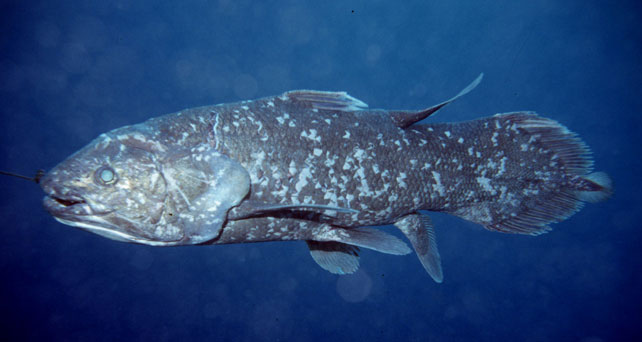
| Second Indonesian coelacanth discovered Photo by Mark V. Erdmann, July 1998. click for larger photo |
| Locality: Known Primarily from the Comoros Islands, which are situated in the Western Indian Ocean between Madagascar and the east coast of Africa, but also occur elsewhere along eastern Africa and Indonesia. In the Indian Ocean only one capture ( the origional one in 1938) is from South Africa and this specimen was long thought to be a stray from the Comoron population. However, resident South African coelanths have been sighted recently in deep canyons, initially by divers using mixed gas "rebreathers", and subsequently by scientists using a submersible. Elsewhere in the Western Indian Ocean specimens have been captured off the west coast of Madagascar and off Mozambique and Kenya, the latter representing the most northern locality record along the African coast. Two confirmed captures (only one specimen preserved) occured in recent years in indonesia, off the island of Manado Tua at the northern tip of Sulawesi. These captures were followed by sightings of two more specimens from a submersible approximately 225 miles southwest of Manado Tua. |
 |
| Habitat: Occurs in temperate waters in the "twilight-zone", generally between 500-800 feet, off steep rocky slopes of volcanic islands. In the daytime the Comoron specimens are known to cluster together in "caves" in submarine lava deposits, from which they venture at night to feed. Two specimens observed from a submersible in Indonesia were in a deep carbonate cave at about 500 feet. The recent sightings off South Africa were at shallower depths, between 300-500 feet, beneath ledges and shallow caves. |
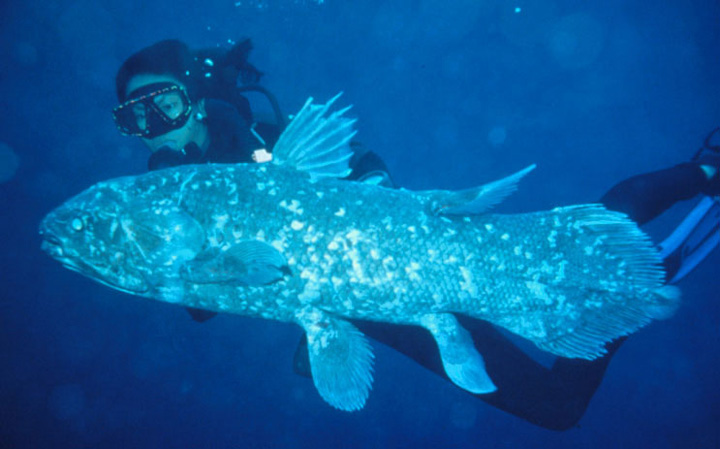
| Indonesian coelacanth, about 50 foot depth, aprox. 4 1/2 feet long. Photo by Mark V. Erdmann, July 1998 click for larger photo |
| Feeding and Diet: The coelacanth is a "passive drift feeder", moving slowly and passivley near the substrate where it feeds primarily on cephalopods (cuttlefish, squid, and octopus) and fishes. It is capable of moving quickly and may do so when capturing prey or avoiding danger. |
| Size and Reproduction: The mode of reproduction is ovoviviparity. This involves internal fertalization of an egg, followed by a gestation period thought to be about a year in length durring which time the embryo feeds off the yolk sac of the egg, culminating in the live birth of a fully formed juvenile. Only two females carrying young, or "pups" as they are called, have been captured. One female contained five full-term pups, each approximately 14" long, and the other had twenty six pups of about the same size. The latter specimen is also the largest recorded coelacanth, weighing nearly 200 lbs. and reaching 6 feet in length. |
| Unique Characteristics: Numerous characteristics are unique to the coelacanth among living fishes. Among them are the presence of a "rostal organ" in the snout that is part of the electrosensory system, and an intracranial joint or "hinge" in the skull that allows the anterior portion of the cranium to swing upwards, greatly increasing the gape of the mouth. Other unique anatomical features include a hollow fluid-filled "notochord" (a |
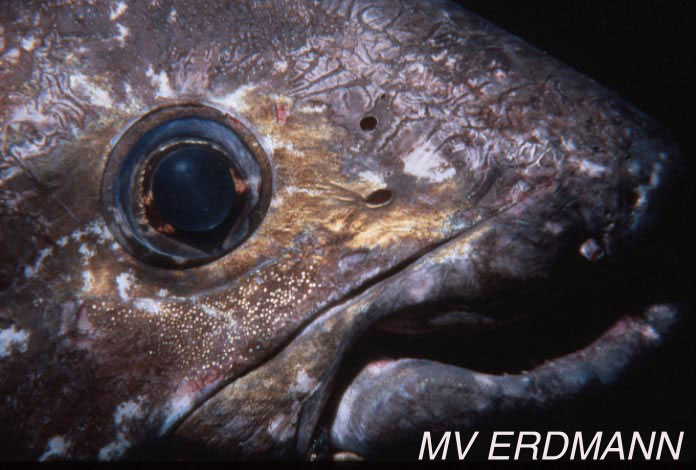 |
| Closeup of snout of Indonesian coelacanth. Note te pores leading into the rostral organ. Photo by Mark V. Erdmeann click for larger photo |
| primitive feature in vertebrates) underlying the spinal cord and extending the length of the bpdy. vertebrae that are incompletely formed or totally lacking bony centra, an oil-filled gas bladder, fleshy "lobed" or limb-like fins that are internally supported by bone, and paired fins that move in a synchronized tetrapod-like pattern. |
| Fossil Record: Prior to 1938 coelocanths were known only from fossils and were thought to have gone extinct approximately 65 million years ago (mya), durring the great extinction in which the dinosaurs disappeared. The most recent fossil dates from about 80 mya but earlier records date back as far as approximately 360 mya. At one time coelacanths were a large group comprising about 90 different valid species that were distributed around the world in both marine and freshwaters. Although Latimeria is a genus distinct from the fossil forms, all coelacanths share numerous features and are easily recognized by their distinctive shape and lobed fins. |
| Relationship to Other Fishes & Tetrapods: The coelacanth's true evolutionary relationships are a matter of controversy. There are several competing hypotheses and many unresolved questions, in large part owing to the many unusual characters found in coelacanths. Experts largley agree that coelacanths are primitive bony fishes (as opposed to a cartilaginous fish, such as sharks and rays), and that their closest living relatives are the primitive lungfish ( known from freshwaters of South Africa, Australia and South America), but they disagree on the exact placement of the coelacanth in the evolutionary history of vertebrates. Coelacanths might best be described as occupying a side branch in the basal portion of the vertebrate lineage, closely related to but distinct from the ancestor of tetrapods (four-legged vertebrates) |
| To learn more about the coelacanth, visit there web sites...: |
 |
|
|
| Site Credits: Information on this site was accumulated from the Smithsonian's National Museum of Natural History's Website. Photos by Mark V. Erdmann, Susan L. Jewett, and Sandra J. Raredon. This page layout done by Adam Freelin. |