 |
| Earth formed 4.6 billion years ago, and a billion years later only thr most primitive life inhabited its oceans. These single-celled bacteria were the planet's dominant life forms for the next 3 billion years. |
| Burgess Shale |
| Suddenly, in a burst of evolutionary creativity beginning 600 million years ago, complex multicellular animals appear in the fossil record. Much of what we know about the so-called "Cambrian Explosion" comes from a unique fossil deposit found in the Canadian Rockies. The Burgess Shale was discovered in 1909 by Charles Walcott, then-Secretary of the Smithsonian Institution, and ranks as on of the 20th century's most significant paleontological finds. |
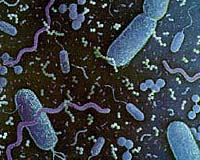
| modern day bacteria |
| The amazing array of creatures preserved in the Burgess Shale includes the ancestors of virtually all modern animals. Other organisms found there are unlike anything alive today. Some of the animals to evolve durring this exciting period include Anornalocaris - a gigantic beast for its time at three feet long - that roamed the seas, preying on smaller creatures. And little Pikaia, a slightly flattened worm, harboring a special trait: a primitive chordate, it is the earlist known representative of our own phylum. |
| Burgess Shale fossils found in the Rocky Mountains in western Canada in 1909 are believed to be dated about 520 million years old. Animals having bizarre shapes, without bones or shells, are preserved here intact. Groups related to many modern animals have been identified in this assemblage. The Burgess Shale has made a major contribution to the study of evolution. |
| Algae and cyanobacteria |
| Site Credits: Information on this site was accumulated from the Smithsonian's National Museum of Natural History's Website; Dr. Ken Hooper Virtual Paleontology Museum, Ottawa-Carleton Geoscience Center and Department of Earth Sciences Website; Dawn of Life Exibit Website; This page layout done by Adam Freelin. |
 |
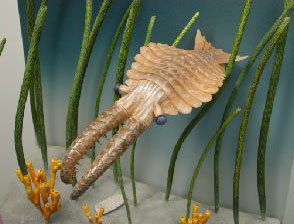 |
| Exibition diorama by the Office of Exhibits Central, Smithsonian Institution. Anomalocaris canadensis |
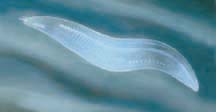 |
| Pikaia ( pick-EYE-ah) is one of the earliest members of the Phylum Chordata-the category to which all animals with spinal cords belong. This is an ancestor to a long and divers line of descendants that include reptiles, dinosaurs, birds, and mammals, including human beings. |
| Burgess Shale Fauna |
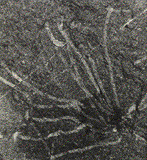
| Yuknessia simplex |
| Not much is known about this green algae except that only three specimens are known. Yuknessia may have attached its hollow body to the sea floor. |
 |
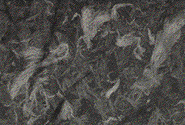
| Marpolia spissa |
| Marpolia is a twisted thread-like cyanobacteria that is believed to have floated or attatched itself to objects within the water column. Not much else is known about Marpolia. |
 |
| Arthropods |
 |
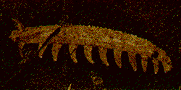
| Aysheaia pedunculata |
| Aysheaia is a soft-bodied, caterpillar-lshaped organism with an average body length of 10-60 mm. Based on its association with sponge remains, it is believed that Asheaia was a sponge grazer and may have protected itself from predators by seeking refuge within sponge colonies. Asheaia probably used its claws to cling to the sponge. Only 19 specimens are known and it is also believed that some modern day inscects, centipedes, and millipedes may have risen from Aysheaia. |
 |
 |
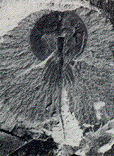
| Burgessia bella |
| Burgessia averaged 10 mm in diameter and contained a branching system in its carapace that was composed of a series of canals. This branching system may have been utilized for food storage or digestion. burgessia walked along the sea floor via its walking legs. It may have also been able to dig into the mud and bury itself. Burgessia is usually preserved as the result of sediment filling up within the canals. |
 |
 |
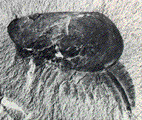
| Canadaspis perfecta |
| Canadaspis is the second most abundant arthropod found and is often found in clusters. A total of 4500 specimens have been found. Canadaspis was a benthic feeder that moved mainly by walking and dug in the mud in search of its food. Once the food was obtained, Canadaspis used its mandible to grind larger particles. |
 |
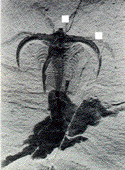
| Marella spiendens |
| Marella is the most abundant and the most common arthropod found with over 15,000 specimens found. It was a deposit feeder that fed on organic particles. The body of Marella is divided into 26 segments of which each ontains a jointed walking leg and a feathery gill branch, used for swimming. Thus Marella was capable of walking and swimming. The preservation of Marella is quite unique in that a dark stain is always left behind, usually at the posterior end. This stain is believed to represent the seeping out of body contents durring decay. |
 |
 |
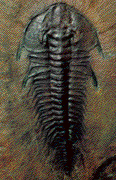
| Olenoides serratus |
| Olenoides was a bethic predator and scavenger. This trilobite dug in the sediment for both concealment and to search for food. When it found its prey, Olenoides used its legs to tear the prey and then passed the peices to its mouth. Preservation of Olenoides is excellent, and complete exoskeletons are common. |
 |
 |
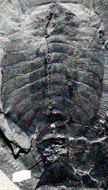
| Sidneyia inexpectans |
| Sidneyia is one of the largest arthropods found and was named by Walcott after his oldest son Sidney. It was a benthic carnivore that walked along the sea floor in search of prey. Gut contents reveal that Sidneyia's diet was primarily comprised of small trilobites and hyolithids (molluscs). About 200 specimens have been documented. |
 |
|
| Brachiopods |
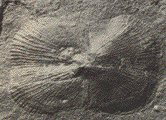
| Diraphora bellicostata |
| This articulate brachiopod has been found preserved only as impressions. There are no traces of soft parts or the shell, as they were dissolved over time. |
 |
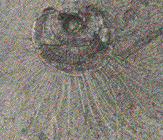
| Micromitra burgessensis |
| An inarticulate brachiopod that used its pedicle or stalk to attach itself to things, most commonly to sponges named Pirania. |
 |
|
| Chordates |
| Pikaia gracilens |
| Pikaia is regarded as the earliest known primitive chordate. It was about 40 mm in length and swam above the sea-floor. Pikaia may have filtered particles from the water as it swam along. Only 60 specimens have been found to date. |
 |
 |
|
| Coelentarates |
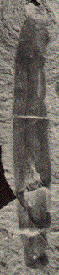
| Mackenzia costalis |
| Not much is known about Mackenzia costalis. Origionally described by Charles Walcott as a sea-cucumber, the species is now recognized as a sea-anemone. |
 |
|
| Echinoderms |
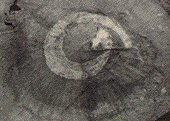
| Eldonia ludwigi |
| This echinoderm was only found in Walcott's Quarry. The body is circular and the mouth bears tentacles. Charles Walcott described this organism as a sea-cucumber. However, Eldonia is now believed to have been a jellyfish, floating freely in the water column. |
 |
|
| Miscellaneous Species |
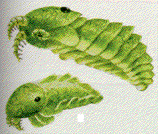
| Anomalocaris canadensis |
| At about 0.5 m in length, Anomalocaris was the largest soft-bodied predator among the burgess fauna. The body was flanked by 11 pairs of fins which were used to propel the animal through the water. Thus, this organism was probably a swimmer, although it way have also rested on the sea-floor at times. The mouth of Anomalocaris is a story in itself. For more than 70 years the pineapple-shaped eating apparatus was interpreted as a jellyfish! |
 |
 |
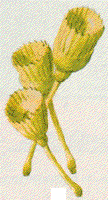
| Dinomischus isolatus |
| Dinomischus was a rare (only 3 specimens know), sessile, plant-like creature 20 mm in length. It stood vertically with the stalk embedded in the sediment. The stalk supported a cup-shaped body at the top. Hairs present on the arms of the cup may have been used by this probably filter feeder to create water currents. It may have been an ancestor to the crynoid. |
 |
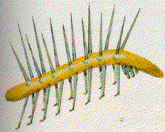
| Hallucigenia sparsa |
| Only 40 specimens of Hallucigenia are known. The name Hallucigenia refers to its bizarre and dream-like appearance. Hallucigenia bore seven pairs of walking spines. Seven tentacles on the dorsal surface were used to grasp food with. |
 |
 |
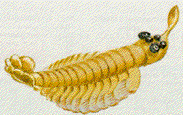
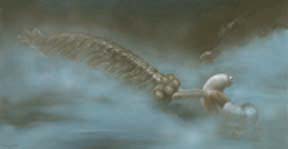
| Opabinia regans |
| Thirty specimens of Opabinia are known and each ranges in size from 40-70 mm. The most intriguing features of Opabinia are its five eyes set on stalks found on the dorsal surface of the head, and a flexible "trunk" ending in a kind of claw. The eyes were used to search for food, and the trunk is believed to have been used to extract worms from burrows . Because of its flexible body it is nor known weather Opabinia was pelagic or benthic. |
 |
 |
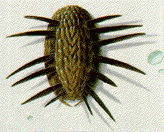
| Wiwaxia corrugata |
| Wiwaxia somewhat resembles a very small porcupine (about 30 mm in diameter) with its quills pulled out. The body is covered by both spines and scales. The spines are believed to have been used for defensive purposes. Wiwaxia probably grazed or scavenged by walking or crawling along the sediment. 140 specimens are known from the Burgess Shale. Similar scales and spines have turned up in similarly aged sediments from elsewhere around the world sugesting that Wiwaxia was widespread during the Cambrian. |
 |
 |
|
| Molluscs |
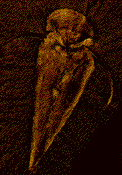
| Hyolithes carinatus |
| Unusual looking for a mollusc, Hyolithes used blade-like structures found along its sides to stabilize itself in an upright position on the sea-floor. Hyolithes also had a cap at the top which it could open for feeding, and close for protection. |
 |
 |
|
| Worms |
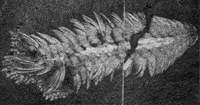
| Canadia spinosa |
| Canadia was a polychaete worm that reached about 30 mm in length. Although it may have been a crawler it is more likely that Canadia was more of a swimmer, utilizing the stiff bristles on its body as paddles. These bristles were spread apart to swim and clumped together to slow down. Canadia may also have been a scavenger. 190 specimens are known from Burgess Shale. |
 |
 |
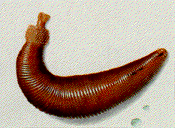
| Ottoia prolifica |
| Ottoia was a priapulid worm about 80 mm in length. It was one of the largest and most abundant of the worms found in the Burgess Shale. The spines on Ottoia's body have been interperated as teeth used to capture prey. Gut contents show that this worm was a predator. Cannibalism, common in priapulids today, was observed in Ottoia as well. Ottoia's mode of life is ncertain but it way have burrowed and tunneled through the sediment. 1,500 specimens are known. |
 |
 |
|