A
Pair of ‘Sceptical’s
for the Sense of being Stared At
1: The Sceptical Petard
1 Anti-Sceptical Hypotheses
2 The Language of Dreams
3 The Sceptic Hoisted
2: The Sceptical Reductio
1 Possible Laws
2 Past Futures
3 Squirrels
References
0: Overview
In the following two (fairly short) sections I glance (very briefly) at the possibility that our deepest epistemological puzzles may (in time) be illuminated by parapsychological research.
I argue in section 1 that Moore (1959) was right to invert the Cartesian sceptical argument in order to deduce the falsity of the sceptic’s hypothesis from a threatened proposition that he was sure of. His right to be sure of that proposition could have been sufficient to justify that deduction because firstly, there is an essential vagueness to how sceptical hypotheses can be possible, which makes sceptical arguments weaker than they look; and secondly, because we hardly know that the extent of our direct acquaintance with the world is limited by the currently well-understood processes—that it is not is to some extent indicated not only by our problems with interpreting existing theories (e.g. quantum mechanics) and by various observations (e.g. of micro-psychokinetics), but also by the very plausibility of Moore’s response to scepticism.
I argue in section 2 that Strawson (1952) and Wittgenstein (1969) were wrong to think that the possibility of non-Humean laws of nature could not justify induction, because our direct acquaintance with the world might enable us to know that such laws are possible and, in particular cases, to know that such laws are likely enough for our inductions to be reliable. (Whether the extent of our acquaintance with the world is indeed sufficient for that is, of course, an empirical matter that I can’t consider here, and whose scientific investigation appears to be as yet some way off.)
1.0: The Sceptical Petard
To begin with, I’m completely certain that:
A: I have actual, flesh-and-blood hands.
But the sceptic (in me) suggests that it is epistemically possible that:
B: I’m a disembodied brain in a laboratory vat, whose present experiences are only virtual ones, produced by a computer. For all I know, the sceptic suggests, virtual experiences could mimic actual ones exactly, so that B might be how things actually are now. Similarly, perhaps:
C: I’m in a coma following an explosion that blew my actual hands off, and my present experiences are only dreams.
Or perhaps I’m being fooled by a hand-eating demon—countless hypotheses like that appear to be possible, and I do not even know that they are all unlikely. On each of them, A would appear to be false and so, judging by such appearances, I do not have the right to be sure that A. So presumably I should decide that:
U: I’m unsure of A.
But while that would be fine if I was just assuming A, in fact I’m completely confident that my hands are real. And furthermore that argument for changing to U appears to be the tip of a bombshell because similar sceptical hypotheses could undermine my confidence in any one, or perhaps in all, of my everyday propositions. I would rather remain, therefore, if I could, with:
S: I’m sure of A
1.1: Anti-sceptical Hypotheses
Perhaps, if my absolute certainty is closed under the logical entailments that I’m completely sure about (and it is obvious to me that it ought to be), I could deduce from S the epistemic impossibility of any hypothesis that would imply the possible falsity of A, much as Moore (1959) argued.
Knowledge is not always closed like that (cf. Nozick 1981: 206), but I do want the beliefs of which I’m absolutely certain to be that coherent—why else would I be troubled by sceptical hypotheses in the first place? But according to the sceptic I can’t reverse his argument like that, because my certainty is only a feeling of confidence (which could be inappropriate), whereas B and C (etc.) are obviously possible. Still, perhaps, insofar as his hypotheses are possible, they are compatible with A (see next section). And after all, the truth of A is also obvious (to me)—why else would I find his hypotheses troubling?
My certainty that A is not just a feeling of confidence, it is justified by my careful checking that A; cf. how I can get even such truths as those of arithmetic wrong, via carelessness (without even noticing), and yet I can also be sure that, e.g., 882/14 = 63, getting my right to be sure by careful checking. I may be unable to apply such checks in a reliable way when I’m being careless, of course, but nonetheless it is clearly possible that my belief that 882/14 = 63 is now justified. Similarly, although checks of A can be unreliable, my right to be sure that A could nonetheless be available now (contra Stroud 1984: 22).
But still, the sceptic wonders, is it really possible that a check of A could yield enough evidence to justify a belief in the impossibility of B and C and all his other hypotheses? Well, a nondoxastically internalistic justification would, arguably, be ideal (see Pollock and Cruz 1999, although cf. McDowell 1994, lecture III, section 6) , and it is epistemically possible that:
Q: I interact with my brain (or else, as I think unlikely, I am my brain, operating) quantum-mechanically, and similarly, not only am I indirectly acquainted with my hands, via my nervous system, I might also (if not ordinarily) interact with them more directly, via interacting wavefunctions.
Were Q true I could be able, when checking the truth of A, to rule out such things as virtual hands; and Q is not completely implausible—e.g. see Stapp 2005 (for one way in which quantum mechanics might provide the mechanism for the mind-brain interaction; and see this page for more on the plausibility of mind-brain dualism) and Sheldrake 2005 (for some empirical observations that might be explained by Q; and also see my aforementioned page). Furthermore it is possible that:
V: Some particular (degree of some) kind of vulnerability (or awkwardness, heaviness, etc.) is a sure sign of wakefulness. An awareness of such vulnerability (etc.) may well indicate wakefulness, at least when things are not going like a dream. If no dream of mine could ever be much like my current experiences in some such respects, then my certainty that I’m now awake could be fully justified (cf. Moore 1959: 222-3). (Note that sensitivity indicative of wakefulness might arise from the operation of some of the neurological mechanisms of Q.)
1.2: The Language of Dreams
Whether Q and V (and their ilk) could yield enough evidence depends upon how B and C (etc.) are supposed to be possible. Brains, laboratories and computers are possible, and people do go into comas—but were B the case those would be virtual brains, and were C the case those would be dream-people. Consider C in particular.
When I think of that possibility I might think of Mr. E, lying in a coma. He might be having a realistic dream, but if he dreams of hands then those hands are not actual, flesh-and-blood hands. Or so we would say in this language—but for him to think of such dream-hands as actual hands whilst dreaming (and perhaps to dream-refer to them as ‘hands’ to psychic visitors to his dream, why not?) why could that not be correct? We do indicate what we mean by ‘hands’ by indicating the things around us, and presumably the same process would apply if Mr. E used language within a dream—as I would be doing now, were C the case.
Conversely, I could hardly be in a coma now if by ‘coma’ is meant the condition that affects Mr. E—if that condition is not a dream-coma. And yet such is the literal meaning of ‘coma’ in this language (which I’m using for communication with the posited other people of this world). Trivially, C is not, on such a literal reading, even possible (cf. Putnam 1981). The possibility of C, if it exists at all, is therefore the possibility of my being in something like a coma, in something like a world (which would be to this world as this world is to a dream). We give C an analogical interpretation, in order to regard it as possible (cf. how ‘some men are pigs’ is automatically interpreted metaphorically so that it might be true). The fact that we so automatically use analogies when attempting to comprehend hypotheses that transcend our experiences (e.g. most scientific ones) may well account for how such a loss of literality might go unnoticed.
Analogies are notoriously vague, but it seems likely that the more different in kind the coma of C and the comas of this world are, the greater will be the plausibility of C’s possibility, and the more the ‘actual hands’ of C will differ from the ‘actual […] hands’ of A. If so, then C, insofar as it is clearly possible, is likely to be compatible with A (see next paragraph), while interpretations of C that are incompatible with A are as likely to be impossibilities (see next section)—so it is quite plausible that a check of A could yield enough evidence to justify a belief in the impossibility of C.
Were C the case in some highly analogical way, the flesh of this world would be composed of something akin (in a loose way) to thoughts; but what I’m certain of, with S, is that I have hands in this world, whatever this world is ultimately composed of, whether 10-dimensional strings or thoughts in the mind of God—or whatever (such hypotheses are only possible insofar as they are compatible with our observations of this world, so they could hardly conflict with A). With such a high degree of analogy, the sceptical hypotheses are practically meaningless (cf. Dretske 1983).
1.3: The Sceptic Hoisted
Conversely, if sceptical hypotheses were given an almost literal interpretation, it would be plausible that they could be refuted by a check of propositions like A (cf. checking that a possible zebra is not a painted horse). Perhaps, the sceptic suggests, I have only recently fallen asleep (or been envatted etc.), so that my linguistic habits make a sceptical hypothesis true and A false? But similarly, it is possible that I was grown in a vat, and only recently put into this non-vat world, and it is counter-intuitive that my linguistic habits should then make A false. Anyway, if I’m ever unsure of propositions like A, as the sceptic is encouraging me to be, I’m likely to check them, and when I consider my hands, in order to apply a check of their actuality and fleshiness (in this world, where something like Q and V may well be true), I will be associating ‘actual’ and ‘flesh’ with the world before me (i.e. greater realities, e.g. of Heavenly things, will be inapposite).
Can the sceptic hope for a bombshell between the extremes of high analogy and near literality? Maybe a scientific sceptic could, but a Cartesian sceptic has little more than a subtle equivocation to play with. It may be scientifically possible that what appear to be your hands are alien bugs with chameleonic powers, which ate your hands while you slept—but therefore scientific evidence could reveal how unlikely that is. My check of A does rule that possibility out, I think; although by contrast, the trees that I see might be alien stick insects, for all I know (without cutting them down). A Cartesian sceptical possibility, on the other hand, must be compatible with all the available evidence—and if that evidence includes A, then it must be compatible with A.
If you do doubt a proposition like A, you probably believe that some sceptical hypothesis is (almost literally) true, which is fine—common sense arguments do not refute such beliefs. The point is that if you do not doubt propositions like A, then hypotheses like B and C (and some scientific ones) need not trouble you, because your complete confidence in such everyday propositions has not yet been shown to be unjustified. Anti-sceptical hypotheses like Q and V have hardly been shown to be unlikely so, insofar as Cartesian sceptical hypotheses imply that your confidence in the former is unjustified, you may deduce that they are epistemic improbabilities.
Since the sceptic (in me) has not shown that all hypotheses like Q and V are false, or even unlikely, he has not shown that I would be wrong to deduce, from S, the epistemic improbability of B and C, insofar as they do conflict with A. Whereas it does remain self-evident (to me) that A, there was only an initial, unquantified (epistemic) possibility of B and C. So, I began with S, and the sceptic has failed to show that I should change to U. And while there are other sceptical hypotheses there are also many more anti-sceptical hypotheses, which the sceptic has not shown to be false, or even unlikely. The only thing that could possibly tip the balance of so much perceived ignorance would be some positive knowledge, such as my direct acquaintance with my own hands, and that yields S.
2.0: The Sceptical Reductio
To begin with, it is clear that many of the inductions that we make are rational, uncertain but rational. In fact, they are so clearly rational that Strawson (1952: 249) considered the following question to be absurdly pointless. “Why should we suppose that the accumulation of instances of As which are Bs, however various the conditions in which they are observed, gives any good reason for expecting the next A we encounter to be a B?”
Strawson’s point was that such an accumulation is by definition a good reason for such an expectation. Nonetheless, whether or not we should suppose such a thing does depend upon what else we know about the As and Bs—if we only know that all observed As were Bs, then we do not have a good reason; cf. finding thousands of instances of a number-theoretic regularity without having any other reason to think it true. So, there are two ways to interpret Strawson’s question:
i: For which As and Bs should we suppose such a thing?
ii: How is it that, in those cases, such accumulations amount to evidence that the unobserved As are Bs? The latter was Strawson’s intended interpretation, but the two are related, because having some idea of how good inductions work could help us to know which criteria to look for. E.g., were such inductions rational insofar as the observed As being Bs amounted to evidence that it is a natural law (in the non-Humean sense of a non-accidental regularity) that As are Bs, then the As and Bs should resemble natural kinds (in some non-Humean sense) rather than Goodman’s (1979) famous grue emeroses.
“The law, a relation between universals, is a theoretical entity, postulation of which explains the observed phenomena and predicts further observations.” (Armstrong 1983: 104) Armstrong argued that since it is analytic that good inductions are rational inferences, Humean scepticism (which regards induction as irrational) yields a reductio of Humean causation (which regards cause and effect as mere coincidence). So analyticity may be a good place to begin.
2.1: Possible Laws
The mere identification of objects as As and Bs involves inductions, e.g. from sense-data to object. In particular, to grasp the meaning of ‘the accumulation of As that are Bs can be a good reason for expecting the next A to be a B’ is to associate words with those shape-tokens, and meanings with those phrases. And of course, they have to be the correct associations, if one is to grasp the meaning of that sentence. But one must get one’s evidence that such shapes have constant meanings from one’s past linguistic successes—one must infer inductively that those shapes still represent those words. So, to grasp the meaning of that sentence is therefore sufficient to justify the belief that it expresses a true proposition. According to Boghossian’s (1997: 334) epistemological definition of analyticity, it is therefore analytic.
Unfortunately, that only means that, insofar as we have to assume that language is rational, we have to assume that some inductions are rational, and such a conclusion is surely too subjective to support Armstrong’s reductio—while it is indeed likely that general terms exist in our language only because they have been used reliably to investigate our world inductively (as grue emeroses have not), we also need a reason to think that they will continue to be reliable. Still, since the lawfulness (or conventionality) of language is what makes it analytic (or true by convention) that some inductions are rational, perhaps it is indeed the possibility of natural laws that justifies that expectation, where our primitive concept of laws is apposite (the reliability of science being in question).
Now, were we directly acquainted, not only with such things as our own thoughts, but also with such things as own limbs—as some stuff that might well be proto-scientific (e.g. the experimentally unimpressive, but perhaps ubiquitous, micro-psychokinetics) does indicate—then we might become directly acquainted with whatever non-Humean laws connect such things as well, e.g. when we learn how to move our own limbs.
Later experiences would yield an enormous, interconnected web of evidence for more natural kinds, and their non-Humean laws, from emeralds and the laws of chemistry, to electrons and the laws of physics, and whilst we might refine some of those kinds and laws in the light of even more experience (so as to make our inductions more reliable), it would remain a web affixed to that with which we were directly acquainted.
A trivial consequence would be that non-Humean laws would be known to be epistemic possibilities (without their needing to be defined explicitly), so that we could know that, either
SL: a relatively simple law connects the As and Bs, or else
CL: the As being Bs was due to complex laws, or was accidental—it arose by chance so to speak, as when a fair coin is tossed, e.g. even if we get a run of heads, the next toss is as likely to be a tail as a head. Now, case SL being possible, consider tossing a coin that is not known to be fair—runs of heads are more likely to come from a coin biased towards heads, and so as heads accumulate it becomes increasingly likely that we will get another one. Unfortunately, there are infinitely many epistemic possibilities for how the As and Bs could be related, so the mere possibility of case SL does not tell us how much more likely it is getting, that the next A will be a B. That depends upon how likely case CL was to begin with, and hence upon what the As and Bs are.
2.2: Past Futures
Fortunately our languages embody a lot of data about the world (e.g. we have the word ‘green’ because of the evolution, or perhaps the intelligent design, of our eyes), whence inductions involving natural kind (or scientific) terms tend to be far more reliable than those involving arbitrary (or fictional) terms like ‘grue’. Were the As and Bs of the former sort, our background knowledge might tell us (more or less) how much evidence we were acquiring, since the As and Bs could then be compared with relevantly related webs of successful inductions, which might be based upon direct knowledge.
Now, since a wide variety of inductions have been accurate in the past, it is likely that relatively simple natural laws govern such things, whence some of the other consequences of the underlying relationships between the fundamental kinds of things are likely to be relatively simple too. Hence we may expect that good inductions will continue to be reliable—but that argument only avoids circularity if SL-type laws are made more likely in that way. Natural laws do not change over time of course, so it all depends upon how small is the epistemic likelihood, say £, that such simple regularities as have been observed arose either by accident or because of laws that are much more complex than they look.
Were £ constant over time we would have a lot of evidence that £ is negligible, because the observed regularities would have had the same chance of revealing their complexity throughout the past, and were £ significant they would probably have done so already. Such constancy would be expected were simple regularities arising by accident (since randomness would remain completely random), so consider the likelihood of the underlying laws being much more complex than they look. For all we know, that likelihood might increase over time, but it has not done so (not noticeably), so there is some evidence that it is also constant. But might not demons control the world, changing such things only when we would be most affected? Well the range of such possibilities is immense, but it is rational to ignore all such possibilities, whatever their likelihoods—as rational as it is to ignore the possibility that 2 + 2 = 5 (despite the unknown likelihood that some sort of Cartesian demon might have falsified all our applications of arithmetic, having first driven us so mad that we believe wrongly that 2 + 2 = 4).
A similar reason for regarding £ as negligible follows from the fact that we should take into account as much evidence as possible when we think rationally about the world—objects whose properties obey (what we think of as) simple laws can readily be reasoned about, whereas stuff obeying very complex laws can’t, whence we should ignore the latter. But of course, that does not mean that £ is negligible, so consider a more objective reason why we can regard £ as constant (and hence negligible)—that the interconnected web of our beliefs about the world has as its foundations those things with which we are directly acquainted. We know that we persist through time with an essential constancy, and we may also (as mentioned above) have such direct experiences as mean that those foundations (e.g. nondoxastically internalistic ones) have a similar constancy.
2.3: Squirrels
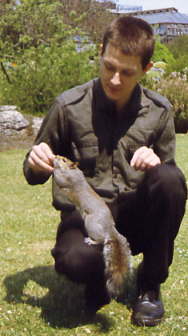
“The
squirrel does not infer by induction that it is going to need stores next
winter as well. And no more do we need a law of induction to justify our
actions or our predictions.” (Wittgenstein 1969, remark 287) Nonetheless
it would be useful to answer (i), and so it may also be useful to know more
about how our direct experience of the laws of nature actually helps to
keep our inductions reliable. And for that we may need to look more
closely at the nature of such direct mind-body interactions, because the
reliability of induction (unlike the rationality of arithmetic) is an empirical
matter.
And note that the theory of natural selection does not explain how induction could be rational—the logical possibility of non-Humean laws of nature is what does that. The past successes of induction are evidence for the actual existence of non-Humean laws of nature—it is clearly no mere accident that what was the future now fits perfectly into the past. But the theory of natural selection is consistent with our having evolved (with our gut instincts and natural languages) in a world of accidental regularities, or of unimaginable complexity—whereas, as we know directly (incontrovertibly), our own persistence through time could hardly be an accidental regularity. And similarly, we might know directly that the future will resemble the past in various fundamental ways (roughly commensurate with our own complexity). Of course, it is currently rather mysterious how we know that we are the same thing that we were yesterday (and will be the same one tomorrow, if we exist at all), but that mystery does not in any way make that (directly known) constancy dubious.
That is not to deny that natural selection explains, to some extent, how we make good inductions, in our natural languages. It does seem likely that our concepts were selected for those that facilitate accurate predictions, for example (cf. Craig 1990). Nevertheless, that our intuitions about what is rational were completely determined by whatever benefited cavemen (and apes, and fish, and so forth) seems prima facie little better than Strawson’s dismissal of (ii) as idle on the grounds that good inductions are by definition those non-deductive inferences used by those people that we regard as rational agents. It may be that our arguments about rationality will all boil down to such definitions eventually, but part of what it means for us to be rational is for such explanations to seem inadequate. And even if we do not yet (and even if we could never) know all about all the reasoning that gives rise to our most rational beliefs, we surely need not assume that good justifications are not there behind our best beliefs; and in fact, our sciences are increasingly yielding evidence that they are.
An Alien Caterpillar?
References
Armstrong, D. M. (1983) What
is a Law of Nature? Cambridge University Press.
Boghossian, P. A. (1997)
‘Analyticity’ in B. Hale and C. Wright (eds.) A Companion to the
Philosophy of Language, Oxford: Blackwell, 331-68.
Craig, E. (1990) Knowledge and the State
of Nature, Oxford: Clarendon Press.
Dretske, F. (1983) ‘The Epistemology of
Belief’ in Synthese 55, 3-19.
Goodman, N. (1979) Fact, Fiction, and
Forecast (3rd ed.), Hassocks: The Harvester Press.
McDowell, J. (1994) Mind and World,
Harvard University Press.
Moore, G. E. (1959) Philosophical
Papers, London: George Allen & Unwin.
Nozick, R. (1981) Philosophical
Explanations, Cambridge MA: Harvard University Press.
Pollock, J. L. and J.
Cruz (1999) Contemporary Theories of Knowledge (2nd ed.),
Oxford: Rowman and Littlefield.
Putnam, H. (1981) ‘Brains in a Vat’ in his Reason,
Truth and History, Cambridge University Press, 1-21.
Sheldrake, R. (2005) ‘The Sense of Being Stared At, 1: Is
it Real or Illusory?’ in Journal of Consciousness Studies 12,
10-31.
Stapp, H. (2005) ‘Quantum
Interactive Dualism: an alternative to materialism’ in Journal of
Consciousness Studies 12, 43-58.
Strawson, P. F. (1952) Introduction
to Logical Theory, London: Methuen.
Stroud, B. (1984) The
Significance of Philosophical Scepticism, Oxford: Clarendon Press.
Wittgenstein,
L. (1969) On Certainty, Oxford: Blackwell.