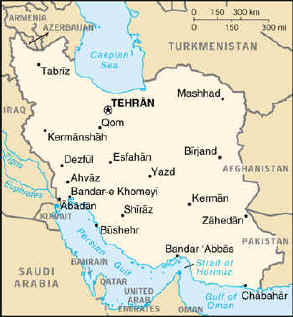
Tehran, Tehran
You know, I could really give a flying shit about what goes in the world these days. I mean, I am here and I am alive and I have running water and free food and one huge and frankly impressive phallus. So I am set, no matter what is thrown in my way I was listening to one of my favorite bands in the world, Duran Duran, when somebody said, "Hey, it would be funny if someone made a band called Tehran, Tehran." And I was all, "What the fuck are you talking about, bitch?" And she was all, "You know, Tehran. Capital of Iran." She saw the baffled look on my undeniably comely face and reiterated, "Iran. You know, mullahs and what not. Last remnant of Persia, once one of the biggest Empires ever?"
I said, "History is for faggots
and sailors." Then when I got home I totally opened a book
and these are pretty much my thoughts on Iran and Saudi Arabia.
You see, in 1979, the Shah (kind
of like king, shahanshah means "King of Kings")
of Iran, Mohammed Reza Pahlavi, was officially overthrown and
ousted from the Peacock Throne. His ambitious plan to "Westernize"
Iran within five years had backfired, and the support for him
had all but dissolved entirely at the time of his final abdication.
Poor guy. His dynasty, established in 1925 by his father, had
never been popular, and throughout his reign the straws on the
camel's back continued to pile up, until it all came crashing
down around him. Pahlavi, was a very unpopular name I hasten to
add, for it went back to pre-Islamic times. On the surface, the
Shah's government has a lot in common with the Saudi Arabian state
of today. Monarchies were the cornerstone of both entities, officials
were notoriously corrupt, the regimes were opposed to democracy,
both struggled with religious fundamentalists, and both had a
unique relationship with the United States. With all these comparisons,
one would assume that the Saudi state is heading into the waters
that the Shah himself wandered into. However that will probably
not be the case, as these similarities reveal a world of differences
between the two states. Plus, let it be said, we simply need Saudi
Arabia these days, especially in the days after those towers crashed
to the earth.
The Archduke Franz Ferdinand of
Austria once boasted, "No man can stop me." What a pompus
fucking asshole. I bet he hadn't counted on the Serbian radical
that ended his life with a single well placed bullet and sent
the world into its first prolonged global conflict. Speaking of
which, not a whole lot of good World War One Movies out there.
Producers and writers take note, I want some trench warfare films
and I want them now. Mohammad Reza Pahlavi, the last Shah of Iran,
had a similar attitude towards the dissidents in his country.
They were pissed on basically. He was a stubborn man, a man who
believed in modernizing his nation and stopping at nothing short
of brutal tyranny to do exactly that. Meaning he was pretty much
a tyrant. The Shah was something of an enchanting figure in his
own right, but Ayatollah Khomeini proved the far more determined
to win the game. The Shah had only paper thin support, the Ayatollah
had the weight of the Islamic world behind him, and it was his
intent to create a true Islamic State and save Iran from the follies
of its monarch. It was a battle of the extremes, and both extremes
were more than a little unflinching, short sighted, and tyrannical
when it came down to it. Only the extreme unpopularity the Shah
enjoyed and the righteousness of the future Supreme Leader convinced
the Iranian people to go through with the "last great revolution".
Americans liked the Shah. They saw the diplomatic side of him, not the complete asshole side of him. He was a paranoid little motherfucker, arguably very astute in the ways of diplomacy, but not very good in the way of humanity. He jailed hella people, exiled even more, and used his own latter day Oprichiniki, SAVAK (his secret police, basically) to smash anyone who had the gall to speak out against him or his cronies. But people of the Western persuasion continued to see what they wanted to see, and they saw the future of the Middle East in Iran, a westernized secular state. An Iranian journalist put it succinctly, "You thought you understood Iran because the Shah spoke good English and because his cabinet had read Shakespeare. You thought he was good because you could see a reflection of yourself in him. But he understood Iran as little as you did, and that's why you both failed."
When it comes to the Islamic World, Iran is in a class of its own. With a history that spans over two thousand years it is difficult not to feel a certain amount of pride in the achievements of the past, not the least of which included an empire spanning from parts of India to the fringes of Greece. In fact, had those three hundred hardcore punk as fuck Spartans not stemmed the tide of the Persian Horde at the gates of Thermopolaye, why we might all be speaking Farsi right now. No, but that's why Greeks are generally despised these days for their hubris, going around and spouting out lines to the extent of "Y'all best show some respect, we saved Democracy forever. Also, I have a really generic but perhaps a bit heartwarming wedding to plan. Ta-ta!"
Iran is the only country in the Islamic World (and the world in general) where the majority of the citizens are Persians. I think the Tajik ethnic group in Afghanistan share some Persian blood, but Iran is definitely the Persian stronghold of the world today. This sets it apart from the Arab world (North Africa all the way to Iraq), the peoples of the Indian subcontinent, Pakistan and Afghanistan, Sub-Saharan Africa, and the Muslims of the far east and Southeast Asia. This vital difference has given them a national characteristic that sets them apart in but one of many ways. For whatever reason, every race of people have always fancied themselves better than the rest, I guess that's just nationalism at work, and though I can't stand that stuff, I can't deny an immediate affinity for the Persian culture.
Another truly important difference from much of the Muslim world is the fact that the majority of Iranians practice Shia Islam. Uh oh. There are more Shia Muslims in Iran than anywhere else in the world. The word Shia comes from a Shiat Ali (the party of Ali) and references Muhammad's first cousin , in some ways Muhammad's adoptive brother, the husband of his favorite daughter (Fatima), and the father of his favorite grandsons. Ali was the fourth and final of the Rightfully Guided Caliph's, which were basically the guys who took over the Islamic Empire, such as it was, immediately following the death of Muhammad. Ali was assinated, just as two of the other four Calips were, and the man who next took power was decidedly un-democratic regarding absolutely everything. So people who refused to follow that Caliph and held out for our main man Ali became the Shia Muslims. To generalize mildly an important aspect of Shia Islam comes from martyrdom, that willingness to sacrifice yourself for a greater good. That sense of martrydom is personified by the massacre at Karbala. Which you can read about if you aren't a lazy piece of shit.
The man who dared fight the Shah was of the highest class of clerical rank, a cult figure of strange popularity. His name was Ayatollah Ruhollah Khomeini and he was the instrument of the downfall of the two thousand year old monarchy.
Modernization did not cut it with
Khomeini. It was "Un-Islamic". The Shah's attempts to
separate church and state were also particularly appalling. "In
Islam, the legislative power and competence to establish laws
belong exclusively to God Almighty." At times Sharia law
kind of gets in the way of some good ideas. Though steadfast in
his views and blindly loyal to what he perceived the true uncorrupted
form of Islam, Khomeini, through the years, was the one who attracted
followers, whereas the Shah found those in favor of his dropping
off substantially. 
In the end the Shah abdicated, dying in exile, never achieving the wealthy beyond belief nation he envisioned. After a brief secular government during the final collapse of the monarchy, Ayatollah Khomeini and his followers took control and he became the first Supreme Leader of the Islamic Republic of Iran. He proclaimed "Shah mat" or "The Shah is dead". Well, now isn't this getting interesting? In United States terms, this would be George W. Bush fighting off the advances of a very very very charismatic Pastor. Nah, that wouldn't happen.
Saudi Arabia is presently ruled by King Fahd and the Crown Prince Abdullah, direct descendants of King Abdul Aziz, who was instrumental in the establishment of the modern Saudi State. Lots and lots of fighting went into capturing that throne. And to show how egocentric they are, Saudi Arabia is now the only country in the world named after the ruling family, the House of Saud. The Saudi Arabia of today has the largest petroleum reserve in the world, hosts the two holiest cities of Islam (Mecca and Medina, the birth and resting place of the Prophet Muhammad), and is infamous for injustices ranging from public executions, scant rights of women, and the sometimes almost Gestapo like religious police who are widely feared. Like the Shah's secret police, SAVAK, they inspire fear by doing whatever their masters bid them to do. Yes, it's a very depressing, depressing thing.
You really don't have to look than the families of the Shah and the Saud Royal House to see the first of many discrepancies between the two ruling regimes. The Shah was in many ways an isolated man, an egomaniac who could not stand to share the spotlight with anyone. He became jealous if his ministers became too popular with the masses, and was not averse to demoting them...or worse, and by worse I mean imprisoning or killing them. His family, though wild at times, was also a relatively small unit. They were not established royal blood, having come to power only a generation before through questionable means. The Saudi Royal House, a huge collection of individuals, has been around in some shape or form for 300 years, and have a sense of legitimacy to their titles. The land they now claim was fought for and won. No CIA sponsored coup's there. There is no doubt that various members of the Saud Royal house are corrupt, however many of the others are still popular with the people, particualrly that charming Prince Abdullah, something the Shah never truly had.
In both countries pockets of fundamentalists have threatened the power of the ruling elite. Powerful figures who are larger than life emerge from all walks of life, each preaching his own "uncorrupted" form of Islam. Yeah yeah, they are all "uncorrupted" aren't they? Christ. Peace Be Upon Him. In Iran the Ayatollah Khomeini proved to be the dominant figure, ready to take the revolution to the next level. He rose in popularity even after the Shah had exiled him, and proved a greater threat from afar than he did right under the monarch's beak-like nose. Hey, it was large, and so austere too! The Shah would go to great lengths to mock Khomeini, including repeatedly calling him "the Foreigner" (the Supreme Leader was born in India). Some would argue that Osama bin Laden represents the Saudi version of the Ayatollah. There are many things wrong with this comparison. A principle reason Khomeini was such an avid hater of the Shah was the monarch's habit of not including the clergy in his autocratic government. Osama bin Laden is the son of a millionaire, not a member of the clergy, a clergy that in fact the government of Saudi Arabia takes steps not to isolate. Khomeini being a hero among the Shia, enjoyed a base of support that bin Laden would never find with the Sunni. It is true that he isn't really Saudi, his family originated in some remote hills in Yemen, but that ain't the point right now, is it?
Religiously there is no unity
in Saudi Arabia as there was in Iran. Odd, no? Saudi Arabia boasts
a small Shiite population, unlike the majority Shiite population
in Iran. The remaining Sunni Muslims in Saudi Arabia make up an
enormous amount of people, people with a thousand different agendas.
There is no real unity among them, and creating a "Pure Islamic
State" when you aren't even sure you agree with your neighbors
definition is next to impossible. Or maybe I am just getting my
definitions mixed up. I tend to do that, but then again, I don't
care. And neither should you, you whore.
The Shah had a plan for a "Great
Civilization". He wrote several books outlining his plans
of modernization. The last book, published toward the end of his
reign, was an incoherent mess. It was crazy-core, basically. His
cabinet of sycophants did not have the nerve to tell him of the
contradictions and hypocrisies in his work. He wanted Iran to
become in essence, a European country. Western dress was encouraged,
western music and art became fashionable. In Saudi Arabia, they
are trying the technique of modernizing the nation without making
it "western". Western forms of entertainment is banned,
traditional dress is desired. We'll see how successful they are
when they want our money...
The Shah enjoyed what was called
a "unique" relationship with the United States. He was
not very friendly with many Democrats actually. Maybe that is
my bias against him. He ridiculed Roosevelt and had no great fondness
for Kennedy or Johnson either, for they had slighted him in various
ways. He was known to openly mock United States policy, declaring
that "The Democrats are playing into the Russian hands. It's
not surprising that the Communists are taking advantage of them
to extend their empire." However he and Richard Nixon got
along well enough. Secretary of State Henry Kissinger was delighted
to be in the good graces of the Shah, his idea of a "grand
design", an axis from Australia to South Africa by way of
the Middle Eastern oil fields was starting to seem like a reality.
Both Nixon and Kissinger were against the Shah democratizing his
nation, they pushed him in the authoritarian direction. It was
the Shah-Nixon-Kissinger triumvirate that began to undermine the
Shah's credibility all over the world, including the second world
power at the time, the Soviet Union. Jeez, Nixon and Kissinger
had their own agenda? That just shocks the pants right off of
me. Wait, they are already off, cause I am looking at porn as
I write this. 
It was that open handed friendship with the "Great Satan" that turned mild displeasure with the Shah into outright hatred. The Saudi Royal family does not bend over backwards to accomodate the United States, nor do they supplicate themselves like vassals. In fact, they avoid the kiss of death "guilty by association" rule by decrying many aspects of United States policy. Covertly however, the Saudi's know what an advantage the friendship of the wealthiest country on earth can be, and bolster the friendship in secret dealings. The Saudi's let U.S. soldiers into its boundaries (the cause of much resentment in the Arab and Muslim world) but don't give them the resounding diplomatic immunity the Shah bestowed upon the thousands of Americans that were within his borders. U.S. troops have been kept isolated from the citizens of Saudi Arabia, instead of the mingling rampant in pre-revolutionary Iran.
The events and political climate, and social situations that led up to the abdication of Mohammed Reza Pahlavi Shah share many characteristics with modern Saudi Arabian society. Yet to think that a revolution like the one in Iran could easily take place in Saudi Arabia is ignoring many key facts. The one man show of the Shah is undermined by the expansive Saud Royal Family and the Council of Ministers. In addition, the political, religious, economical, and foreign policy outlets all vary to such degrees that make any comparison to the government of the Shah unfounded and obsolete. The Saudi Arabian Royal family will most probably continue to prosper with its brand of smart yet sensible politics, despite the corruption that infects much of the state. Kind of annyoing isn't it? Don't worry. I have a plan. No, I don't.
Alex Cesario Siquig Esquire