
You may have seen films where the hero or damsel in distress is bound and suspended above the floor by some means. You may have considered emulating these 'scenes'. If you have, you quickly realise that a very secure anchor point is required for the suspension, not to mention some aquired expertise in how to attach someone to the anchor point, so that they remain 'relatively' comfortable and safe from suspension injury or falling. The latter information can be obtained from other resource sites, this page will look at the former. All the above information assumes you have a little successful knowledge of DIY. If you have little ability and aptitude in this area, it may not be for you. The information here is presented in good faith, but the writer cannot accept responsibility for any subsequent accident or injury, however caused. This page hosted by
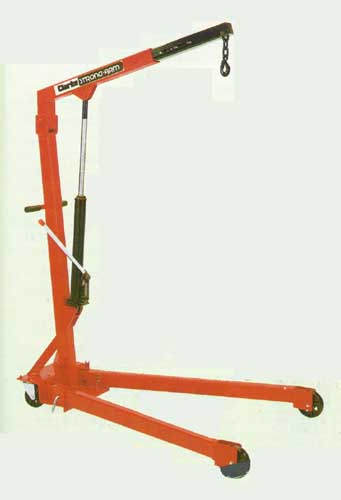 It is usually possible to arrange a fixed suspension point in most buildings that will support the weight of a person. The point will always be fixed and not always in the right position for every 'occasion'. If you don't wish to disturb the building fabric and need a portable solution, one option is to use an engine hoist. The smaller versions of these can lift 500Kg and fold up reasonably small. They are not particularly light (90kg) and the ease of transporting should be checked before considering its use on an upper floor. The jib extension and folding legs can be usually be removed to ease transport and lower the total weight. They do contain hydraulic fluid, and while it is unlikely that the fluid would leak, use of a protective tarpaulin under the hoist would be advisable, especially on carpet or if the hoist is hired. If you're not gaining the desired height with the hoist, check that you have extended the jib to its farthest. It's advisable to practically check in the shop, that the highest available jib height is suitable for your purpose, before purchase or hire.
The hoist will be quite stable with a static load but if a significant degree of swinging is envisaged some additional stabilisation should be used, especially at the narrow piston end. This could be obtained by fixing a suitable timber or steel section across the lower arms. The assembly should be checked for 'swingable' stability before embarking on a scene. The 'swing seat' as described in the 'post' section of this site can be used for this check.
The action here is not a constant vertical movement, as in a conventional hoist, but an arc, the length of the jib, is moved around the top pivot. This action does not usually pose any difficulty, but if it is intended that this hoist is to be used together with some fixed equipment, this arc movement should be considered for suitability. An advantage of this hoist is that, with care, it can be moved around when loaded.
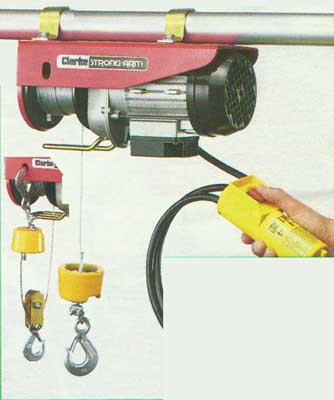 If you have a suitable frame or anchor point (maybe the prop and beam from the 'post' page) and you are no longer agile or fit enough to get yourself or your partner into position (or just can't be bothered), an ideal item is the electric hoist. The one shown adjacent can lift 250 Kg and 500Kg with the cable doubled. For this particular type I recommend the cable doubled. It seems to apply the load more evenly to the hoist and the resultant halving in speed is not a problem for this use, in fact the speed is adequately brisk. The mains cable and control cable are a little short, but an extension cord can solve the former. Sufficient information is provided that the competent can extend the control cable, providing adequate safety measures are observed, due to the mains voltages present there. Sometimes when the top 'stop' is activated the hoist does not respond to the next down command. This is usually rectified by applying load and issuing an 'up' command followed by 'down', to release the brake. The failure, if at all, seems to always be 'safe' as expected in a good design. This particular hoist has brackets for a 'tube' support only, but provided the same type and size of materials are used, it should be possible to fix to other supports. Other hoists sometimes have a built-in hook support instead of brackets.
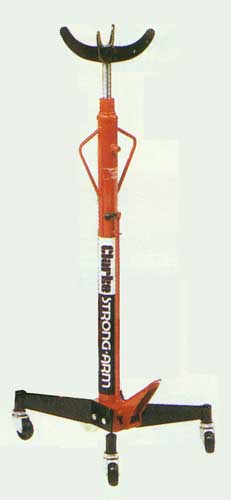 If you have need to raise something from beneath, one item of equipment worth considering is the transmission jack. This is a long-throw hydraulic piston, mounted vertically on a castored dolly. The four-pronged cradle is mounted loosely on the top and when removed reveals the flat bevel-edged top of the piston rod, awaiting the attachment of whatever comes to mind. The top of the piston is 1280mm high, and foot-pedal operation extends this by 7.5mm per action up to 1800mm in total. An initial accessory could be a bicycle seat, although the average bike seat-tube diameter is much smaller than the piston diameter. Your local metal shop or bike shop should be able to fashion a 'reducer' to cope with the differing diameters. If you want to raise other things, an adjustable head, with tilt, controls is available as an optional extra. This may not be suitable for what you have in mind, but is worth inspecting for the principles of connecting to the jack. There are some office chair tilting seat mechanisms that are readily convertable to be mounted on this jack. The jack is stable when little offset load is applied. It may be neccessary to add longer 'outriggers' to the existing base, if significant sideways load is expected. Testing the stability in the desired configuration is recommended before use, where your partner for some reason, may be unable to escape the assembly, should it topple.
 Get your own Free Home Page