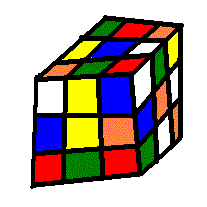
My method
OK, let's go straight, no introductions this time! I'm using the Lars Petrus method, but a little bit modified. I'm not going to describe Lars' method because it's not my invention and it's too big anyway. But I'll describe the difference between our methods.
After doing the 2x2x3, that is steps 1-2 (of Lars' method), you should normally go for step 3, i.e. twisting the bad edges. My method is so that you correct the permutation of the corners while you twist two edges, those edges being the last bad edges. So step 3a is to twist bad edges until there are two of them left, and step 3b is to twist these last two bad edges at the same time with permuting the corners.
There are two possibilities at the beginning of step 3. Either you have bad edges or you don't. If you have, then you twist them until there's two of them left (sometimes you may not need to do anything!) and then go to step 3b. If you don't have any bad edges you just go forward to step 4 and hope the corners are in the right position. I have an algorithm for permuting the corners without twisting the edges but it's as long as Lars' Niklas (7 moves), so it's your choice. You'll see below why it's better to go on to step 4.
(I hope the pictures are easy to understand. You see two faces in each picture, and those faces are F and R with their centers where the letters are. There is a "common column" i.e. the middle column which belongs to both sides. A cubie placed on that column is seen like the other cubies although really it has two facelets on the F and R faces. It's easier to understand this two-dimensional representation as you don't need anything but the position of the pieces, not their orientation. The U face is above the picture, the D face below.)
Step 3b
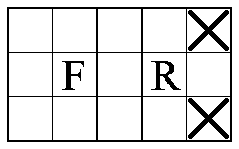 So now you've got two bad edges left. Since it's hard without a notation, suppose the two sides left are F and R
(when I'm cubing I hold the cube like the two sides are U and L -- I'm left-handed!--, but it's easier with
F and R). Bring the corners RBU and RBD in the RBU and RBD positions, not necessarily in their right positions, i.e. they may be
switched. Then find out which two corners you have to switch. Bring those corners to the FRU and FRD positions and apply one of
the switching algorithms.
So now you've got two bad edges left. Since it's hard without a notation, suppose the two sides left are F and R
(when I'm cubing I hold the cube like the two sides are U and L -- I'm left-handed!--, but it's easier with
F and R). Bring the corners RBU and RBD in the RBU and RBD positions, not necessarily in their right positions, i.e. they may be
switched. Then find out which two corners you have to switch. Bring those corners to the FRU and FRD positions and apply one of
the switching algorithms.
Now we see how you find the corners which have to be switched (if any). The basic rules for finding those corners are:
1. Switching two corners diagonally on the F face is equivalent to switching the RBU and RBD corners.
2. If RBU is in RBD and RBD is in RBU, then switching two adjacent (i.e. not diagonal) corners on the F face is equivalent to switching the other two corners on the F face with the RBU and RBD corners in their right positions.
3. If RBU is in RBD and RBD is in RBU and all the corners on F face are correct, then in order to solve the corners you need to switch RBU and RBD.
4. If RBU is in RBD and RBD is in RBU and you need to switch two corners diagonally on the F face to get the F corners correct, then this position is equivalent with the corners solved position.
Rule 3 is quite obvious, and rule 4 is equivalent to rule 1, but I think it's best that we have all rules here. They can be memorized fairly easy by making an analogy to the sign (+/-) multiplication in the following way: RBU and RBD in their correct positions equals +; RBU in RBD and RBD in RBU equals -; a corner position of the F corners on the F face equals + (*); same corner position but with two corners switched diagonally equals -. Now "multiply" or "combine" one of the first two statements with one of the other two statements (you should get a position of the corners on the F and R faces). The results are as follows: the corner position in statement (*) equals +; the same corner position with two diagonal corners switched equals -. It works!! (for example rule 1 means that minus equals minus; rule 4 means that minus times minus equals plus, and so on)
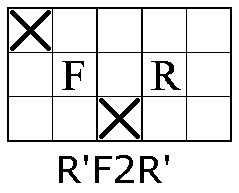 It's easy to bring the RBU and
RBD corners in the RBU and RBD positions, and it takes at most 3 moves.
For example if the corners are in the position in the figure you can do R'F2R' (or RFR2) and you're done.
It's easy to bring the RBU and
RBD corners in the RBU and RBD positions, and it takes at most 3 moves.
For example if the corners are in the position in the figure you can do R'F2R' (or RFR2) and you're done.
Next, find out what corners you have to switch (you may not need to switch any corners sometimes, precisely 1/6 of the time; this will be taken in consideration too). The rules for finding those corners are the 4 rules stated above, and they apply as follows: if RBU and RBD are in their correct positions and you need to switch corners C and D on the F face, switch them; if RBU and RBD are in their correct positions and corners C and D are diagonal, switch RBU and RBD; if RBU and RBD are switched and you need to switch (adjacent) C and D on the F face, switch the other two corners E and G of the F face; if RBU and RBD are switched and two diagonal corners on the F face need to be switched, the permutation of the corners is correct;if RBU and RBD are switched and C, D, E and G are in (relative) correct position, switch RBU and RBD (obvious!); if RBU and RBD are in their correct position and C, D, E and G are in (relative) correct position, the corner permutation is correct (double obvious!).
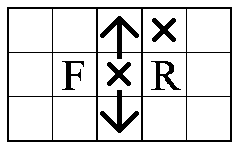
First suppose you have to switch some corners. After you've brought them in FRU and FRD positions, look where the two bad edges are. There are 21 possible positions, but many of them are symmetries, and we can ignore two symmetric positions since the corners to be switched are in the centre of symmetry of the system. Seen this way there are 8 positions. Depending on the position, apply one of the following algorithms (the X's are the bad edges):
 UF'U' |
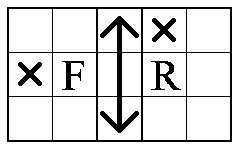 R2FR'U'R'U |
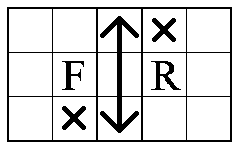 R2F2R'U'R'U |
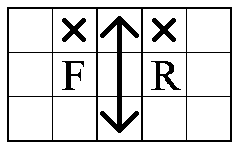 F'UFU' |
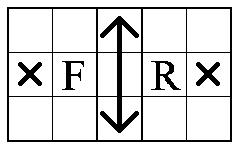 R'UF'U' |
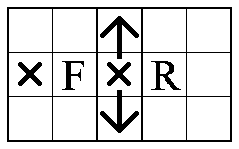 R2FR2U'RU |
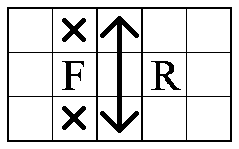 R2FRUFU' |
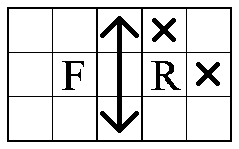 FR'UF'U' |
There are two exceptional situations: either the corners are correct but there are two bad edges, either the edges are correct but the corners are not.
If the corners are correct and there are two bad edges, bring the edges to one of the following positions and perform the adequate algorithm:
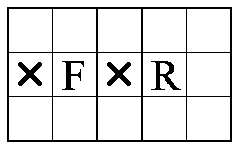 UFU'DR'D' |
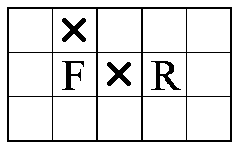 UF'U'FU'RU |
It takes at most one move to get the bad edges in one of these positions, so I think there's no need to give algorithms for every possible position.
If the edges are already correct, I advise you to go directly to step 4, as you need more moves to correct the corners than you need after step 4. Anyway, here's a move that switches two corners without twisting any edge:
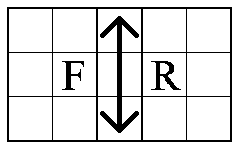 U'R'UFDR'D' |
After applying the algorithms, just go on to step 4, but be careful to turn only the same two sides! There are some algorithms for step 4b on Lars' page that move more sides, and at least some of them don't conserve the corner permutation. You can keep any of the two sides as the last layer, the corners are correct any way.
