
The melting point of a crystalline compound is best defined as the temperature at which the solid phase is in equilibrium with the liquid phase.
At the melting point sufficient heat has been applied so that thermal vibrations of the molecules in the crystal lattice are great enough to overcome the electrostatic, dipole, and van der Waals cohesive forces, allowing the molecules to take on the more random and mobile arrangement of the liquid state. The freezing point, or the temperature observed as the liquid form cools and solidifies, is the same temperature as the melting point.
Melting points are readily obtained with great precision using simple apparatus. It is the most widely determined and useful physical constants of organic compounds. Melting points are used both as
criteria of purity and as a clue to the identification of organic compounds. A narrow melting point range is indicative of a pure substance. It is a good generalization that, as a compound is purified, the melting points become sharper (range narrower) and higher. Since hundreds of organic compounds may have similar melting points, exact identities are difficult and risky, based only on simple melting point determinations; but at least the number of possibilities can be narrowed from the millions of known organic compounds.
Observed melting points are generally
recorded as a range of temperatures because of the rather large quantities of compounds used and the difficult in controlling the experimental variables in the usual methods for determining melting points. Only when one or two crystals of an extremely pure compound are melted on specially controlled hot stages and he observations conducted with the aid of high-powered magnifiers and/or polarized light are melting points observed as single temperatures. The temperatures recorded as the observed melting point range are the temperature at which there is a definite sign of liquid in the sample and the temperature at which there is nothing but liquid in the sample, e.g. 123.5-125.0oc. An apparent shrinking, slumping, or softening is often the first indication that something is about to happen as the melting point is approached but these changes should NOT Be mistaken for the first signs of liquid in the sample.
The melting point range (the interval between the beginning of liquifaction and complete liquifaction) is a valuable inaction of the purity of the substance. A pure crystalline organic compound generally possesses sharp melting point range a sharp melting point range, usually a 2o
Range or less provided a good technique is used. The melting point range is influenced not merely by the purity of the material but also by factors such as the size of the crystals, the amount of material, rate of heating, determination method, experimenter, etc.
In the most common methods of melting point determination, a small amount of finely powdered crystals is placed in a thin-walled capillary tube. The tube is placed in very close proximity to a thermometer and capillary tube is heated in a small electric block or oven or in a well-stirred oil bath. A finite time is necessary for the transfer of heat from the hot block or bath through the walls of the capillary tube and throughout the mass of the sample. If the block or bath is heated too rapidly, the temperature of the block or bath will rise several degrees. This time lag required for the melting process make the observed melting point range much larger than the true one. Likewise, too rapid heating will cause the thermometer reading to be lower than the actual block or bath temperature, because of the time required for heat transfer to the mercury. Consequently, the observed melting point range will generally be broader and lower than the actual melting point range if too rapid heating occurs.
Satisfactory results are obtainable if
a uniform rate of heating of no more than 10 or 20 rise per minute is employed in the vicinity of the melting point. The temperature may normally be raised rapidly until 10o or 15 o below the melting point with the rate of heating then being adjusted to the uniform rise of 1o to 2o per minute.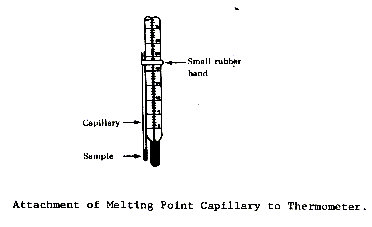
To minimize the lag in the melting process and heat transfer the compound should be finely ground and packed densely to a height of 2-5 mm in a fine capillary tube having a small diameter and very thin walls.
Two other sources of error in melting point determinations are
The surrounding atmosphere cools that portion of the mercury column that is exposed above the surface of the heating bath of block. The registered temperature is, therefore, below the true temperature of the mercury in the bulb of the thermometer and of the sample in the capillary tube. For temperatures below 100o this cooling effect does not cause any considerable error, but for high temperatures the observed reading maybe several degrees lower than the true temperature.
Melting points of organic compounds are usually markedly influenced by the presence of even small amounts of miscible or even partially miscible impurities. These impurities normally depress the melting point and broaden the range. This lowering and broadening of the melting point range is presumably caused by the molecules of the impurity interrupting the uniform structure of the crystal lattice of the organic compound. It weakens the crystal lattice. These facts may be used to establish the identity of organic compounds by determining the melting points or mixtures, a method commonly referred to as “mixed melting points.”
Mixed melting points
Two sample of the same compound, having the same melting point separately, should have the same melting point when they are mixed together. Also, in general, sample of two different compounds having the same or similar melting points separately, will act towards each other same or similar melting points separately, will act towards each other as impurities when they are mixed together; hence, such mixtures will have broadened and depressed melting point ranges. Identification of a solid unknown by mixed melting points is remarkably reliable when an authentic specimen is available.
A broadened melting point range may be due not only to impurities present in the original sample but also may result from the pure substance undergoing some decomposition before or during the melting. In some instances the material undergoes a slight softening or contraction (sintering) at a temperature below the true melting point; in others, the material may become discolored slightly; and in still others, the substance may decompose completely and turn black so that a definite melting point cannot be ascertained. The behavior of substance on melting should be observed closely and recorded in the lab-book.
Each time a melting point is determined or rechecked a fresh sample should be placed in a new capillary since even slight, undetected decomposition may cause a false reading if the old sample is remelted.
Broadened and depressed melting point ranges are also frequently obtained if the sample is not completely dry. It is because the sample is wet with water or some other solvent used in the purification of the compound. In stead of melting, wet compounds merely dissolve in the solvent present as heat is applied. If the compound “dances around”
or there are bubbles in the melt, a wet compound should be suspected.
Observe melting points should be compared with literature melting points for the compound with both the observed melting point and the literature melting point, including the complete reference as to where it was located in the literature, should be recorded in the lab-book. Experimentally observed melting points will normally match literature melting points within two degrees, with the observed melting points generally on the low side since literature melting points as a rule are reported on compounds of very high purity. Variations in literature melting points from one reference to another for the same compound are encountered frequently. It is due to differences in purity of the samples.
 PLEASE click the Friendly Links below 《友善連結》