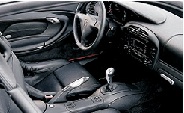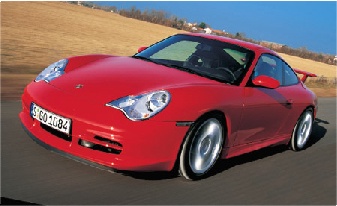
2004 PORSCHE 911 GT3
As penance for building a sport-ute, Porsche produces a stunning kiss-and-make-up
gift.
BY LARRY WEBSTER
June 2003
With a spring arrival of the 2004 Porsche 911 GT3—and the introduction
of the outrageous Carrera GT supercar later this year, Porsche is reasserting
its position as a premier sports-car builder. Could this year's offerings
be penance for its Cayenne sport-ute? Maybe not, but the GT3 is a 911 to brag
about, a naturally aspirated, 375-hp version of the $183,765 twin-turbocharged,
456-hp Porsche 911 GT2. It will sell for about $84,000 less than the GT2—figure
an even $100,000—and will fill the rather wide performance and price
gap that existed between the $82,565 911 Carrera 4S and the $118,265 911 Turbo.
Now there's a vast array of 911 models, from the base $69,365 Carrera to the
extravagant GT2.
The GT2 was and is Porsche's response to those who suggest that the 911 Turbo
is a soulless high-speed appliance. On Porsche's scales the GT2 weighs about
220 pounds less than the Turbo because it doesn't have the Turbo's four-wheel-drive
system. It also makes more horsepower (456 versus 415).
Likewise, the GT3 is the hairiest of the non-turbo 911s. It packs 60 more
horsepower—for a total of 375—and, no surprise, has a suspension
tuned more for racetrack driving dynamics than on-road comfort. It's also
the first GT3 street car offered in the U.S.
The previous Porsche GT3, introduced at the Geneva show in 1999, wasn't sold
in the U.S. Its intended mission: Satisfy the homologation rule required to
race in the Le Mans GT class that says an automaker must sell at least 500
production versions of the car it is going to race. So Porsche cooked up a
higher-performance 911 and called it the GT3. Porsche easily met the 500-car
minimum and in fact built 1856 of them.
There wasn't a homologation requirement to fulfill this year, so the GT3 is
simply another model in the 911 range. The main difference between the GT3
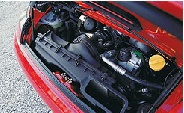
and lesser 911s is the engine. Standard 911s use a two-piece engine block
split down the center line of the crankcase. On the GT3, Turbo, and GT2 models,
the split-crankcase parts are cast separately and bolted to the two blocks
of three cylinders per bank, a design that was originally developed specifically
for racing applications.
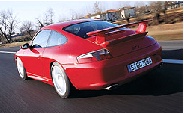
The benefit of this design is that it's stiffer and can accommodate higher
power levels. The removable cylinders, Porsche says, also allow for easy displacement
modifications to accommodate ever-changing racing rules. The GT3 shares its
3600cc displacement with the 911 Turbo and GT2 (regular 911s are 4cc smaller,
derived from a smaller bore and longer stroke).
The GT3 is the highest-revving of any 911 because it has the lightest engine
internals. The redline on the tachometer is 8200 rpm for the GT3, 7300 for
a base Carrera, and 6750 for the Turbo and GT2. Compared with the 911 Carrera,
the GT3 uses titanium connecting rods that are 0.09 inch longer, shorter pistons,
and shorter hydraulic valve tappets. Porsche says that by using the lighter
pieces, it could also remove the crankshaft vibration damper, saving 4.4 pounds.
Even though Porsche included its variable-valve-timing system to smooth out
the power band, the 375-hp power peak occurs high in the rev range—at
7400 rpm—and the torque peak of 284 pound-feet is at 5000 rpm.
The six-speed manual transmission—the only gearbox offered—received
new internals as well. Fourth and fifth gears are shorter, and the top four
gears use steel rather than brass synchros for greater durability. Finally,
there's a transmission-oil cooler.
So, is the GT3 a shark swimming in the 911 school? Absolutely, but we'll have
to temper that praise with two caveats. First, the good stuff.
The GT3 shares its suspension with the GT2, so its handling is equally crisp,
lively, and taut. Compared with a base Carrera, the GT3 is a lot better balanced,
not so afflicted with incessant understeer, and it's much easier to use the
rear end to change direction.
The brakes, like those on all 911s, are phenomenal. The standard GT3 brakes
use 13.8-inch front and 13.0-inch rear steel rotors. Porsche's lightweight
ceramic composite rotors, standard on the GT2, are optional on the GT3.
Our favorite part, however, is the engine. Its deep-throated wail is the most
enthralling and mesmerizing Porsche soundtrack we've heard since 1998, when
the 911 started using water-cooled engines. It does its best work over 4000
rpm—pulling harder and more urgently as the revs climb. The Turbo and
the GT2 may be more powerful, but the GT3 feels just as quick, a perception
backed up by our test results.
The GT2 rips to 60 mph in 3.8 seconds. During a preliminary test performed
at the GT3's introduction in Venice, Italy, the GT3 hit 60 in four seconds
flat and blew through the quarter-mile in 12.3 seconds at 118 mph. (The GT2
turns the quarter in 12 seconds flat at 121 mph and the Turbo at 12.3 seconds
at 116 mph). When we eventually test a GT3 on the high-traction straight of
our regular testing venue, we think it will prove even quicker.
Now for those caveats. The first one has to do with the stiff ride—too
stiff for anyone who isn't surrounded by smoothly paved roads. We didn't encounter
many bumps on our Italian adventure, but we felt every one we did. We know
we're a little sensitive to ride quality because we live in an area where
the miserable roads are better suited to Baja trucks than cars, but if you
want to use your 911 every day, the GT3 probably isn't the 911 for you. We
didn't get a chance to drive one on a racetrack, but that is obviously where
the car will feel most at home.
And then there's the issue of choice. Think of the 405-hp Corvette Z06, a
car that is certainly close in speed—if not faster—but is an incredible
bargain at just $52,095.
We don't expect a Porsche to be a value leader. We do, however, expect the
750 GT3s that will come to our shores to find their way into very enthusiastic
hands.