
CY
1998 IMPLEMENTATION PLAN
PHILIPPINE POPULATION
MANAGEMENT PROGRAM
Table of Contents
Part 1 -- BACKGROUND
Introduction
Program Framework
Program Components
Gaps and Challenges
Part
2 -- PROGRAM CONCERNS
IN 1998
Political Commitment
and Policy Reform
Skills Development
Data Management
Part
3 -- 1998
PROGRAM GOAL AND OBJECTIVES
Program Goal
General and Specific Objectives
Part 4 -- MAJOR PROGRAM
TASKS
Population Planning
Policy Formulation and Analysis
Advocacy
Modeling and Development Frameworks
Monitoring and Evaluation
Resource Generation and Mobilization
Technical Assistance
Part 5 -- SPECIFIC
ACTIVITIES
Advocacy
Information, Education, Communication
Institutional Capability Building
Research, Database Development and Evaluation
Service Delivery
Institutional Support Mechanism
Resource Generation and Mobilization for Program
Institutionalization
Part 6 -- INSTITUTIONAL
ROLES
Coordinative
Mechanisms
Introduction
With the approval of the 1998-2003 Directional Plan of the Philippine Population Management Program (PPMP) on July 23, 1997, the Commission on Population (POPCOM) assumed responsibility for coordinating the preparation of the Directional Plan's 1998 Implementation Plan.
The process began with the formulation of guidelines for drafting the implementation plan. Adopting a bottom-to-top planning approach, POPCOM enumerated and prioritized desired inputs from local government units (LGUs), nongovernment organizations (NGOs) and regional partner agencies (PAs). Every region was required to prepare and submit regional population plans. The bottom-to-top approach recognizes the strategic role that local institutions play in the PPMP. Following the mandate for devolution and stronger local autonomy set by the Local Government Code of 1991, the PPMP recognizes local government units as vital program partners and implementors.
POPCOM central office conducted two major national-level consultations. First, POPCOM held a meeting of partner agencies. Its purpose was to facilitate coordination and clarify roles, functions and other institutional arrangements. Second, POPCOM convened an assembly of partner NGOs to define areas for collaboration and the potential roles of NGOs in the program. It was agreed at these consultations that action plans would be submitted to POPCOM for incorporation in the implementation plan.
Consultations also were conducted at the regional level. These drew the participation of partner agencies, local government units and non-government organizations. It was during these consultations that important inputs for the drafting of regional population plans were provided. Preliminary versions of regional population plans were discussed and endorsed in follow-up meetings. The regional population plans were then presented to either Regional Development Councils (RDCs) or Regional Population Executive Boards (RPEBs) for further endorsement.
POPCOM central office consolidated the various regional plans, and the inputs from national partner agencies, NGOs and the different divisions of POPCOM central office. Based on this consolidation, preliminary drafts of implementation plans were prepared for the five PPMP component programs.
An ad hoc committee facilitated a workshop where the implementation plan was further developed. Members of the ad hoc committee were chosen from the POPCOM executive staff and the regional directors. The working draft was presented to members of the PPMP's Committee on Policy and Advocacy, as well as to other experts for comments and guidance. Subsequently, the working draft of the 1998 implementation plan was presented to POPCOM senior management at a conference convened for the purpose.
As a final step, this working draft will be presented to the POPCOM Board for approval.
Program Framework
The PPMP seeks development harmony through an empowered population. The PPMP follows a conceptual framework that sets, as an ideal, a balance among (a) population growth and distribution; (b) human, fiscal and economic resources; and (c) environmental conditions. The framework recognizes that population leaves a footprint on both the country's resource base and its environment. At the same time, the utilization of resources and the state of the environment impacts significantly on the quality of the population. It is by having a dynamic harmony between population, resources and the environment that the Philippines can achieve sustainable development. The PPMP refers to this as the Population-Resources-Environment or P-R-E framework
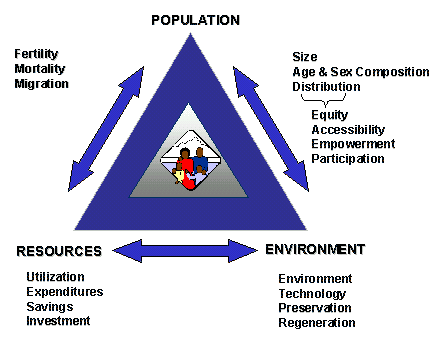
FIGURE 1
The PPMP also maintains an expanded framework that shows how reproductive health and gender come into play within the P-R-E framework (Figure 2). Mainly, this second framework depicts those enabling conditions (i.e., economic, political, socio-cultural, and physical/environmental) that "empower" the population: -- that, in other words, transform the population into a positive force of development.
The framework shows that individual men and women (to include adolescents, young adults, couples and families) are empowered when they can: participate in all decisions affecting their lives, gain equal access to resources and the benefits of development, and achieve their reproductive goals. The PPMP holds that this empowerment process becomes complete only if gender and reproductive health interests are promoted. Individuals thus empowered, result in a population able to exist harmoniously with available resources and the environment.
The P-R-E framework is in step with the international population and development community. Its major themes are consistent with policy recommendations promoted by landmark international gatherings on population and development. Among these gatherings are:
- 1984 International Conference on Population, Mexico City. The recommendations for the "Further Implementation of the Plan of Action of the International Conference on Population" stated that "Governments should take population trends fully into account when formulating their development plans and programmes."
- 1992 United Nations Conference on Environment and Development in Rio de Janeiro produced Philippine Agenda 21 which serves as the blueprint for sustainable development in the 21st century. The Philippine Agenda 21 recognizes population management as a key to human and ecological security and sustainable development.
- 1994 International Conference on Population and Development in Cairo spelled out policy directions for population programs in the next decade, underscoring the need for population, resources and environment balance, gender equality and women empowerment, and meeting the reproductive health needs of men and women.
- 1995 World Summit on Social Development in Copenhagen reinforced the policy directions set forth in the Cairo conference and underscored the need for poverty alleviation.
- 1996 Habitat II in Turkey recognized population growth, age and sex composition, density and distribution as important considerations in the development of sustainable human settlements.
- 1996 Asia-Pacific Economic Cooperation Summit in Manila affirmed the factoring in of population dimensions as essential to attaining economic prosperity and sustainable development.
The P-R-E framework operates in the context of national development goals. In particular, it subscribes to the process of devolution and stronger local autonomy ushered in by Republic Act No. 7160, the Local Government Code of 1991. One of the most important legislative measures affecting Philippine governance, the Code moved development decision-making and administration from the national government to local government units. It has made local governments the focal point of development action and placed them on the frontline of the country's quest for sustainable development.
With devolution, the various government and non-government institutions at the national and regional levels provide general direction, technical guidance and resource assistance to LGUs. Accordingly, POPCOM positions itself as an over-all coordinating body responsible for policy recommendation and monitoring, plan formulation, standards setting and resource allocation for local governments.
POPCOM sees its contribution as influencing both national and local levels of governance so that there is adequate integration of population factors (such as fertility, mortality and migration) into development decision-making. This has been translated into program goals that deal with demographic outcomes, the level and extent of P-R-E integration, and the resulting improvements in quality of life.
More specific interventions have been formulated under each of the five program components. These interventions are directed at institutions and groups that provide direct services or support to the Program; key influentials or gatekeepers whose endorsement and active support are necessary for the services to effectively reach the target beneficiaries; and, to some degree, the general public, particularly with regard to the Program's IEC messages.
Following the supplementary framework to the P-R-E, these interventions are designed to reinforce those enabling conditions that will empower individuals to lead self-determined, productive, satisfying and fulfilled lives through informed decisions on when to marry, when to have children, where to live, and the like. These decisions eventually help to determine the rate of population growth and distribution, and -- in consequence -- the kind of balance formed among demographic factors, resource availability and utilization, and the environment's carrying capacity.
Program Components
The PPMP's five program components are: (a) Population and Development Integration; (b) Gender Equality and Women Empowerment; (c) Reproductive Health and Family Planning; (d) Adolescent Health and Youth Development; and (e) Migration and Urbanization. These program components, which will be carried out within the Directional Plan period (1998-2003), are described as follows:
- Population and Development Integration. The PPMP shall actively pursue integrated population and development planning. This is the explicit and conscious consideration of population and environment concerns in the formulation of plans, policies and programs at all levels of government and across all sectors of development. POPDEV integration at the LGU level is critical since LGUs now assume greater responsibilities for implementing development programs and providing essential services to the people. The Program will ensure that responsive policies are formulated addressing the socio-economic, demographic and environmental concerns at the local level.
- Gender Equality and Women Empowerment. The PPMP shall contribute to fostering those socioeconomic, cultural, political and environmental conditions that women and men need to participate in decision-making, including the exercise of their reproductive rights. For women, especially, these conditions can be achieved by empowering them so that they can gain access to resources like education and employment, and participate in community and political organizations.
The Program will also advance the promotion of shared responsibility particularly on fertility management, including men's active participation and involvement in all areas of family and household responsibilities - in housework, and in child-rearing or childcare.
- Adolescent Health and Youth Development. The PPMP shall support the promotion of the total well-being of adolescents and the youth. This is done through the formation, internalization and practice of proper values related to their reproductive and sexual health. The aim is to prepare them for making responsible decisions as they grow into adulthood. The Program will contribute in addressing issues among the youth and adolescent like reducing incidence of early pregnancy through the promotion of delayed marriage, responsible adulthood or responsible sexuality and responsible parenthood as well as in reducing incidence of sexually transmitted diseases including HIV/AIDS, abortion and other health risks through the provision of quality care services, information and education.
- The PPMP will also endeavor to pursue programs that help the young to: gain access to and control of the resources they need to realize their potential; develop their capabilities; and, enhance their participation in political and social processes to prepare them for leadership roles.
- Reproductive Health and Family Planning. The PPMP shall assist couples and individuals achieve their reproductive goals. The PPMP adopts a reproductive health approach to family planning. It recognizes reproductive health as a vital element of the total well-being of every woman and man, affecting the health not only of the person but also of future generations. As such, population policies and programs, including those of the country's family planning program, should go beyond reducing the population growth rate. They should foster enabling conditions that will allow women and men to take control of their reproductive health based on informed choice, and pursue socioeconomic opportunities.
- The PPMP in this regard, shall advance the campaign for universal access to and availability of RH/FP quality care information and services to reduce unmet need for contraception, high risk births, early pregnancy and other pregnancy-related diseases, abortion, including prevention and cure for STDs and HIV/AIDS, and other health diseases.
- Migration and Urbanization. The PPMP shall promote population- and environment-sensitive management of human settlements. The PPMP's action agenda is to encourage a more spatially balanced distribution of the population by establishing mechanisms to monitor population movements/ migration patterns and magnitude and pacing of population density as well as manage urban growth through resource-conscious planning.
- The Program shall also endeavor to create awareness and appreciation of the impact of migration on human and ecological security.
Gaps and Challenges
To achieve its objectives, the PPMP must be part of the national effort to address major socioeconomic challenges -- challenges that reflect the complex interrelationships among population, resources and the environment. These include the following:
- Reducing the incidence of poverty;
- Reducing environmental degradation;
- Slowing the growth of human settlements;
- Reducing the unmet need for contraception;
- Developing more responsible reproductive behavior among adolescents and youth;
- Increasing opportunities for education and human resource development; and
- Reducing inequalities in gender relations.
The PPMP also recognizes the need to address certain concerns in program implementation in order to contribute significantly to the effort of meeting these challenges.
PART 2 - PROGRAM CONCERNS IN 1998
Political Commitment and Policy Reform
An important factor is a high degree of commitment from national and local leaders to apply the P-R-E framework in decision-making. This requires an effective advocacy campaign and greater investments in information, education and communication (IEC). Political commitment is particularly crucial in ensuring that necessary policy reforms are made. Specifically, policy reform is needed so that national and local decision-makers will:
- Consider population factors when developing socioeconomic plans;
- Understand and accept the reproductive health approach to family planning (although many government organizations and NGOs already address this issue, there is still no consensus on what the approach means);
- Responsibly educate adolescents and youth on sexuality and reproductive behavior and ensure that PPMP initiatives under the adolescent program are comprehensive and integrated;
- Develop a well-defined urban development agenda to guide migration flows (current migration and urbanization patterns continue to result in adverse consequences for both migrants and the urban centers that receive them); and
- Achieve substantial gender equity and women empowerment in development plans, since sustainable development requires the full, equal participation of men and women.
Skills Development
Advocacy and IEC need to be accompanied by an upgrading of the technical knowledge and competencies of decision-makers. Program planners and managers continue to lack the skills to apply the P-R-E framework in the formulation of development plans. In particular, this seems to be the case for those involved in planning for local governments and defined sectors of the population. The priority for POPCOM is to effectively transfer expertise to planners working at these levels. Other areas where skills development is needed include: managing or rationalizing urban development, managing youth development (for counselors, teachers and other professionals working with the youth sector), and population, gender and reproductive health integration.
Data Management
There remains a lack of appropriately dis-aggregated data and indicators crucial to the various program components of the PPMP. At the local level, there is an urgent need to install functional community-based management information systems to facilitate retrieval and analysis of complete, accurate and timely data needed for local planning.
In responding to these needs of the program, it is important for program actors to discern when and how to intervene in order to achieve desired outcomes.
PART 3 - 1998 PROGRAM GOAL AND OBJECTIVES
Program Goal
The overall development goal of the Philippine government is to achieve a better quality of life for every Filipino. For the PPMP, quality of life is achieved through a balance among population growth and distribution, the country's available resources and its environment situation. Promoting this balance requires that women and men have a sustained capacity to live self-determined, productive and fulfilled lives. Achieving this P-R-E balance/harmony promotes the country's quest for sustainable national development.
General and Specific Objectives
To integrate vital population including gender and reproductive health factors, issues and concerns into socio-economic development and environmental policies, programs and plans.
Specifically, the Program will endeavor to:
- Enhance the capability of 576 local planners and program workers in development planning using the POPDEV approach;
- Secure the commitment and support of 32 local chief executives and local legislative councils (Sanggunians) to integrate the POPDEV approach in the formulation of their respective development policies and programs;
- Integrate POPDEV indicators system in 32 pilot areas at the local government unit level; and
- Promote POPDEV approach in 80 percent or 114 LGUs by increasing their awareness on the relevance of this approach to local development planning.
To improve the over-all status of women and enable women to gain equal rights and access to opportunities with men.
Specifically, the Program aims to:
- Create an environment to enable 80 percent of the country's population policymakers, influentials, planners, implementors to adequately address prevalent gender inequalities and women issues and concerns through the formulation of gender-responsive policies, programs and plans;
- Create an environment to empower and mobilize women and men on population and development activities to achieve their reproductive health intentions; and
- Integrate gender and development and reproductive health concerns in all the components of the PPMP for the succeeding years within the Plan period and beyond.
To assist couples and individuals in meeting their reproductive goals within a framework that promotes overall health, responsibility and well being.
Specifically, the Program will pursue the following:
- Create awareness and appreciation of the reproductive health and gender concepts, key issues and concerns through advocacy and information, education and communication (IEC) among eighty percent of the total LGUs;
- Conduct of institutional capability building among health workers, medical practitioners, program workers of participating agencies and local government units on integrated RH/FP/Gender approach;
- Conduct of research undertakings on integrated RH/FP/Gender/ population issues and concerns;
- Putting in place and strengthen coordinative mechanisms, planning, monitoring and evaluation and delivery of integrated RH/FP quality care services; and
- Promote and sustain the provision of RH/FP services by increasing government financing as well as expanding the role of non-government organizations and the private sector in implementing contraceptive social marketing in more areas;
To address adolescent health and development issues of youth and help them prepare for responsible adulthood.
Specific objectives of the Program are to:
- Create awareness on adolescent health and youth development issues and concerns among policymakers, influentials and program managers through advocacy and IEC activities;
- Institutionalize efforts to build the capability of program workers and youth volunteers on adolescent health, sexuality, responsible adulthood, responsible parenthood, peer counseling and information services, population education, fertility management, family life education, value formation programs;
- Strengthen mechanisms to mobilize youth for population and development activities;
- Ensure the provision of service delivery that will respond or cater to the needs of youth and adolescents;
- Develop innovative approaches and conduct of research undertakings on adolescent health and youth development; and
- Provide technical and funding assistance to adolescent and youth development programs.
To promote gender- and population-sensitive approaches to environmental management, as well as the management of sustainable urban human settlements. Specifically, the Program will endeavor to:
- Provide technical assistance to four LGUs as convergence areas and 14 participating line agencies in managing urban human settlements;
- Develop an up-to-date database system on urbanization and migration at the national level; and
- Strengthen advocacy among national and local officials to enhance their understanding and consciousness of the impact of unsustainable urban human settlements.
POPCOM is the lead coordinating body of the Program. With the collaboration and active involvement of participating agencies at the national, regional and local levels, POPCOM will cause the following major program tasks to be carried out:
Population Planning
POPCOM will coordinate with participating GOs/NGOs/LGUs in the formulation of the long-term, medium-term, and annual plans of the PPMP. POPCOM and PAs will define the vision, objectives, strategies and the activities of the program for a given planning period. Both lateral and bottom-up approaches of planning will be employed where partner agencies in the program and local government units are actively involved. Guidelines to the population planning process will be provided, starting from the local government units, to the regions and to the national level.
As a support to Program sectors, POPCOM will ensure the expansion and proper management of its database. This means improving its information technology and providing success indicators to the program. POPCOM will further ensure that relevant research activities to improve program strategies are undertaken.
Policy Formulation and Analysis
At the Board of Commissioners level, POPCOM formulates policies designed to ensure the effectiveness and success of the PPMP. In conjunction with other government agencies participating in the PPMP, it formulates policies in order to provide direction to these agencies. Existing policies will be regularly reviewed. Moreover, relevant issues in relation to population and development, gender, reproductive health, adolescent health, migration and urbanization needing policy action will be identified through research undertakings. The research findings will be widely disseminated to appropriate audiences to either formulate their own policies or influence other agencies to formulate policies to address problems that are encountered in the implementation of the PPMP. Essentially, recommendation for new policies for national, regional, and local bodies will likewise be proposed to provide guidance in the implementation of the PPMP.
Advocacy
POPCOM, with participation of concerned agencies, will advocate for the creation of a supportive environment that strengthens the commitment of GOs/ NGOs/LGUs to the PPMP, and influences national and local government policymakers to increase funding support to the PPMP.
Modeling and Development of Frameworks
Models and frameworks will be developed to provide blueprints and direction to program workers on how to determine whether Program's objectives are achieved based on the various projects and activities that are undertaken. The modeling of training modules, operations research and pilot-testing of innovative projects as well as development of prototype IEC materials will be employed to some extent to come up with frameworks for implementation of projects or programs by participating agencies.
Process documentation, which is an important element, will be utilized in the modeling development and framework formulation. This includes recording the whole process undertaken through projects so that success factors can be identified and be replicated in other areas, taking into consideration the difficulties encountered.
The development of innovative strategies for implementing the PPMP will be considered, particularly in the identification of model areas.
Monitoring and Evaluation
A monitoring and evaluation plan of the five-year PPMP Directional Plan will be developed. It will contain the five objectives of the PPMP Directional Plan, the indicators and their data sources. Monitoring and evaluation plan will be periodically reviewed and updated when necessary.
The M & E Plan will have a systematic access to information to determine the progress and impact of program implementation. A Management Information System will be installed and maintained which will take into consideration three vital questions:
- Are program activities being implemented as planned, on schedule and within budget?
- Are these activities leading to expected results (e.g., increased capabilities in planning through training, utilization of services by clients, changes in behavior patterns, etc.)?
- What are the problems encountered which cause delays or unexpected/unfavorable results?
A monitoring instrument will be developed to look at the activities listed in each strategy of the plan. An outcome is listed for each activity. There will be an indicator for each outcome, to determine whether or not the particular outcome has been realized. The monitoring tool will track down the progress of project/ activity implementation. Whenever necessary, changes will be recommended to produce favorable results.
An evaluation instrument will be developed to look at program activities in relation to program objectives. This instrument will determine the strengths, weaknesses and potentials of the program. Program implementation should be undertaken with an explicit consciousness of the evaluation instrument since this is how program managers can determine whether the program objectives are being met. Program evaluation will be conducted every six months.
Consultations will be conducted at the national, regional and local levels. At the national level, evaluation results will be presented to partner government agencies and NGOs for assessment and discussion. At the regional level, evaluation results will be presented for discussion by the regional population executive board. At the local level, the local population coordinating committee will be used as a forum to assessing the local application of the program.
Resource Generation and Mobilization for Program Institutionalization
One of the strategies of POPCOM is to sustain the Pledges of Commitment of the partner agencies so that they will allocate budgets for population-related projects, programs and activities. It will also venture into advocacy mobilization efforts for the passage of resolutions or ordinances among LGUs for the provision of funds for said activities. POPCOM will continue negotiating with donor agencies for financial assistance. Mechanisms or systems will be employed for ensuring sustainability of financing.
Technical Assistance
Technical assistance -- the provision of technical expertise in planning, monitoring, advocacy, policy analysis and formulation and in all other aspects of PPMP implementation -- will be provided to national and local government agencies so that they can fulfill their roles in the Program. In so doing, POPCOM will vigorously promote its human resource development/capability building program.
The following are crucial activities of the Program that will be implemented in 1998 in cooperation/involvement of various partner and participating agencies at all levels:
Advocacy
Information, Education, Communication (IEC)
Institutional Capability Building
Research, Database Development and Evaluation
Service Delivery
Institutional Support Mechanism
Resource Generation and Mobilization for Program Institutionalization
All government agencies have been enjoined to integrate population dynamics and the PPMP's component program areas into their respective programs. With devolution, local government units now assume a greater responsibility and accountability in implementing development programs and providing essential services to the people. The national government agencies are now responsible for providing policy guidelines, standards, and technical assistance to LGUs in implementing an integrated, comprehensive and holistic development program. Non-government organizations and people's organizations also play vital roles as links to the people.
POPCOM is governed by a Board of Commissioners, composed of the Secretaries of ten (10) Departments. These are:
- National Economic Development Authority (NEDA) -- chair
- Department of Health (DOH) -- co-chair
- Department of Interior and Local Government (DILG)
- Department of Social Welfare and Development (DSWD)
- Department of Education, Culture and Sports (DECS)
- Department of Agriculture (DA)
- Department of Agrarian Reform (DAR)
- Department of Labor and Employment (DOLE)
- Department of Trade and Industry (DTI)
- Department of Public Works and Highways (DPWH)
Also members are the director of the University of the Philippines Population Institute (UPPI), and three Private Sector representatives who are appointed by the President.
The Board sets the PPMP policies and directions that guide participating agencies in integrating population and development concerns, and strengthening the visibility of gender and reproductive health, migration and urbanization, and adolescent health concerns in their respective policies and programs.
ROLES OF VARIOUS AGENCIES IN THE PPMP
Commission on Population (POPCOM)
- Orchestrates and monitors the contributions and performance of participating agencies at all administrative levels on the explicit considerations of population and development interrelationships including gender and reproductive health;
- POPCOM Central Office coordinates activities at the national level while 15 regional offices coordinates and provides technical assistance on coordinating, planning, monitoring and evaluation of the Program at regional and local levels;
- Reviews existing policies and makes recommendations to ensure that these become POPDEV and GAD sensitive;
- Advocates explicit consideration of population and development interrelationships in policy formulation and planning process; and
- Responsible for consolidating program efforts in the promotion of total well-being of the youth and reduction of the incidence of RH problems.
National Economic and Development Authority (NEDA)
- Ensures that all government agencies and LGUs incorporate PPMP perspective in the development process:
- Reviews current national, regional and sectoral plans and assesses whether population concerns have been adequately integrated in the development of framework, and in the policies and strategies identified in these plans;
- Formulates composite indicators of socio-economic and demographic development, in addition to conventional plan targets or indicators that serve as parameters for monitoring plan implementation; and
- Ensures that the criteria for project evaluation are consistent and supportive of the POPDEV objectives of the plan when identifying priority programs and projects.
- Provides technical assistance on integrated POPDEV planning.
Department of Health (DOH)
- Explicitly considers POPDEV framework on Health in prioritizing health care services, maternal and child health programs and family planning;
- Leads in providing structural and functional adjustments required of integrated RH/FP service delivery;
- Sets policies/guidelines/standards/frameworks/procedures for RH/FP as part of public health policy of PPMP. Said policies are also endorsed by the POPCOM Board for adoption;
- Lead agency for family planning wherein the target focus are women of reproductive ages both young and adult;
- Develops IEC materials and provides training on RH/FP counseling and services, including contraceptives and other logistics; and
- Provides assistance in service delivery among local government units' workers.
Department of Interior and Local Government (DILG)
- Provides support for policy formulation and coordination with LGUs to ensure institutionalization of POPDEV integration in local development planning process and in the integrated capability building program of the Local Government Academy;
- Monitors the Presidential directive allotting 20% of 20% of development fund to Human and Ecological Security-related programs/activities which give emphasis on population issues and concerns;
- Monitors the creation and maintenance of population offices at the LGU;
- Mobilizes local planners for gender-sensitive POPDEV Planning; and
- Ensures that each LGU will provide basic services to include family planning.
Department of Social Welfare and Development (DSWD)
- Integrates population and sustainable development, gender and reproductive health concepts/issues in responsible parenthood, responsible adulthood, population awareness and family life orientation programs and in the comprehensive and integrated delivery of social services under the Social Reform Agenda (SRA), the Kabuhayan Program, etc.;
- Intensifies responsible parenthood and pre-marriage counseling services using the total family approach concept, in partnership with DOH and other roles;
- Responsible for providing interventions/opportunities that aim to uplift the living conditions of the distressed and disadvantaged child and youth population of the country;
- Ensures that family planning is included as one of the minimum basic needs indicators used in monitoring the changes in the levels of well-being among poor families; and
- Responsible for referring identified indigent families to public hospitals.
Department of Education, Culture and Sports (DECS)
- Incorporates POPDEV, gender and RH concepts/concerns in Population Education Curriculum for formal and non-formal education;
- Encourages formal, non-formal and indigenous learning systems as well as self-learning, independent and out-of-school youth study programs;
- Fully institutionalizes PopEd Program intended for In-School Youth in all levels of formal education; and
- Develops core messages on population education and integrates POPEd concepts in textbooks.
Department of Agriculture (DA)
- Integrates and institutionalizes POPDEV, gender and RH concerns in their existing training program for agricultural extension and other workers;
- Includes referral system for family planning services provided by agricultural extension and other workers; and
- Organizes rural out of school youth ages 10-24 and provides them venues for involvement through individual, group and community projects that would prepare and develop them to assume the role as partners in agricultural activity.
Department of Agrarian Reform (DAR)
- Implements POPDEV, GAD Programs in activities in Agrarian Reform Communities;
- Establishes human settlement areas including those for coastal and upland migrants; and
- Strengthens agricultural land tenure improvement projects to minimize out-migration.
Department of Labor and Employment (DOLE)
- Integrates POPDEV/GAD/RH concerns in Collective Bargaining Agreements (CBA), Industry-based Family Welfare Programs, Programs for Women and Youth;
- Explicitly considers POPDEV interrelationships in the labor sector in identifying priorities and implementing plans and programs;
- Provides population and FP services to Filipino workers and their spouses in different business firms and commercial establishments which employ 200 or more workers;
- Exercises overall technical supervision, implementation and monitoring of projects and activities of the working youth in the regions;
- Promotes RH as component of family welfare programs; and
- Oversees the welfare/concerns of overseas Filipino workers.
Department of Environment and Natural Resources (DENR)
Responsible for the environment part of the PRE equation:
- Ensures that all environment policies, planning, Environmental Impact Assessments (EIAs) have taken population factors into consideration;
- Undertakes population-environment IEC Program which aims to heighten awareness of grassroots communities on the close interrelationships of population, resources and environment and family planning;
- Enriches implementation of Community based Forestry Management Program/Forestry Coastal Program with Population-Development-Environment (PDE) interrelationships;
- Responsible for the implementation of PDE component in EIA;
- Leads in the integration of population and development variables in environmental impact assessment (EIA), community-based forestry management program (CBFMP) and forestry coastal program; and
- Promotes reproductive and environmental health as twin conditions for sustainable development.
Department of Trade and Industry (DTI)
- Incorporates population impact considerations in the establishment of economic and industrial zones, in investment priority areas including enterprise development programs; and
- Undertakes enterpreneur and livelihood skills development programs where population concerns are incorporated.
Department of Public Works and Highways (DPWH)
- Explicitly considers population variables in infrastructure planning. It also utilizes POPDEV framework in its training programs; and
- Ensures that human settlement is an important criteria for infrastructure investment allocation.
National Commission on the Role of Filipino Women (NCRFW)
- Ensures that all government agencies incorporate gender issues into their respective policies, plans, programs and activities;
- Conducts advocacy, training and monitoring initiatives ensuring gender and reproductive health concerns are taken into consideration in all development efforts;
- Monitors allocation of 5% of total budget for gender and development projects and activities; and
- Ensures that population and environmental concerns are integrated in its plans and programs.
National Youth Commission (NYC)
- Coordinates the comprehensive program on the youth; and
- Promotes population, gender/RH issues and concerns in youth development programs.
Technical Education Skills Development Authority (TESDA)/Commission on Higher Education (CHED)
- Recognize and adopt gender responsive PPMP in their policies, plans and programs;
- Ensure the availability of training programs for the out-of-school youth and working youth; and
- Provide assistance to working students who wish to pursue vocational and technical education and training.
National Statistics Office (NSO)/National Statistical Coordinating Board (NSCB)/Statistical Training and Research Center (SRTC) and other statistical agencies
- Provide comprehensive database system for population and development planning;
- identify/develop core indicators for population and development planning at the local level; and
- provide technical assistance in gathering and processing data needed for planning.
Housing and Urban Development Coordinating Committee (HUDCC)/ Housing Land Use Regulatory Board (HLURB)
- Recognize and adopt gender and reproductive health-responsive PPMP in their policies, programs, plans.
University of the Philippines Population Institute (UPPI) and other research institutions
- Develop research studies on population and development, gender and reproductive health, migration and urbanization and adolescent health for policy action/consideration; and
- Provide technical expertise in research methodologies, training and advocacy.
Department of Science and Technology (DOST) and other government agencies
- Incorporate/integrate population, development and environment concerns in land use planning, in the implementation of RA 7279;
Local Government Units (LGUs)
- The Local Government Code of 1991, as reiterated by Executive Order No. 307 issued in 1998, mandates LGUs to take over the responsibility for the delivery of basic health services, including family planning. LGUs are responsible for:
- Enacting policies/ordinances supportive of the PPMP and in providing the required political commitment for its sustainability
- Creating and maintaining focal points for local population management program planning, monitoring and advocacy;
- Establishing and maintaining a mechanism for inter-sectoral collaboration among GOs/NGOs/POs in implementing the local population program that incorporates gender and reproductive health concerns; and
- Developing and maintaining a data base system;
- Through the provincial and municipal health offices, LGUs are responsible for providing family planning as part of the integrated reproductive health care services. The integrated family planning, reproductive health and gender-sensitive program is a multi-level, multi-sectoral and multi-agency component program coordinated by the LGUs through the population offices.
Non-government Organizations (NGOs)
NGOs play a vital role in the implementation of a gender-responsive PPMP with a reproductive health perspective. They can provide resource persons, technical inputs in training, contributions to IEC and support to service delivery activities. Various nongovernment groups also undertake projects related to the adolescent health and youth development, gender, reproductive health, population and development integration, and migration and urbanization.
Coordinative Mechanisms
There are various coordinating mechanisms at the national, regional and local levels of the PPMP. These include the POPCOM Board of Commissioners at the national level, the Regional Population Committees or Regional Population Executive Board and the POPDEV Committees created at the regional and LGU levels. The Cabinet Cluster C, the Social Development Committee, the Philippine Council for Sustainable Development/Committee on Socioeconomic Dimensions, the Regional Development Council, Technical Working Groups, SIBOL and other committees are all coordinating bodies that recognize population and development interrelationships, the FP/RH approach and gender consideration as important concerns at both national and regional levels.
In particular, the Social Development Committee provides a forum for population issues and concerns. Upon the recommendation of POPCOM, population issues shall be brought to the attention of the members for recommendation to the cabinet. At the regional level, the Regional Development Council also discusses population issues and concerns based on issues or concerns expressed by the POPCOM regional office or the Regional Population Executive Board.