|
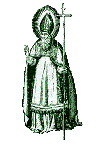
Saint Patrick whose real name was said to be Maewyn Succat, was thought to have been born in Scotland around 385. When he was about fourteen years old, he was captured during a raiding party and taken to Ireland as a slave to herd and tend sheep. During his captivity, he turned to God in prayer. After his escape from slavery when he was about 20, he began his studies for the priesthood. When he�d been ordained a bishop he was sent to Ireland to preach the Gospel. Legend also has it that Saint Patrick drove all the snakes out of Ireland. It is said that Saint Patrick drove the snakes into the sea where they all drowned.
|
 |
The shamrock, a member of the clover family, was used by Saint Patrick to explain the mystery of the Trinity, the three leaves of the shamrock representing the Trinity (the Father, the Son and the Holy Spirit). According to Irish legend, Ireland's patron saint chose the shamrock as a symbol of the Trinity of the Christian church. To this day the shamrock remains the national emblem of Ireland and is worn proudly by Irish people the world over on St. Patrick's Day (March 17). No one can agree on which plant is the shamrock picked by St. Patrick. Many claim it is the small hop clover (Trifolium procumbens), a plant with yellow flowers and blue-green leaflets. Others believe it is a variety of white clover (T. repens) or the black medic (Medicago lupulina). These plants are native to Europe and naturalized in North America. The European wood sorrel (Oxalis acetosella), which grows in Europe and Asia, is also often considered to be the true shamrock.
|
|
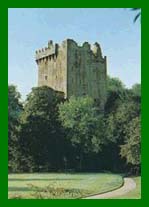
Blarney Castle was originally a timber hunting lodge built in the 10th century, which was replaced by a stone castle in 1210. The present day construction was completed by Dermot McCarthy, King of Munster in 1446. The Castle remained the ancestral stronghold of the McCarthy family until the arrival of Oliver Cromwell with cannon guns in 1646. Fifteen years later with the arrival of King Charles II on the English throne saw the return of the McCarthys to the Castle. Following the Battle of the Boyne in 1690, all Irish chiefs were stripped of their powers and the McCarthys were again forced to leave Blarney Castle. The Castle was sold to Sir James Jefferyes, Governor of Cork in 1703. The Castle is now owned and managed by the Trustees of the Blarney Castle Estate.
The Blarney Stone is a stone set in the wall of the Blarney Castle tower in the Irish village of Blarney. Kissing the stone is supposed to bring the kisser the gift of persuasive eloquence (blarney). The origins of the Blarney Stone's magical properties aren't clear, but one legend says that an old woman cast a spell on the stone to reward a king who had saved her from drowning. Kissing the stone while under the spell gave the king the ability to speak sweetly and convincingly.
|
|
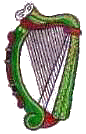
The Irish harp is a symbol of Ireland and can be seen on Saint Patrick's day decorations. Called a clarsach, it is small, held on the knee, and is carved from a solid block of wood. The Irish harp is displayed on Irish flags, coins, and on the Royal British coat of arms.
|
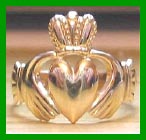 |
Claddagh means "Love, Loyalty and Friendship".The Claddagh ring is a design of a heart with a crown above it, encircled by two hands. It is a symbol of love and friendship. The hands signify friendship, the crown loyalty, and the heart love. The ring is worn either on the right hand with the heart turned outwards showing that the wearer is fancy free or with the heart turned inwards to denote that he or she is spoken for. When worn on the left hand, with the heart turned in, means the wearer is happily married.
|
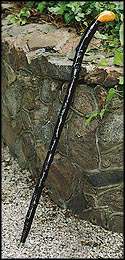 |
The shillelagh (a cudgel/fighting stick/cane) is called a bata in Gaelic. It got it�s name from the Shillelagh forest near Arklow in county Wicklow. The bata was often made with wood from the Blackthorn (Prunus spinosa). The knob on the end of a blackthorn stick is the rootknob and the bark is left on for added toughness. To keep the wood from splitting during the drying process the Irishman would bury the cudgel in a dung heap or smear it with butter then he would put it in the chimney to cure.
The stick was carried by Irishman almost everywhere he went, but it was at fairs, or at wakes that most of the deadly Faction fights broke out. Faction fighting was unique to nineteenth century Ireland. Factions were armies of country people, their battle grounds were fair greens, market places, race courses and frequently streets of towns and villages. Most often the factions were members of certain families or of political groups. The last recorded Faction Fight was at a fair in county Tipperary in 1887.
Fights with the bata were not always of the Faction variety, some were sport while others were conflicts of a more personal nature. These combats were not always a deady duel like most Faction fighting was, often they were friendly if somewhat rough contests. The bata was held somewhat towards the lower middle of the stick and was snapped out with the wrist rather than swung like a tradional cudgel.
|
 |
Uilleann pipes are native to Ireland and to England dating back to the beginning of the 18th century. Uilleann pipes have become a purely Irish instrument, they didn�t survive in England. Although the uilleann pipes are technically bagpipes they aren�t to be confused with the better known Highland Bagpipes. Unlike the highland bagpipes, uilleann pipes are played while sitting down, they�re played in a wide variety of styles, they�re played indoors, and traditionally one learns to play the uilleann pipes by ear, not from sheet music.
|