
Placing bagpipes by the cradle is a sure test to discover whether the child is a faerie, since no changeling can resist them. Soon faerie music spills out of the house and into the village, paralyzing with joy all those who hear the sounds.
|
The Leprechaun is an Irish faerie. The name leprechaun is derived from the old Irish word luchorpan which means little body. A leprechaun is a faerie taking the appearance of a miniature old man. Leprechauns are solitary creatures and spend their time making shoes. If you hear the sound of his hammer when he is at work you know you have found him. If you catch him, he can be forced to tell you where his treasure is, but you must keep your eyes on him every second. If your eyes leave the leprechaun, even for just a second, he will vanish. |
|
There are two types of faeries in Ireland, the sociable faeries and the solitary faeries. The sociable fairies can be found making merry near the hawthorn tree or at feasts in fairy palaces. They delight in company, while the solitary fairies avoid large gatherings, preferring to be left by themselves and separate from one another. The solitary faeries are found living in the bushes and in circles of stones in Irish pastures. |
|
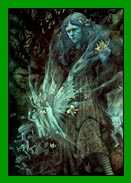
In Ireland and the nearby islands it's said that when one sees or hears a banshee ('faerie woman') she's portending your death or the death of someone dear to you. Typically she has long streaming red hair, with a pale complexion, dressed in a gray cloak over a green dress. She looks more like a thick cloud rather than substance. Some stories suggest that she can take the form of a crow. |
|
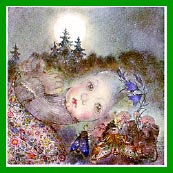
When a mother finds a scrawny, ill tempered, foul mouthed little man in the cradle, she knows that the faeries have traded her child for this creature. It is said that changelings are the stunted, deformed infants of faerie parents. Faeries are repulsed by these ugly creatures and they swap them with healthy human children. Placing bagpipes by the cradle is a sure test to discover whether the child is a faerie, since no changeling can resist them. Soon faerie music spills out of the house and into the village, paralyzing with joy all those who hear the sounds. |