A Brief History
|
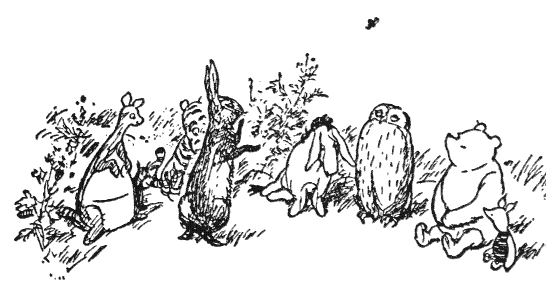
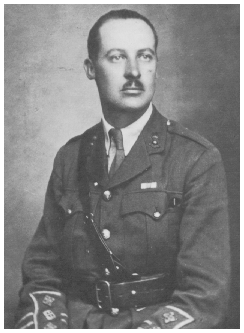
Alan Alexander Milne was born in London on January 18, 1882, the third and youngest son of a schoolmaster. He went on to attend Cambridge University and became the editor of the undergraduate paper, Granta. After graduating from Cambridge in 1903, Milne moved back to London with enough savings to live for one year. He was determined to become a writer. By 1906, he had been offered the position of Assistant Editor at Punch, a classic British humor magazine. He remained at Punch for the next eight years. In 1923, during a rainy holiday in Wales, Milne began work on a collection of verses for children. The result was "When We Were Very Young", published in 1924. Demand for Milne's whimsical work was overwhelming, and in 1926, he duplicated his earlier success with the publication of "Winnie-the-Pooh". The sequel, "The House At Pooh Corner", followed in 1927. "Now We Are Six", another charming collection of verse, followed one year later. |
 |
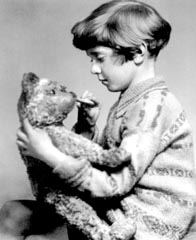 |
bear from Harrods, and later a tiger, pig and donkey. |
|
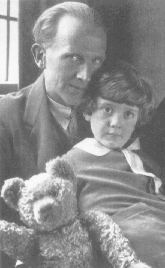
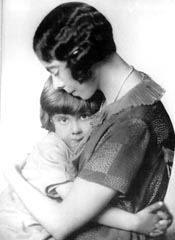
and his young son, Christopher Robin, who inspired him to write the poems and stories � the literary journey began in 1924 when the Very Young Christopher Robin was introduced to an American black bear at the London Zoological Gardens. |
 |
 |
Ernest H. Shepard was best known for his whimsical illustrations found in A. A. Milne's "Winnie-The-Pooh," "The House At Pooh Corner," "When We Were Very Young," and "Now We Are Six." Shepard was born in 1879 in London. His father was an architect and his mother, who died when he was ten years old, was the daughter of a notable watercolorist. It was she who first encouraged young Ernest to paint and draw. Art became Ernest's passion, and after attending Heatherly's Art School and the Royal Academy Schools, Shepard supported himself by drawing for the illustrated papers and by illustrating books. In 1903, Shepard married Florence Chaplin. Florence was a mural painter and fellow student at the Academy. The Shepards had two children: Graham, who was killed in World War II, and Mary, who later illustrated Mary L. Traver's Mary Poppins books. The illustrations that Shepard created for all four of the Pooh books received worldwide acclaim. For the next thirty years, he continued to illustrate books for both adults and children. In 1973, for the first time, he added color to his drawings for Winnie-the-Pooh. Shepard ultimately donated several hundred drawings to the Victoria and Albert Museum in London. Shepard's work also appeared in Wind In The Willows (Kenneth Grahame), and he went on to write 2 children's books of his own, "Ben and Brock" (1965), and "Betsy and Joe" (1966). Ernest H. Shepard continued to pursue his love of drawing until his death in 1976. |
when Milne had been asked to write a story
for the Christmas Eve issue of the Evening News
He wrote down one of the bedtime stories he had made up for his son
about his toy bear Edward bear, later renamed Pooh.
Eeyore, Tigger, Piglet, and Kanga & Roo ...were also
Christopher Robin's toys
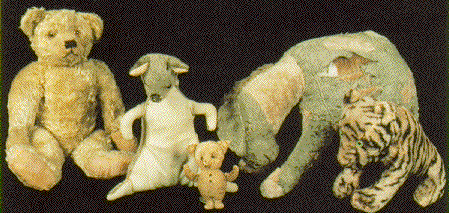
You can see the original toys owned by Christopher Robin in the
New York Public Library