Ancient Coin Collecting
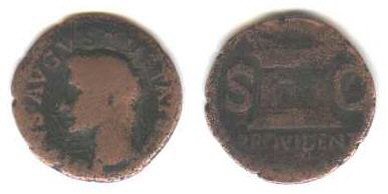
A commemorative of Augustus Caesar (Luke 2), minted in the time of Tiberius (14-37 A.D.)
One of the coolest hobbies you'll ever see.... or return to Rev-Darren's Spot!
(This
page still under construction, but it's a start...)
What are ancient coins?
The beginning of minted coinage occurred around the fifth to seventh century B.C. There are about as many opinions on what an “ancient” coin is as there are numismatists (a “numismatist” is one interested in the study of coins and/or monetic numeration.) Most numismatists divide themselves by eras of coinage: Greek, Roman, Romaion (also known as Byzantine,) Mideval, “Colonial,” modern, etc. Eras, though, are as much a matter of coin style as time and place of production. (There are also those who distinguish between Roman Republic and Roman Empire, Egyptian coins, etc.) Most ancient numismatists (a fancy term for an ancient coin collector,) close the ancient period with the end of the Romaion period (about 1450 A.D.) There just isn't one solid definition, and that’s part of the fun. I like considering “ancient” as whatever was minted before I was born; since I was born in 1969, though, I get a lot of negative feedback about that. J
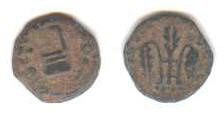
Personally, I collect coinage which
relate to biblical themes, or coins which somehow relate to the history of the
Christian Church. The main period
of my own study has been the Roman Empirical period. The majority of my
personal collection ranges from Caesar Augutus (27 B.C.-14 A.D.) through the
sons of Constantine the Great (abt. 350 A.D.)
I have had coins, though, from about 270 B.C. through 1718 and beyond.
It’s all a matter of what you want to collect, and what you want to
spend.
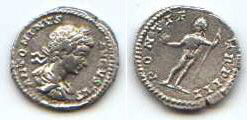 A Denaurius of Septimus Severus, minted 195 A.D. (Septimus
issued edict attempting to purge the Christian Church, which included the
"Martyrdom of Perpetua and Felicitas," an early church text.)
A Denaurius of Septimus Severus, minted 195 A.D. (Septimus
issued edict attempting to purge the Christian Church, which included the
"Martyrdom of Perpetua and Felicitas," an early church text.)
Myths about ancient coin collecting
Ancient coin collecting is not expensive.
Like any hobby, it can be relatively inexpensive to start, and you can
spend as much money on it as you would like to.
Genuine ancient coins begin pricewise as low as approximately $20.00 per
coin, and go up from there. Many
denarii (small silver coins of the Roman Empire) sell for $30.00-$50.00.
Copper based coins cost much less. The
nice part is, they’ve been around for so long, and the supply is plentiful
enough, that you can take your time in collecting them.
Nobody has “all” the ancient coins, and nobody ever will.
Collecting ancient coins is NOT unlawful in the United States, and in most countries. There are many detailed and hard to follow laws that importing coin dealers must be aware of (especially in the United States,) and in some countries laws that the buyer must be aware of. As one example, it is unlawful to knowingly import any antiquity that has been defined as a 'cultural treasure,' from those nations that have a treaty. More about this issue can be found at the U.S. State Department website (I'll post the link at another time.)
Most collectors in the United States, however, buy from reputable
dealers. If you travel outside your
country, or don’t know your own country’s laws, beware buying “ancient”
coins, for each country has its’ own laws regarding antiquities.
Turkey is especially known for its’ harshness in allowing antiquities
of any kind to be exported. England
has rather liberal laws, including opportunities for you to dig your own ancient
coins from the ground, as long as the law is upheld.
There are also people who will knowingly sell you counterfeits, everywhere. Coins are very available on internet auction sites, but with counterfeiters and con men out there the only universal rule is caveat emptor (let the buyer beware.) Reputable dealers will almost always refund your money if you’re sold a counterfeit or misattributed coin, as long as you act quickly.
Most dealers I personally consider to be reputable are members of their
countries’ guilds or professional dealers societies.
(In the U.S., there are several; the American Numismatic Society and the
American Numismatic Association are two of them.) Reputable dealers often
will belong to one or both, and it's generally considered de rigeur for
coin dealers to belong to a professional society of some sort. This
doesn't
mean that a reputable dealer has to be in a society, or that you can't buy on
the internet. Starting out, however, it's best to know who you're dealing
with.
There are five rules of thumb that helped me in starting out: First, know the law of the country you’re in with regards to antiquities. Second, buy only from dealers with established reputations. Third, until you’ve immersed yourself a little in the collecting world, don’t rush out and buy everything you see. Fourth, always buy from dealers with established reputations, or take your chances. Finally, don’t expect to get rich by “dealing” or “investing” in coins: the market is really too volatile for all but the most patient and educated collectors. Don’t let these rules stop you from collecting; it’s one of the most fun hobbies I’ve ever taken up!
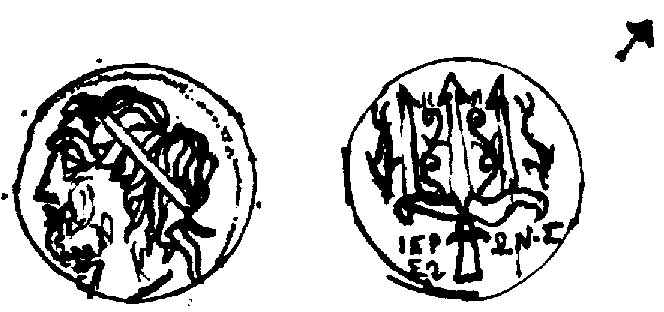
Nobody really knows how many ancient coin collectors there are, or
even how many dealers or collectors exist worldwide. Many
museums and historians do collect coins. There is always a debate about who
“legitimate” coin collectors are. Many collectors (including myself) collect them not just
for their history alone, or to study history, but also to appreciate the beauty,
art, philosophy, and even theology that can be found in coins.
Each ancient coin has a story to tell, a story that will never
be fully known by us. Ancient coins are in and of themselves handmade works of art:
most were made from hand-cut dies, and struck by hand.
Each one is a small piece of historical art.
The numismatist's ally: Resources
Certainly, if you buy ancient coins, you’re curious about what
the coin is: when was it made,
where it came from, what the letters (if any) mean, who is portrayed, when was
it made, etc. The numismatist
living today, though, has very powerful allies:
books, internet sites, email listservers, and much more.
It’s easier than ever to do the “detective work” on a coin, to
attribute it yourself. Most ancient
coins bought from dealers are already attributed, but you can also read and
study the period in which it came from, as well.
(And once in a great while you’ll find a coin that was misattributed.)
Have I stirred your interest yet?
Here are a few links that may help you get started in ancient coin
collecting: (links to be added soon...)
Print resources in getting started:
The Celator Magazine: The
standard periodical in the U.S. for Ancient Numismatists. It also features
articles by large-name dealers, average collectors, and persons who publish
fairly economical works like David Hendin and David Vagi.
Wayne G. Sayles’ Ancient Coin Collecting series:
Volume 1 is enough to get you started; I buy all of Sayles’ books as I
have money.
The Pressman Guide to Ancient Coins: Not really an exhaustive reference, but a very economical
book when you’re starting out.
Coin World: More geared to modern U.S. collecting, but the only weekly coin collecting periodical in the U.S. I’m aware of.
E-Mail and Internet Resources (non-profit)
Moneta-L: Mainly lists
questions and answers, and a general forum
Ancient Coin Market Listserver:
Mainly lists ancient coins for sale
American Numismatic Society’s EGroup Listserver
The
American Numismatic Society
The American Numismatic Association
Be careful: the
listservers about generate a LOT of traffic, but they’re worth it.
There are other listservers also.
Collecting
Some dealers I’ve done business with or have come to respect:
Calgary Coin Gallery
William Rosenblum’s Rare Coins
Forvm Ancient Coins
Note that I've got literally dozens of favorite web sites, including many I use for research. This, though, should be enough to get you started in collecting.
or you can send me an email. I
do not sell coins, but I am glad to help as I can.
Hooked yet? Here's some
tools for the beginning numismatist:
Only the first one is absolutely necessary.
1. A BRAIN
This doesn’t mean being a genius, a great historian, or anything that
you don’t already have. Simply
use your intelligence and common sense in purchasing, researching, etc.
You'll hear this again and again from ancient numismatists.
2. Books and Resources
While you can always place your faith blindly in dealers, and just
collect pretty pieces of metal (seriously!), it’s good to know something about
what you’re buying. These are
where resources come in. Auction
catalogues and expensive reference are great, but you don’t have to expend a
lot of money to learn a lot about ancient coins in general, or the period which
you study. I’m really emphasizing this because so few beginners set aside any of
their hobby money for resources. (I
now set at least 10 to 25 percent of my coin budget for resource purchases.)
3. Some basic
magnification tools
A magnifying glass is all you really need, but several magnifiers, in
increasing magnification, help greatly. (I
have 3x, 5x, and 7x magnifying glasses, and 10x and 16x jeweler’s loupes.)
At the top end of the scale are stereoscopic “hobby” microscopes.
They range from 10x to 40x magnification generally.
You don’t need a lot of magnification, though, and I don’t own a
microscope…. yet.
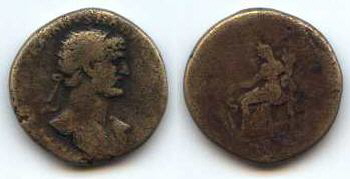 See
what you can get when you magnify? Look at the letters on top: ...AIANVS
HAD... a Dupondius of Emperor Hadrian, c. 120AD
See
what you can get when you magnify? Look at the letters on top: ...AIANVS
HAD... a Dupondius of Emperor Hadrian, c. 120AD
4. Something to hold
your coins for study
Although hands are great for this (hold the coin by the edge!)
I like to study a single coin for minutes or hours at a time.
I “homebrewed” the following:
Parts list:
One block of wood of adequate size (3.5" x 5" x 1"
is what I used,) One coat hanger
Tools: A rubber mallet (or hammer with block of wood,) drill with bits, a wire cutter, epoxy, safety gear.
What you do: Drill a hole in the block of wood slightly smaller than your tubing width. Cut about 1-2 in. piece of tubing. Tap it into the block's hole. Remove the scribe tips from the compass. Replace them with small lengths of coat-hanger wire. Drill a small start-hole into the thick of the bumpers. Seal them with epoxy to the coat-hanger wires. Adjust the coat hanger wires for best fit against the bumpers. Line either the tubing shaft or the compass gripshaft. Insert the compass (upside-down) into the tubing. Voila! You've got a tool to hold your coins for hours on end that can rotate 360 degrees.
5. Storage of Coins (yet to come...)