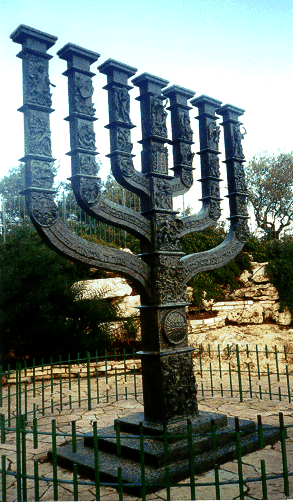
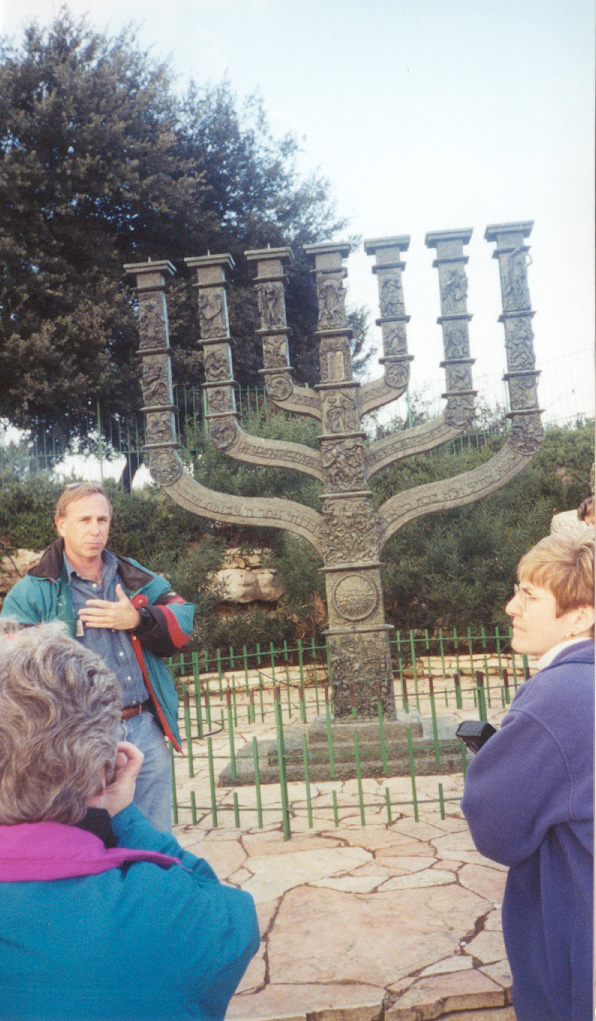
The Menorah tells the story of the history of Israel. On the right candle is Jeremiah, the prophet of doom; on the left is Isaiah, the prophet of comfort. In the middle is Moses with two men holding up his arms for, as God had dictated, as long as Moses raised his arms, the Israelites would be victorious in their battle. To the left of Moses is David holding Goliath�s head; beneath him is Abraham. Under Moses are the Ten Commandments, and to the right of Moses, parallel to Abraham is Jacob-Israel wrestling with the angel. Under the Ten Commandments is Ruth holding wheat (a symbol of the threshing floor where she met Boaz) and Rachel, the second wife of Jacob, weeping. The Bible records that Rachel died while giving birth to Benjamin; she is buried on the way to Bethlehem. She is depicted here weeping for her people in exile. Above Ruth is a menorah with three candles, since it was three generations from Ruth to David, and the crown of David; below that is Ezekiel and the vision of dry bones, then the Holocaust, and then the Shema Israel, the prayer Jews are to say before death so that the gates of heaven will be opened to them. Our guide explains that during the war, many Jewish families gave at least one of their children to a Christian family in the hopes that the child might survive. Often, the parents were killed, but in cases where they lived, they returned to find children who might have forgotten much of their old life and customs; the Shema Israel was the phrase used to reunite families. On the base of the Menorah is a kibbutz, because the state of Israel is founded upon the kibbutzim.
After our visit to the Menorah, we stopped by the hotel again for a moment, then the bus took eight of us to Jaffa Gate. Joan, Gina and I tried to walk the ramparts, but the entrance was closed, so we went up Greek Catholic Patriarchate Street to the Christian sector of the market. We were met by Emir, who gave us hot tea with mint leaves. We shopped for a bit, and I stopped to talk to Joseph, who showed me a 700 year-old icon given to him by the Russian Embassy. Then Gina, Elaine and I walked back to the hotel.
|