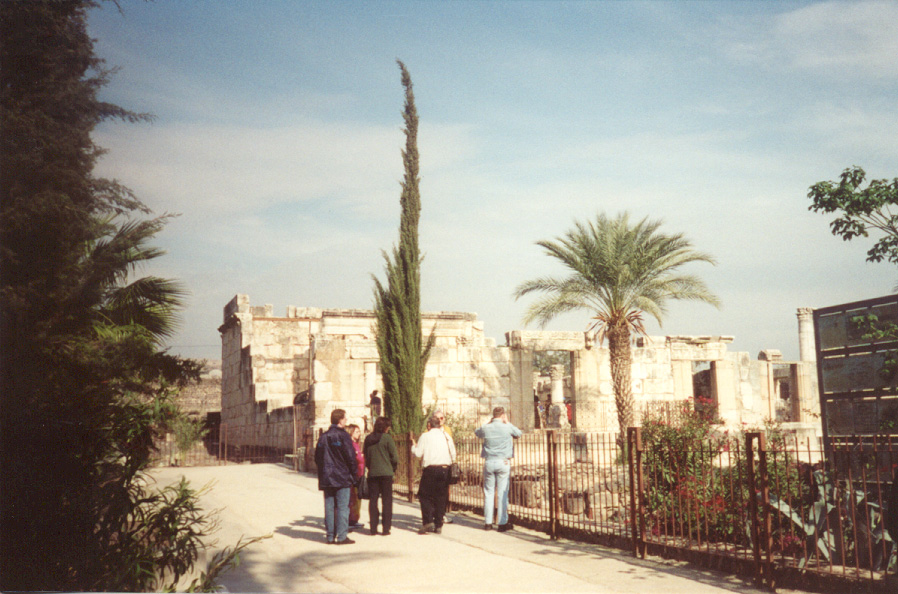
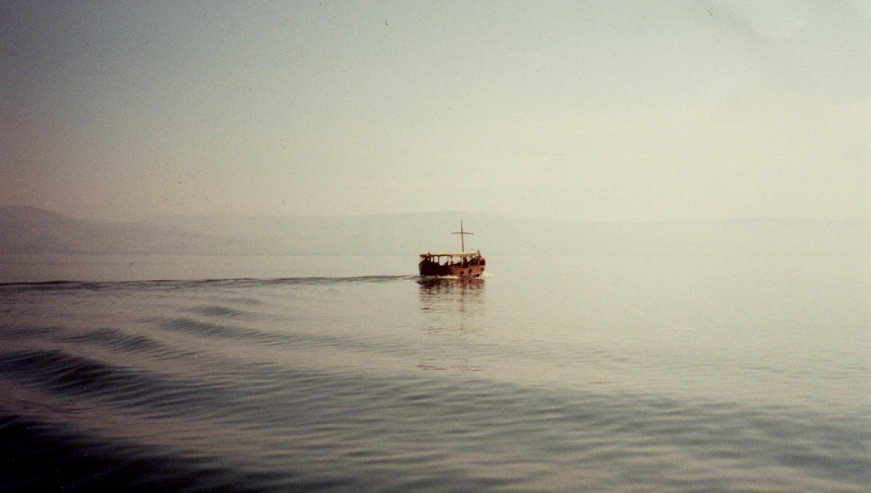
| The city unearthed shows that houses were simple, usually consisting of only one floor. (It would have been easy to lower the paralytic through the roof of a one story building.) In the distance we see the red domes and white cross of a Greek Orthodox Church, and slowly make our way over to the ruins of a synagogue. Dating from the 4th or 6th century, the ruins resemble a basilica more than a synagogue, but we know it�s a synagogue because it faces Jerusalem. Why would a synagogue be built in an entirely Christian town? Perhaps as a memorial of one of two places where Jesus read from the Torah�the other synagogue being in Nazareth. This is actually the third synagogue built on this location; we know it was this location because according to Jewish custom nothing can be built on top of a synagogue except another synagogue. Outside the synagogue, carved into the stone pavement are games for children, including tic-tac-toe, the official game of the Crusaders (found in every fortress!) After a short ride we board a wooden boat on the Sea of Galilee, where sailors are shouting and arguing. We sail out under the bright sun, into the fog where the birds are black spots above the water and their shadows are not visible. The captain cuts the engine and we drift silently. Father Greg reads to us from Matthew�s account of Jesus walking on water. |
 |
 |
 |
| Day 10 continued... |
| On our drive to Capernaum, we pass the ruins of the original Church of the Beatitudes, as well as the place known as �Peter�s Primacy,� where Jesus appeared after his resurrection to his apostles and three times asked Peter, �Do you love me?� Matthew 9 records that Jesus left Nazareth because he was not accepted there. The town he went to was Capernaum, far away from kings and the Temple. Here, the people listened to him and he began his public ministry. All archeological findings have so far matched biblical accounts with amazing accuracy�the house of Peter�s mother-in-law, the home where the paralytic was lowered through the roof to be cured by Jesus. Columns of limestone with Aramaic writing, originally part of a synagogue, were found here as well. On one column is the carving of a wagon used to wheel the Torah into the synagogue for services and the Star of David. |
| Capernaum was a fishing village; the north of the Sea of Galilee is warmer than the south, so there are more fish. Peter, a fisherman before he became a fisher of men, had his residence here. There are three sites about which we have the greatest certainty, and one of them is the house of Peter. |
| The waters, previously calm, become choppy; the captain tells us that in summer there are strong winds that come at 2 P.M. and last for four hours. They are called shrkia, and they come from the east. We sail to Tiberias. |
 |
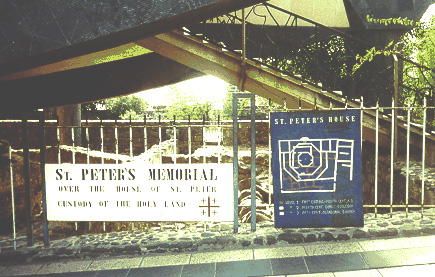 |
| The House of Saint Peter in Capernaum. Christians have worshipped here since the middle of the first century. |
 |