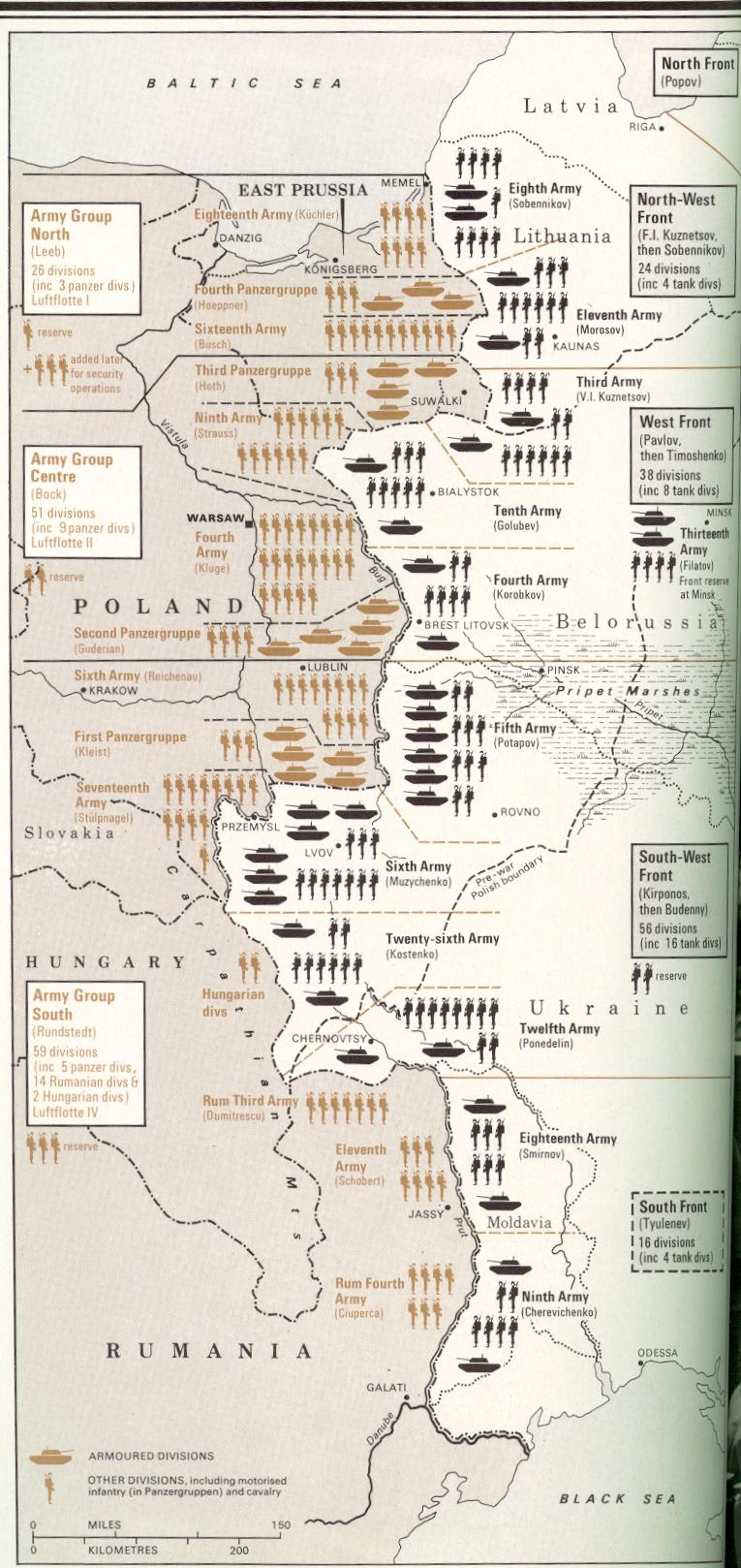
Order of Battle  3:00 AM June 22,1941 
 

Barbarossa


The cynical military collaboration between Nazi Germany and the Soviet Union came to a bloody end at 3:00 AM on June 22, 1941. From the Arctic Ocean to the Black Sea stretching almost 800 miles,  Adolph Hitler unleashed the greatest Armada every witness in the history of warfare. 152 Divisions (including 17 Panzer Divisions) in three major army groups rumbled across the vast Soviet frontier to capture three objectives, Moscow, Leningrad and Kiev. Facing the German Army was the Four Soviet Fronts that consisted of 102 Army Divisions and 32 Tank Divisions. The battle would end almost four years later in the rubble of Berlin. Military Directive #21 (Codename Barbarossa) became official on December 18 1940. However, it's origin began on July 29, 1940 at the beginning of the Air War over Great Britain. It was at a staff meeting that the Chief of German Operations Colonel General Alfred Jodl told his staff officers that the Fuhrer had decided to attack the Soviet Union in the spring of 1941 to avoid the harshness of the Soviet winter. However Germanys ally Italy began a misadventure in Greece that would change the outcome of Barbarossa. The six week delay in the start of the invasion would not be evident until December. That is when the first snow fall began, right as the German Army reached Moscow. The great General Winter would save the capital


GERMAN  ARMY GROUPS

  • Army Group North (or A as it would be latter called) was commanded by Field Marshall Ritter von Leeb. He commanded the 16th and 18 th Army and the 4th Panzergruppe. They consisted of 23 Army Division , 3 Tank or Panzer Divisions and the Luftlotte I (which is the the German Air Force. It's target was Leningrad.
  • Army Group Center was commanded by Field Marshal Fedor von Block. He commanded 4th and 9th Army, 2nd and 3rd Panzergruppe and Luftlotte II. They consisted of 42 Army Divisions and 9 Panzer Divisions. It's target was Moscow. 
  • Army Group South (or B) was commanded by Field Marshall Gerd von Rundstedt. He commanded 6th, 7th  and 11th Army, and 1st Panzergruppe. Their was also under his commanded two Hungarian Divisions, the Rumanian 3rd and 4th Army. They consisted of 38 German Divisions 14 Rumanian Divisions and 2 Hungarian Divisions, 5 Panzer Divisions and the Luftlotte IV. It's target was Kiev.
SOVIET FRONTS
  • North West Front  was commanded by Marshall F.I. Kuznetsov then Sobennikov. Under their command was 8th and 11th Army groups. They consisted of 24 Divisions and 4 Tank Armies. 
  • West Front  was commanded by Marshall Pavlov then Marshall Timoshenko. Under their command was 3rd, 4th, and 10th Army groups. 13th Army was revered for the defense of Minsk. They consisted of 38 Divisions and 8 Tank Armies.
  • South-West Front was commanded by Marshall Kiponos then Marshall Budenny. Under their command was 5th, 6th, 26th, and 12th Army groups. they consisted of 54 Divisions and 2 in reserve, plus 16 Tank armies.
  • South Front was commanded by Marshall Tyulenev. He commanded 18th and 9th Army groups. They consisted of 16 Divisions and 4 Tank Armies. 



Brigadier Shelford, Christopher Chant, Chris Steer, Jonathan Moore, Richard Natkiel, "Hitler's
Generals and their Battles"
(London: Leisure Books, 1984) The Map is on Page 78.
Hosted by www.Geocities.ws

1