Plastics are the most serious problem of waste disposal as it is long lasting (hardly be divorced) and harmful to our environment. So as to solve the problems of waste disposal of plastic, degradable plastics are being developed and processes for recycling of plastic waste are now underway.
Degradable
plastics
Plastics normally undergo extremely low degradation because the enzymes in micro-organisms tend to attack only at the ends of the polymer chains. Manufactures are increasingly seeking ways to make plastics more degradable. This is particularly important and useful for thermosetting plastics, which are not readily be recycled. There are several types of degradable plastics:
Biopolymers are polymers made by living micro-organisms that are able to break down these polymers under the anaerobic condition of a landfill. Degradation is usually complete within nine months. However, biopolymers are 15 times more expensive than poly (ethene).
Photodegradable plastics have light sensitive functional groups (such as the carbonyl groups), which enhance the ability of the ability of the plastics to absorb ultra-violet (UV) radiation, incorporated into their polymer chains. The plastic absorbs UV radiation from sunlight and breaks down into small fragments that can then be broken down by nature into carbon dioxide and water.
Synthetic biodegradable plastics are be made by incorporating starch, cellulose or protein into the polymer during production. This decomposition makes the bacteria and mould more easily to break down the plastics into small pieces, like the decay of paper and cloth. The very small pieces left over have a large surface area that greatly speeds up their biodegradation.
Recycling
of plastics
Since
plastics are essentially be derived from petroleum that has limited reserve,
disposal of plastics by way of landfilling or incineration is a waste of useful
resources. Such wastage may reduce by recycling, in one form or another.
Direct
recycling
It is only apply to thermoplastics. The plastics in the waste are be separated, cleaned, pulverized and remoulded into plastic items.
As there are many types of plastics being used together, so we need to sorted by polymer type. It is because different plastics have different physical properties that have to be softened and remoulded at a different temperature, otherwise it will plug up the machinery in the recycling factory.
Today, the sorting processes are be carried by hand that present technology is much slower at separating the different types of plastics than people.
A uniform coding system was be developed that makes it possible to sort waste plastic. The SPI coding symbol consists of three triangulated arrows surrounding a single digit code number. There are seven code numbers:1-6 refer to specific polymers;7 refers to all other types.
Success of direct recycling depends:
 manufacturer
using a single plastic wherever possible for an article;
manufacturer
using a single plastic wherever possible for an article;
The
article must be clearly labelled with the name of this plastic;
the
public to be educated on the common sense and awareness of recycling;
sufficient
collection vessels available at convenient locations like supermarkets and
carparks. These collection vessels must be frequently enplied;
Pressure
from an environmentally conscious government on the public and on plastic
manufacturers to support recycling.
Once the waste plastic is being separated, it can be reprocessed into new plastic items.
Recycling
of energy
Incineration of plastics to produce energy is, in a sense, a recycling of energy content stored in the materials. The energy values contained in plastics are quite high. The energy so obtained can be used for heating or generation of electricity.
Recycling
of chemicals
Another way to recycling plastic waste without the need for costly separation is to use it as a raw material for catalytic cracking. The process is known as pyrolysis. The products of pyrolysis are separated by fractional distillation and can be used to make plastics and other chemicals.
Measures
to reduce solid waste
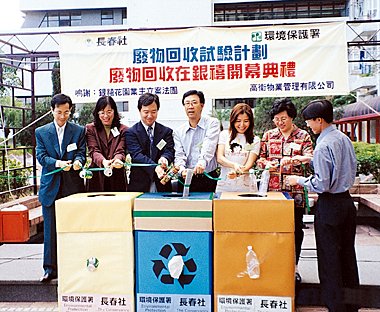
The Hong Kong government has since 1990 been actively promoting the 3Rs concept (Reduce, Reuse and Recycle) to increase public environmental awareness and participation in waste minimization and recycling activities. This not only helps in saving resources but also in reducing the demand of valuable landfill's space. Discarded items such as newspaper, office paper, aluminum cans, glass containers and certain plastic items can be collected for reuse or recycling.