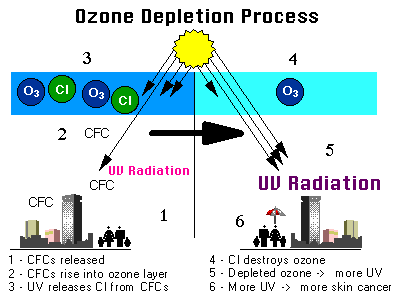
Depletion of ozone layer is caused by the accumulation of
chlorofluorocarbons in the stratosphere. CFCs
have been widely used for many years as solvents in cleaning electronic
components and metals, as refrigerants and as blowing agents in foam plastic
manufacturing. Some of them escape
into the atmosphere during use, or when the refrigerators/air conditioning units
are scrapped or then the foam plastics are disposed of.
The CFCs are so unreactive that they break down very slowly in the
atmosphere. CCl3F, for
example, has a lifetime in the atmosphere of about 75 years.
This gives it plenty of time to be transported up into the stratosphere.
Furthermore, CFCs are relatively insoluble in water and are therefore not
removed from the atmosphere either by rainfall or by dissolution in the ocean.
Once in the stratosphere, the ultra-violate radiation from the sun is
intense enough to dissociate CFCs, giving CI free radicals, which are very
effective in destroying ozone.
As
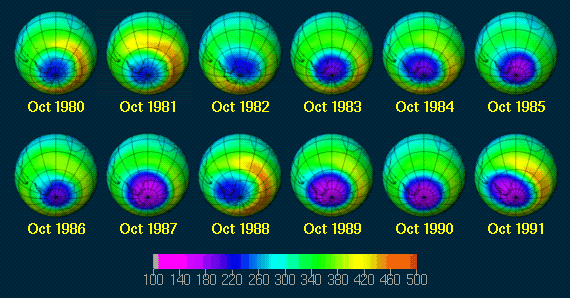
time goes by, ozone hole exists. An ‘ozone hole’
was first discovered in the stratosphere over the South Pole in 1986.
In the late winter and early spring of 1987 and 1991, the loss was as
much as 40 percent of the ozone layer. In
1989, a hole in the ozone layer was detected over the North Pole for the first
time. Since three quarters of the world’s population live in the Northern Hemisphere, depletion of the ozone
layer over Arctic could have even more serious consequences than depletion over
the Antarctic.
Among
other adverse effects on aquatic and terrestrial ecosystems, ozone depletion
leads to reduced crop yield, higher incidence of skin cancer and eye cataract.
There is therefore an urgent need to minimize the use of CFCs and to
develop suitable CFC substitutes, which do not adversely affect the environment.