The purpose of this course is to provide
instruction and learning experiences emphasizing family roles,
relationships, responsibilities, and resources; and to develop
understanding, attitudes, and skills relevant to personal, home, and
family life responsibilities.
Credits:
Consumer and Homemaking is a year long course.
Completion of this course will earn one elective credit toward
graduation.
Course Sequence:
Course Sequence:
Week 1-2
Reaching your Potential
Week 3-4
Changes and Building Character
Week 5-6
Responsibility and Decision-making
Week 7
Respecting Others
Week 8-9
Communication/Conflict Resolution
Week 10-11
Making Healthy Food Choices
Week 12-13
Safety and Sanitation
Week 14
Measurement/Time-work Plans/Reading Recipes
Week 15
Fruits/Vegetables
Week 16
Eggs/Dairy
Week 17
Cookies/Cakes/Baking
Week 18
Review and Exam
Week 19-20
Housing Needs
Week 21-22
Interior Design
Week 23-24
Design Project
Week 25-27
Money Management
Week 28-29
Banking and Savings
Week 30
Sewing Machine Parts and Use
Week 31-35
Work on Sewing Projects
Week 36
Review and Exam
Careers will be discussed in each area*
Grading Procedures:
Students will be given a number of daily
assignments. These assignments will count one-third of the class
grade. Tests will count one-third of the grade and lab experiences
will count one-third of the class grade. If a student is absent
arrangements must be made with the teacher to make up the assignment
after school with an alternate experience. This is a year class so
students are allowed to miss five days and still receive credit for
the course.
It is the student's responsibility to ask for any
assignments that are missed due to absence or school sponsored field
trips. Remember a student has the number of days absent,
plus one to make up the work. All make up work is to be done from
7:30AM to 8:00AM or between the hours of 3:10PM and 4:10PM.
Class Rules:
Be prepared for class before the bell rings.
Be in your seat before the bell rings.
Do not eat nor chew gum in this class.
(Unless, of course, we cook the food.)
Bring required materials for projects the day
the assignment is given.
Bring notebook, pen or pencil, and your book
to class each day.
Disagreements concerning money are the number one cause for divorce
in our country. Making a workable budget and following it is the best
way to avoid money problems in a marriage.
Task:
You and your partner have decided to marry in four months. The two
of you have decided to make financial plans to help avoid possible
problems in the future. Your task is to find a career that meets your
interest and educational level (four years of college or two of tech
school). After determining your income, find a place to live, make out a
budget, purchase a car, purchase insurance, and plan for savings.
Process:
1. Go to
Career Missouri
or
College Board Career and choose an occupation that interest
you. If a beginning salary is given use it for your income. If no
beginning salary is given then follow through to get the median salary for that occupation. Subtract $2,000 from this salary since you will be a new
employee. This will be your income for the budgeting exercise. Give
the duties for the occupation, requirements for
certification for the career. Example:
2. Now that you have determined your gross income,
go to Pay Check City
Click Personal calculators, then, paycheck calculator. Complete the
information to determine your net or take home pay. (change to SC,
monthly, married, filing status 2) Copy and paste this information
in a word document. Save. Example:
3. Work with your assigned partner, if
you have one, and go to
Yahoo Real Estate. Click real-estate to find a home.
After you choose a home and calculate the payment for the home. If your
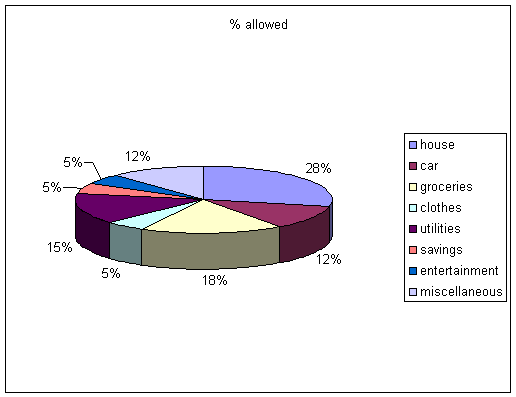
payment is more than 28% of your net income you must search again.
Copy info and save to your word document.
Example:
4. Go to
Yahoo Autos or
Auto Web or Car Max and
locate a car or two if you will need two cars. Calculate the payment
(s) for the car (s). If payments are more than 12% of your net pay,
you must search again. Copy and paste your car and payments to the
word document. Save. Example:
5. Next, you and your partner are ready to figure
your food budget. To determine the amount of money needed for food,
the two of you must make out a list of foods needed each month. Go
to Pea Pod Groceries type in the
zip code 60652 and find the cost for your food.You may also
shop atNetgrocer. Prepare a chart
showing the amount spent food should not exceed 18 percent ofyour income. Remember to include food eaten away from home.
6. Calculate the rest of your expenses by using the
average percents spent by most people:
Expense
Percent
Dollar Amount
House/insurance/taxes
28%
Car/gas/upkeep/insurance
12%
Groceries
18%
Clothes
5%
Utilities (electricity, gas, phone,
water)
15%
Savings
5%
Entertainment
5%
Miscellaneous (gifts,
unexpected expenses)
12%
7. Use Excel to make a chart showing expenses and
percentages of income in each area. Transfer the chart to your word
document.
8. Analyze the budget. Does it seem workable?
Discuss the actual dollar amounts with your partner. Make any
necessary adjustments to the budget.
9. Turn in a copy of your original and revised home,
car, grocery list, and budget spreadsheet. Explain the rationale
behind changes to the final budget. Include what the two of you have
decided to do with any money left after expenses.
10. Answer the following questions
in conclusion:
What have you learned about needs versus wants?
What conflicts did the budget cause between you and your
partner? How did you resolve these differences?
Why do you think money problems cause marriage problems?
How can a well planned budget help you plan for the future?
Will you use a budget when you become financially
independent? Why or why not?
What have you learned about financial planning from this
exercise?
Turn in the information from #9 along with the answers to
these questions listed above.
Resources:
Use the URL's provided to reach the required sites.
Learning Advice:
Your career and take home pay should be completed separately.
Make sure you include this information along with your budget. You
and your partner must agree on all other parts of this experience.
You should work together and discuss every aspect of the budget. I
suggest that one partner keeps the chart on his/her computer while
both of you do research on the other partner's computer. Remember to
save your information to your student id number.
a.Teachers design classroom presentations to meet
students’ needs and abilities. They also work with students individually.
Teachers plan, evaluate, and assign lessons; prepare, administer, and grade
tests; listen to oral presentations; and maintain classroom discipline. They
observe and evaluate a student’s performance and potential and use new assessment methods.
b.Requirements for regular licenses to teach
kindergarten through grade 12 vary by State. However, all States require general
education teachers to have a bachelor’s degree and to have completed an approved
teacher training program with a prescribed number of subject and education
credits, as well as supervised practice teaching. Some States also require
technology training and the attainment of a minimum grade point average. A
number of states require teachers to obtain a master’s degree in education
within a specified period after they begin teaching.
c.Beginning salary is $26,730 a year or $2227.50 per
month. Back to
project
Sauté onion in margarine. Add broccoli, soup, and
Cheez Whiz. Stir and cook until bubbly. Add rice. Place in a 9x13-inch
pan; bake at 350° F. for about 45 minutes.
Monkey Bread
Bread
3 cans flaky biscuits
2 teaspoons cinnamon
1 cup granulated sugar
Mix cinnamon and sugar in plastic bag.
Cut biscuits in quarters
Drop into sugar and cinnamon mixture to coat each
piece well.
Drop biscuit pieces into a buttered tube pan.
Pour remaining cinnamon/sugar mixture over the
top.