American Energy: Between
By Richard B. Simon
Several years ago, I was
invited to take a cruise to
Of course,
To native peoples such as
the Inuit, the Aleuts, the Tlingit, the Inupiat (a.k.a. Eskimo), the Gwich'in
and the Athabascans,
In the eyes of those of us
"lower 48ers" who merely visit, Alaska is a land of wonder - a
backyard Serengeti where the Aurora Borealis unfurls its phantasmagoric astral
curtains; magnificent, carnivorous American mammals chase equally magnificent,
herbivorous American mammals across the tundra; and rivers of glacial outflow,
glowing brilliant emerald-blue with sediment freshly scoured under a mile of
prehistoric icepack, writhe with salmon so abundant, one can practically pluck
them out of the water like ripe peaches off the tree.
Indeed, the "Great
Land" is a vast, verdant country, as lush with exotic flora, as teeming
with extraordinary fauna - and as lacking of cement, asphalt, smog and the
orange nighttime of light pollution -- as 21st-century Americans of the lower
48 can only imagine our great nation stood in its primeval state, before
resource-hungry Europeans conquered it in the middle of the last millennium. It
is a treasure trove virtually unlatched, a miraculous land frozen in time, a
fertile subcontinent left purposefully fallow by history, for later generations
to enjoy.
Now, in the stark light of
the ascension of the oil industry to the executive branch, it would seem that
we have seen the later generations, and they are us.
So, like many others this
past summer, my favorite travelling companion and I figured we had better get
up there before the Bush-Cheney administration turned the whole place into a
Texas playground of oil derricks and pipelines.
I had expected that our trip
would offer a glimpse into the Alaskans and their views on environmental
politics - but little did I know that having a conversation about Alaska, in
Alaska, without it turning to environment and politics, is nearly impossible.
Alaska is all about its land, and Alaska's economy is all about how that land
is used - whether fished, forested, drilled, mined, or simply savored for its
natural beauty. So, in Alaska, politics, the economy, and the environment mix
far more readily than, say, oil and water.
While deploring cruise
ships, we still wanted to travel by sea and feel the distance we would
traverse, so we booked passage on the Alaska Marine Highway, the state's ferry
system, which runs from Bellingham, Washington, and travels several routes
around Alaska's southern shores. We boarded the 500-passenger M/V Matanuska on
a cloudless July afternoon, climbed to the top deck - where many of our fellow
travellers were already scrambling to pitch their tents -- and claimed the last bit of prime view
property, along the deck's outer rail. We wrestled with our tent for what
seemed like hours in the windy harbor, eventually securing it to the rail with
rope. We moved all our gear to the edges to keep the winglike blue dome from
blowing off the back of the boat, then stood on deck, awed as the foghorn
blasted and we pulled away from the dock and off to sea, snowcapped Mount Baker slowly shrinking from
view.
The first friend I made on
the ferry was a Texan named Brandon Reed. The tall, blonde-haired 23-year-old
said he had not travelled much, and that this was his first time to the Pacific
Northwest. Amazed by the clean air and water, he marvelled at the beauty of
Northern Washington, compared to polluted Galveston, where, he said, the Gulf
of Mexico is a murky brown, and the omnipresent oil rigs spill and dump freely.
"In my mind, George W.
Bush was the lesser of two evils," Reed said of the 2000 election, though he
saw Green party candidate Ralph Nader speak in Houston last fall, and
appreciated his no-nonsense style. I talked to him about the California energy
crisis - about the prime planning role in the state's failed deregulation
scheme played by Enron CEO, Bush friend and reputed "shadow energy
czar," Ken Lay. I explained to him the shutting down of 1/8 of the flow of
natural gas to California by the "marketing subsidiary" of
Texas-based El Paso Energy. He hadn't heard about any of that down in Texas.
That evening, the sky glowed
all hues green to purple as the sun lit the haze on the horizon. I ran for my
camera. Meanwhile, a giant cruise ship
moved in front of us, far off to the horizon, literally blocking the sun, and
spoiling everyone's photos (or perhaps giving them scale and relevance). We
retired to our tent, but shorly thereafter, I was startled by a brilliant light
in the dusky sky. Conditioned to city living, I figured it was the headlight of
a jet plane, but as it held its position, I realized that the object was Mars.
Unlike the pinprick of light
most of us see through the polluted skies of the populous lower 48, Mars was a
palpable orb hanging in space, apparent in its volume and mass. Up there where
the air is still clear, it became easier to understand why the Greeks and
Romans called the planets gods, envisioning them wheeling across the sky in
chariots of gold and silver fire. For
someone accustomed to the particulate-obscured night skies of early twenty-first
century America, the view - and its implications -- were startling.
Eventually, I fell asleep,
but I awoke in the middle of the night, and stepped out onto the deck to see
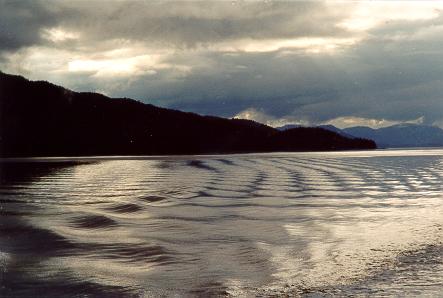
one of the most incredible sights I have ever seen -- a fat, gibbous moon
hanging in the sky directly to stern, lighting our wake in otherworldly
brilliance, a bridge of light across an ink-black sea. For the first time in my
life, I truly understood earth's satellite, that it was a touchable, rocky
locality, and not just an ethereal disc of light. I felt, as I overheard an
older man say the next day, "closer to God."
The next morning, we were
awakened by a woman yelling "Free Willy!" We clambered into our
clothing, and jumped out of the tent in time to see a male orca surface, his
straight, black dorsal fin rising maybe five feet out of the water. Later, a
school of Pacific Whiteside dolphins frolicked alongside the ferry, breaching
the surface and darting to and fro beneath the hull.
We spent the day travelling
along the cedar- and fir-covered coastal hills of British Columbia, where
occasional clearcuts marred the landscape like patches of mange on a dog's
back. In the evening, I met Michael Patrick Bradley, an ornery tramp logger in
his 40s, on his way to Ketchikan, in search of work. Bradley was talking to Reed
and a few others camped out in deck
chairs in the ferry's solarium. He was angrily bemoaning the effects of
environmentalists and their affinity for spotted owls on his livelihood.
I joined the conversation. I
said that as far as I see it, loggers and environmentalists are not enemies.
The big timber companies pit their employees against environmentalists,
distracting them from seeing that shortsighted, non-sustainable harvesting
benefits only those at the very top of the financial ladder. I asked him how
much he makes as a self-professed "pillager" and "raper of the
wood."
"$15 an hour," he
said.
"That's hardly hazard
pay," I said. He didn't disagree.
Instead, he explained how
much more difficult selective forestry is than clearcut (in which case loggers
should command more pay, I suggested -- another reason big timber companies may
have little interest in sustainable-yield harvesting). Bradley derided
Californians for not allowing clear-cuts around Lake Tahoe in the Sierras,
where a huge fire then burned from Truckee to Auburn
"They'd rather look at
a mountain of dead, burnt trees that isn't worth anything than a
clearcut."
For Bradley and many others,
trees are valued solely in dollars per man hour - and dollars per board foot --
not for their beauty or contributions to biodiversity. Most environmentalists,
Bradley believes, "haven't worked a day in their life."
Two days later, we arrived
in Sitka, Alaska, once the capital of Russian America. The town's three main
tourist attractions are the Alaska Raptor Rehabilitation Center, where injured
birds of prey are nursed back to health; St. Michael's Church, the 19th-century
seat of Russian Orthodoxy from Kamchatka to California; and the Russian
Bishop's House, the home of Church leader Innocent before Alaska was sold to
the U.S. in 1867.
Built by Finnish shiprights
in the 1840s, the Bishop's House incorporates an astounding array of
energy-efficient building techniques, such as floors insulated with packed
sand, masonry stoves (central chimneys in which a fast, hot stick fire heats a
labyrinth of firebricks, re-radiating heat into the home for hours) and high
threshholds between rooms, to eliminate drafts. All the windows are
double-paned. The stairway and outside doors are in a non-heated atrium, which
is closed off from the living space, and acts as an airlock.
In announcing his
"national energy policy," Vice President Dick Cheney maintained that
"technology" will save us from an "energy crisis." Yet technology
did not save California from the energy companies who appear to have
manipulated the state's energy market for their own profit. Touring the
Bishop's house, it is hard to understand why, if 19th-century Finns could build
a nearly ideal energy-efficient dwelling - and a large, luxurious one, at that
- Cheney refuses to consider energy-savvingg technologies as any major part of
his "national energy policy" for the 21st century.
Instead, by
"technology," Cheney means new oil recovery techniques - in Alaska's
case, high-tech drilling machines that stand on relatively small feet as they
tower over the pristine and delicate tundra of the Arctic National Wildlife
Refuge. To Cheney, it is more desirable to fast-track new, taxpayer-subsidized,
multi-billion-dollar explorations for oil (operations in which the
multinational oil industry titan the Halliburton Company, which Cheney ran as
CEO during the Clinton years, holds financial
stakes) than it is to
maximize the efficiency of our current lifestyle.
The next leg of our journey
took us to the capital, Juneau, where the cruise ships dock right downtown, but
the ferry terminal is nearly fifteen miles away. We walked a mile to the
nearest public bus stop, across from a
small grocery store, DeHart's Auke Bay, where we went for coffee. The woman at
the counter quickly chatted us up, and learned that we were from California.
"The story on that
energy crisis sure changed once the Democrats took the Senate," she said,
adding that she was glad for Vermont Senator James Jeffords' power-shifting
defection from the GOP. "Now they've got their eyes on Alaska," she
said warily.
Of course, this was Juneau,
where the dollars roll in off the cruise ships, not the oilfields. (Actually,
much of Juneau's economy is based on its being the seat of state government -
which is inseparable from oil money.)
There is a definite
dichotomy in the locals' relationship with tourists, mainly because their
relative impact on Juneau is so great. Imagine living in a small, remote city
of 30,000, with a main downtown area of six or seven blocks, when suddenly, two
9-story Celebrity cruise ships -- one carrying 800 crew and 2000 passengers,
the second with 1000 crew and 2500
passengers.-- pull in to
tower over downtown, and dump as many as 6,000 people onto the streets. Then,
two more cruise ships pull into port.
Juneauans are happy to share
their favorite hiking trails with backpackers, but not with cruisers. Indeed,
on our way down the 3.5 mile West Glacier Trail - where an otherwise
spectacular hike had been plagued by the relentless drone of an endless queue
of Temsco tourist helicopters - we met a gang of very clean-looking hikers, who
told us "everyone in town discouraged us from taking this trail."
Locals like to keep the bejeweled,
perfume-soaked cruise ship passengers on the beaten path, where they buy
trinkets at a myriad of gift shops in town
- many of which, unknown to
most passengers, are owned by the cruise lines themselves, and therefore
"leak" tourist dollars away from the local economy.
The cruise lines have been
taken to task recently for freely dumping untreated wastewater too close to
shore, and they fought hard against (and
lost) a lawsuit seeking to
limit the number of ships allowed into - and, therefore, their impact on -
Glacier Bay.
Still, as little love as
Southeast Alaskans have for industrial tourists, cruise dollars comprise
approximately 10 percent of the region's economy.
Cruise ship tourism, the oil
industry, and U.S. foreign policy are inexorably linked in Alaska. Before 1991,
cruise ships stuck to warmer waters, but the Persian Gulf War, fought chiefly
to ensure the steady flow of oil out from the Middle East, kept Americans and
Europeans wary of travel in the nearby Mediterranean, leading to a dramatic
expansion of cruise routes throughout the scenic and safely American shores of
Southeast Alaska.
The make-or-break impact of
the cruise trade is felt sharply today in the small, un-touristy town of Haines
(pop. 1,811), partly because the cruise lines have cut their stops there to one
ship per week. This, we were told on the ferry by writer Natalie McPherson, is
in retribution for Haines' refusal to allow the cruise lines to build souvenir
strip malls in town. In addition, Haines voters passed a 4 percent bed and tour
tax, and endorsed capping cruise ship visits. As a result, Royal Caribbean line
has since pulled out, and next year, Haines will have only one "big ship
call," a devastating blow to a microeconomy already reeling from declining
fisheries.
MacPherson said most Haines
residents are fundamentalist Christians, and have little use for
environmentalism, but a vocal minority of artists and environmentalists, many
of whom live clustered around the still waters of Mud Bay, hope to make the town
a sort of environmentalist mecca. Their vision includes a conference center and
research facility, which would establish Haines as a world capital of the
movement, appropriately located on "the last frontier." With the
backing of major environmental organizations, such an effort could help protect
Alaska against environmental devastation - and perhaps rescue Haines from
economic extinction.
Of course, if an eco-mecca
could provide some steady, sustainable jobs for cash-starved Haines, while preserving
the town's local and decidedly non-commercial culture, then perhaps the locals
will understand that environmentalism is about people, after all, and not just
whales and spotted owls.
Men like Kirk, a seasoned
fisherman and boatbuilder we met on the ferry M/V Leconte, who picked out the
dorsal fins of twenty dolphins where I had seen only open water, or the native
fisherman I met on the M/V Kennicott, who knew every ripple, every fish, every
rock and twist in every channel, and even Bradley, the logger for whom the
great northwestern forests are more home than anyplace else, are the true
shamen of environmentalism. They are the keepers of the secrets of the
ecosystems in which they live and work. It's just that no one's explained that
to them yet.
That includes the
white-haired Haines bus driver who gave us a ride to the ferry, showing off a
photo of his prize, 300-pound halibut.
"Now don't get me wrong
- I'm no environmentalist," he saiid ((it's a dirty word in these parts),
before stating calmly that the oil companies are only interested in immediate
profits, and "don't give a damn" about a place or its people once the
wells have run dry. He knows from some experience - he worked as an operating
engineer on the Trans-Alaska Pipeline.
Now he drives a tourist bus
and wrestles with rivals who charge half his fare from town to the ferry
terminal, fighting over the table scraps left over from the cruise ships'
billion-dollar feeding frenzy.
Complicating Haines'
situation, curious representatives from both BP (which controls the lion's
share of North Slope oil production) and VECO (a multinational providing
construction and support services for the oil
industry) have been visiting
Haines, which - rare among Southeast towns -- is accessible by both road and
sea. Haines and touristy Skagway are being considered as a transit hubs for
construction of a proposed new pipeline, which would deliver North Slope
natural gas to Canada and the lower 48 - and
which most Alaskans are certain will be built.
Governor Tony Knowles - a
former oilman, himself - is pushing hard for the gas pipeline (Canadian
officials have vowed to take their tithe of the gas if the pipeline crosses
their soil.) Speaking to the Resource Development Council in August, he proposed
a 10-point plan to bring the pipeline to fruition - including wooing Native and
labor organizations - important, because Teamsters support effectively pushed
ANWR drilling legislation through Congress. In recent months, President Bush
has turned to labor for support on his energy policy, this time citing
"jobs" as the key reason for drilling in ANWR. With labor backing the
Bush Administration on energy policy, Senate Democrats, who rely heavily on
labor for votes and campaign money, will have a harder time killing the
legislation.
According to Governor
Knowles' own press release, the pipeline plan should "[i]nclude economic
incentives such as accelerated depreciation, an investment tax credit, and gas
tax credit to give investors additional level of confidence." Knowles is
pushing for federal subsidization of the project, because "the [gas]
producers have indicated the project is currently uneconomic and said the
federal government should provide incentives to make it feasible."
Indeed, the Cheney energy
plan includes $10 billion in loan guarantees for the pipeline's construction.
Knowles has invited the
likely recipients of such corporate welfare -- El Paso, Duke, Foothills,
Williams, and - you guessed it - Enron, to meet with him "to explore
opportunities for partnerships."
Another certain recipient of
a cut of the $10 billion is Halliburton. Halliburton's subsidiary, Kellogg
Brown & Root, is a partner in a five-company joint venture called the
AlasCan Group. The group was awarded the Conceptual Engineering contract for
the 1,800 - mile stretch of the pipeline that would run from Alberta, Canada,
to Chicago.
The Halliburton Company
bills itself as "the world's largest provider of products and services to
the petroleum and energy industries." Its Chief Executive Officer, from
1995 until August 16, 2000, was Dick Cheney.
"Having worked closely
with Dave Lesar and the Halliburton management team over the past five years, I
have great confidence for the future success of Halliburton," Cheney said in
the company press release, announcing his departure from the company to become
George W. Bush's Vice Presidential candidate.
Cheney's successor, Dave
Lesar, said "Halliburton has immensely benefited from Dick Cheney's
leadership and the worldwide respect he commands. Together we have established
corporate strategies that will remain in place and continue to lead Halliburton
in the future."
Nearly 60 percent of
Alaskans favored the Republican ex-oilmen George W. Bush and Dick Cheney in the
2000 presidential election. Bush/Cheney campaigned on a pledge to open the
Arctic National Wildlife Refuge to oil and natural gas exploration. While
offering most Americans tax rebate checks for their votes, they gave each of
the 626,932 Alaskans an additional financial incentive to cast their lot with
the Republicans: besides creating jobs, opening ANWR would provide a sure boost
to the annual check that each Alaskan receives from interest on the state's 22
billion dollar "Permanent Fund." Alaska's most sacred cash cow, the
fund is a treasure chest filled by the state's share of oil companies' lease
payments to operate on land controlled in joint by the state and the federal
governments.
For Alaskans, an extra boost
to the annual dividend is always welcome. Last year, each Alaskan man, woman,
and child received a Permanent Fund Dividend check for nearly $2000. For a
family of five, that's a $10,000 valentine from the oil industry. Alaskans pay
no state income tax - though much-loved Senator Ted Stevens, the ranking
Republican on the powerful Senate Appropriations Committee, is among an elite
handful of Senators who draw the most federal funding for home-state or
"pork" projects. According to Citizens Against Government Waste,
Stevens pulled $480.3 million in federal funds for Alaska for fiscal year 2001
- or $766 per Alaskan, less than half oof eeach Alaskan's Permanent Fund payout
for the year.
As the battle lines are
likely being drawn, with many locals pinched by the cruise industry freeze-out
and eager for pipeline jobs and bigger Permanent Fund checks, it would seem
that the beautiful, un-touristy, local charm of Haines is itself an endangered
species. But Alaskan pipeline booms have been traditionally just that, and
booms go bust, as one bumper sticker pinned to the wood panelling of Juneau's
Red Dog Saloon attests:
"Lord, please give us
another boom - we promise not to spend it all on booze this time."
Eventually, we made our way
into the Interior. We spent a week in awe-inspiring Denali National Park,
trudging across the backcountry tundra, bushwhacking through dwarf willow
forest, and running across grizzly bears, moose, caribou, and even lynx, which
are cats the size of German Shepherds. 20,320-foot Denali (aka Mount McKinley)
had been shrouded for three weeks in weather its icy faces create, but on our
last day in the park, the mountain emerged. We travelled across Denali by park
bus - the only way, as the park is closed to most vehicular traffic - to see
the mountain's majesty. Its sharp peak and upper half poked into the clouds,
but its sheer bulk and the powerful presence of its icy, blue-white
shoulders was awesome - the tallest
mountain in North America, a fitting icon of America's natural heritage.
As we rounded the
washboarded curves at the easternmost point from which the mountain is visible,
our bus driver pointed out "the imaginary site of the Mount McKinleyview
Amusement Park, the Mount McKinleyview Hotel and Resort, the Mount McKinleyview
car wash and diner and condos," and a host of other typical American-style
attractions from which Denali had been saved by prudent governors who set it
aside, in 1917, as a wildlife refuge. (Denali National Park and Preserve was
formally created in 1980, by the Alaska National Interest Lands Conservation
Act - the same law which created ANWR.) He urged all aboard to protect our
favorite backyard natural places, underscoring that the lynx, the bear, the
wolf, the moose and all their cousins were under great pressures from
encroaching development.
On the bus back to
Anchorage, debate over ANWR, energy policy, politics and Alaskan jobs and
resources swirled amongst us -- a 30-something editor for the German news
agency in Washington DC; a couple of Russian Canadians - a civil engineer, and
a tax accountant - in their 50s; a computer engineer from St. Louis who had
actually visited the North Slope; a retiree from Boston in her 60s, who cried
about having to leave; my lovely companion, who teaches fifth grade; and I.
The computer engineer who
went to Prudhoe said you can't get to the Arctic Sea without being on a tour
"specially blessed by the oil company," which "controls the
entire world" up there. She said she went to Prudhoe with an anti-oil
mindset, and came back more confused - partly by her appreciation of the
amazing feats of engineering, and partly by the oil companies' efforts to
balance what they destroy with pro-nature deeds. Still, she said, partly due to
the conspicuous absence of any "bad stuff" on the tour, she said of
the idea of minimal-impact drilling in ANWR:
"I don't believe a word."
Her North Slope guide, she
said, suspects the industry's plan is to extend the pipeline's lease (currently
on the Congressional table), so that it remains in action for 50 years. In that
case, the pipeline would become eligible for historical landmark status, and
Alyeska (a joint venture owned by BP, Exxonmobil, Amerada Hess, Phillips,
Unocal and Williams), which operates the pipeline, would not be required to
return the pipeline route to its initial pristine state, as is required by law
in the original lease. As silly as it may sound, the pipeline is already the
subject of tour stops and postcards, and Interior Secretary Gale Norton last
year tried to designate a sanitary landfill a United States historical
landmark.
As we drive through the
strip-mall Anchorage suburb of Wasilla, talk on the bus turns to oil booms.
"Before 1970, Wasilla
didn't exist," says our bus driver, a tall man who has lived in Alaska
since retiring from military service in the 1950s. During the 1970s boom,
pipeline workers, who work a week on, a week off, had turned Wasilla into a
bedroom community, but during the 1980s bust, workers who had taken on $1,500
mortgages were earning only $300-400 per month from unemployment. Legions of
those once wealthy laborers "walked into the bank, threw in their house
keys, and went back to wherever they came from." Which, in most cases, was
Texas or Oklahoma.
"For an Alaskan to get
a job on the pipeline, he had to go down to Texas and fill out a job
application," our driver said.
The woman who went to
Prudhoe agreed that those were the accents she heard across the CB up on the
North Slope - Texans.
"Why don't Alaskans
remember that?" said the woman from Boston.
"Different people up
here now," said our driver.
Like many of us who remember
the good before the bad, Alaskans, excited about the economic prospects of a
new oil boom, are slow to remember the long, dark backslide of bust.
Even while he recounts firsthand
the heartbreak of post-boom Alaska, our driver still complains that Alaskan
logging is all but shut down, and its fishing industry in a shambles (and since
declared in an official state of emergency), leaving oil as the only viable
industry (along with tourism) that Alaska has left.
But he admits that even the
Teamsters won't get great wages for line workers.
"I'm a Teamster.
Believe me," he says. "You know where most of the money goes (from
North Slope oil production)? It goes to British Petroleum, which controls most
of the production up there (they own a controlling 50.01 percent of Alyeska),
and they send it all back to England."
It takes only a recollection
of history to envision ANWR's oil flowing to Japan, the profits and jobs
flowing to Texas (and England), the natural gas ending up in Canada, and the
brunt of the environmental degradation and public health risks sticking around
Alaska for decades, if not centuries.
And when, in every park in
Alaska, signs and rangers plead with tourists to tread lightly on the tundra -
or stay off it altogether - for many of its fragile shrubs, lichens and
wildflowers take centuries of very short growing seasons to become established,
it is difficult to imagine 2000 acres of fragile tundra ecosystem growing back
in the lifetime of anyone currently alive on this planet.
Even so, our bus driver says
Alaskans don't like outsiders "coming up here and telling people what to
do with their own land."
Of course, ANWR is owned by
the people of the United States of America. The oil fields on the North Slope
are leased to BP, Exxonmobil, Phillips, and friends, in joint, by the State of
Alaska and the good citizens of the United States of America. In 1867, Alaska
was purchased from the Russians by the United States of America. Taxpayers from
all 50 states subsidize exploration, road-building, pipeline construction, and
other costs of oil production, but only the Alaskans receive a share of the
profits. In fact, Alaskan citizens, who pay no state income tax, pay nearly
zero percent of their state's operating and infrastructure costs.
Whatever state projects are
not funded with oil lease cash are paid for by the citizens of the United
States of America, courtesy of Alaska Senator Ted Stevens. So, to some degree,
Alaska's land, its oil, timber, gold, roads, bridges, and incredible state
ferry system, have been paid for by New Yorkers and Californians - not to
mention Iowans, Arkansans, Hawaiians and everybody else. And when - before the
tragic terrorist attacks of September 11 - some Democratic Senators had pledged
to filibuster any bill that would open ANWR to Big Oil, Stevens pledged to
block any energy policy legislation that would cross the Senate floor without
provisions for drilling in the refuge.
It's not the first time
Stevens has stood up for the oil industry's presence in Alaska. BP's own
corporate history recalls the battle to authorize the Trans-Alaska Pipeline:
Environmental groups had
blocked the pipeline bill in 1970, with a federal injunction that ruled the
200-page environmental impact statement inadequate. After a new EIS was drafted
- its stacked pages standing 7 feet talll - the environmentalists found a 1920
law, under which the proposed pipeline right-of-way was too big and, therefore,
illegal.
BP - a.k.a. British
Petroleum - goes on to boast of its influence in the U.S. Congress, which
drafted a bill to get around "the right-of-way matter."
"There would have been
no problem getting it passed, but unfortunately, just about then, in addition
to the environmental impact stuff, the word got around from somewhere that we
were going to export oil to Japan," said now-deceased BP exec. Charlie
Elder. "It was 1972-73, and the nation was experiencing an energy shortage
because of the Arab oil embargo."
Stevens and fellow Sen. Mike
Gravel introduced into the bill a "no more" rider, which, said
"that enough was enough on debate and lawsuits. In the national interest,
work on the pipeline should proceed immediately."
"A lot of purists, particularly
those folks who were lawyers, felt that the amendment removed due
process," Elder continues in the BP folklore. "I guess in retrospect,
we were smart."
By "smart," Elder
meant that BP was able, with the help of Alaska's senatorial delegation, to
successfully co-opt due process for the
great strategic and financial gain of a foreign corporation which still managed
to send Alaskan oil, in the midst of a Middle East energy crisis, to foreign
shores.
The lesson was not lost on
Alaska's industries. A federal judicial ruling in June, 2001, struck down part
of Alaska's campaign finance reform law, thereby re-legalizing "soft
money" contributions. In the few weeks following the ruling -- and just as anti-wastewater dumping
legislation was being debated -- the cruise industry poured $75,000 into
Republican party coffers. Tesoro Petroleum, a ubiquitous player in the oil
industry, gave $5000 each to the Republicans and the Democrats.
As for "no more"
clauses, Stevens invoked the one written into the 1980 Alaska National Interest
Lands Conservation Act, recently, in a letter to former President Jimmy Carter.
Carter had visited Alaska toward the end of the Clinton Administration, and
urged Clinton to designate ANWR a National Monument. Stevens responded angrily,
blasting Carter, essentially, for interfering in Alaskans' business:
"The Alaska National
Interest Lands Conservation Act contains the 'no more' clause, requiring
Congress alone to enact any future land withdrawals of more than 5,000 acres in
Alaska," Stevens wrote. "Implicit in this provision is the concept
that the American people should determine the disposition of the Arctic Refuge
through their elected representatives in Congress. Just such a congressional
debate is underway."
Never mind that the debate
was largely scripted by the recently former CEO of the Halliburton Company,
again, "the world's largest provider of products and services to the
petroleum and energy industries."
The Bush-Cheney
administration is determined to drill in ANWR at any cost - so much so that
their rationale for opening the refuge changes along with each shift in the
political wind. Last summer, the administration held that drilling was
necessary to stave off the California "energy crisis."
California's "energy
crisis" subsided, and it became readily apparent that the crisis was
attributable not to California's lack of new energy infrastructure or
Californians' wastrel ways (Californians reduced their electricity use by 20
percent during the crisis, with little effect on energy prices), or even to
drought conditions that decreased the availability of hydroelectric power. In
fact, the "crisis" was born of a failed deregulation scheme, which
was engineered by Enron and its CEO and long-reputed Bush "shadow energy
czar" Ken Lay.
While California businesses
were going under because of unnaturally exorbitant electricity bills, Lay was
giving the administration "unpolished advice" - through in-person,
secret meetings with Cheney - to do nothing. Cheney met with Lay on April 17,
2001, to discuss the "energy policy" and the California crisis. The
very next day, the Vice President announced that the Federal Government would
not support price caps on wholesale energy prices in California.
The Lay-Cheney plan to do
nothing in California had several desirable effects for the administration and
for Enron. Among them: it kept Californians' cash flowing into Enron's bank
accounts; it humiliated California Governor Gray Davis, who, as chief executive
of the world's sixth largest economy, was an automatic contender for the 2004
Democratic Presidential nomination; and it gave the Bush-Cheney administration
their chief argument for opening up a federally-protected wildlife refuge to
oil production.
When the California "crisis"
evaporated, Bush-Cheney needed a new reason for drilling in ANWR. They invoked
the word "jobs," leaning on a 1990 study, sponsored by the oil
industy lobbying group the American Petroleum Institute, which found that
opening up ANWR could create 700,000 jobs. The findings were debunked by
several economists (though all numbers on ANWR, including the amount of oil
there, are purely theoretical), but not before the administration got the
Teamsters on board. With their clout, the Bush-Cheney plan cleared the House of
Representatives in August.
In Spring, 2001, when
California lawmakers, looking for evidence of collusion among the state's
energy providers to manipulate the market, sought records from Enron, they were
told that the company's records were in Houston, and "not under your
jurisdiction."
California is often seen as
the nation's bellwether, as in "where California goes, so goes the
nation." Essentially, energy companies held California hostage in 2001,
and the Bush-Cheney administration allowed it.
In that light, Cheney's
refusal to hand "energy task force" records over to Congress' General Accounting Office sounds both awful
and awfully familiar.
Enron is still under investigation
for alleged manipulation of California's energy market - a market Enron,
itself, helped to design, and from which Enron profited greatly, at a time when
ordinary citizens were being raked over the coals by quadrupling electricity
bills. This is the counsel Cheney sought, when formulating an energy policy for
the good of the nation. It is only natural that Cheney would seek Lay's advice.
After all, both men served as the Chief Executive Officer of an energy
corporation with global reach.
The national debate on
energy paused in September, as the nation reeled from the horrific terrorist
attacks on New York City and Washington D.C. Crashed into a frightening world,
ordinary citizens, hyper-aware of the need to stand together as a nation, shelved
the previous week's criticisms of an energy policy dictated in secret by
corporate interests, such as Bush friend and Enron CEO Ken Lay. Suddenly, the
entire climate of energy and environmental politics stood new and shocked, on
footing as unsure as spongy, waterlogged tundra underlain by ever-shifting
permafrost.
Within days of the terrorist
attacks, pro-ANWR-development groups, including Alaska Senator Frank Murkowski,
began again to push for oil exploration, declaring brashly that it is now, more
than ever, in our nation's strategic interest to develop ANWR and reduce our
dependence on "foreign oil." (Of course, the definition of
"foreign oil" is itself shifty, for today, the majority of the Trans
Alaska Pipeline is itself controlled by foreign interests.)
While pretending to avail
himself of politics-as-usual during the period of national crisis and mourning,
Bush actually wasted little time in calling on the Senate to pass his energy
bill, authorizing oil exploration in ANWR, this time, for the sake of
"national security." (Recall that the President's national Security
Advisor, Condoleezza Rice, is a former board member at Chevron, and has an oil
tanker named in her
honor.)
Our insatiable thirst for
oil again complicates - and even dictates - U.S. foreign policy in wartime. The
U.S. walks on eggshells around oil-rich Saudi Arabia, a nation whose citizens
comprised the majority of the force that attacked us on September 11. We are
still at war in Afghanistan, where, right up until September 11, we were
negotiating with the Taliban to secure rights-of-way for a pipeline which would
allow oil from the Caspian Sea region to come to market via the Arabian Sea
(Afghanistan's new interim leader, Hamid Karzai, is a former Unocal
consultant). While friends of ANWR drilling tout "independence from
foreign oil" as their current goal, it is fairly obvious that the oil
industry has no intention of turning its back on oil deposits that do not
underlie American soil.
But in post-September 11
America, where everything on the Bush-Cheney agenda is a matter of
"national security," Senators who vote to oppose ANWR development in
favor of conservation measures stand to be branded "un-American."
Certainly, their political rivals are poised to do the branding.
Posed with this dilemma, San
Francisco geologist Tim Whalen suggested that any new development in ANWR will
further open Alaska's energy infrastructure up to terrorist attack. Security
has been stepped up on the pipeline - but not enough to prevent a drunken Alaskan
from pulling out his handgun and blasting several holes in the pipe in October,
creating a breach large enough to douse the surrounding forest with nearly
300,000 gallons of crude oil.
As the Senate debates the
energy bill, drilling in ANWR is not the only issue on the table. Some even
consider the ongoing debate focused on the refuge to be a distraction from the
greater issues facing the nation as our elected representatives plot the course
of our relationship with the energy industry for the foreseeable future.
But ANWR is a ready metaphor
that Americans can use to understand the greater forces at work.
The very powerful energy
industry, whose influence in Washington has recently become distressingly
apparent, is deeply, deeply entrenched in petrochemical solutions to our
problems. Infrastructure already exists - entire towns and processing
facilities - to literally squeeze oil out of rock, in the form of tar sands and
oil shales, economically unfeasible sources of hydrocarbons which the oil
industry is so certain will become viable as the world's supply of oil
disappears, that they have been prepared for decades to exploit them, the very
moment the market will bear it.
As both an economic savior
and an energy source, oil is not a sustainable, long-term solution, but a quick
fix. Had the Reagan administration in its earliest days not virtually
eliminated the budget for alternative energy research, not only might we not be
dependent on foreign oil today, we might not be dependent on oil at all.
In light of the Enron
scandal, as evidence clings to the front pages of the administration's thorough
and complete ties to the energy industry, the American people are clamoring for
elected officials who represent the interests of We, The People - not only
those of their largest financial supporters. In light of this new spirit,
Bush-Cheney's "energy plan" is a dinosaur (so to speak) - fossilized
evidence of the influence of the wealthiest few over the best interests of the
many.
What Alaska's hearty and
economically disgruntled people need is viable development and jobs for the
long term. Surely, we can find better solutions to the Alaskans' economic
hardships than drilling in ANWR. Opening the refuge will create some jobs, to
be certain. But once the oil runs dry (one estimate holds that ANWR can supply
enough oil to run the entire United States, but only for six months), so will
the jobs. Most of the jobs ANWR drilling will create for Alaskans will
disappear as soon as those high-tech platforms are in place. The money will
continue to flow from the wells, but it will flow into the coffers of big oil
companies and their executives, who, as we have learned in yet another bitter
lesson from the Enron fiasco, know how to hide it from the tax system.
The Alaskans may get their
first fiscal infusion as a service industry grows around our stepped-up
military deployment in the war on terrorism, effectively extending to
year-round economic benefits similar to those of the tourist industry. Alaskan
tourism itself is on the rise once again, as travelers avoid more exotic
locales in favor of the relative safety of home. Its growth must continue in a
way that preserves and protects Alaska's ecology, which is the natural resource
that attracts most people to Alaska in the first place.
ANWR production will have
very little effect on U.S. dependence on foreign oil. The U.S. Geological
Survey's best estimates indicate that ANWR could hold enough oil to run the
entire country - for six months. The only thing that can possibly reduce the
United States' dependence on foreign oil is a reduction in our dependence on
oil, period. Oil knows no boundaries. Neither do the oil companies or the oil
market.
Opening ANWR at the behest
of the oil industry will set the precedent that even the most sacred of our
national treasures can be bought, for a price - not because the national
interest dictates that it be necessary, but because influential individuals and
corporations will it so, for their own financial interests. The national
interest appears to be whatever the cash-on-the-wellhead says it is.
Just ask the park rangers in
our treasured Yellowstone National Park, who are forced to wear respirators on
the job to protect themselves from snowmobile emissions. When the snowmobile
manufacturers sued the United States Forest Service, attempting to strike down
its ban on snowmobiles in the park, Bush-Cheney sided with the snowmobiles,
suspending the ban.
The people who have written
our "national energy policy" - a strategy to which our nation, if it
passes the Senate, will be committed by law, far into the future - are not
future-thinking people. Bush, Cheney, and their global energy industry
constituents, are throwbacks to the 19th century. Their energy plan could have
been written in 1950. They envision a strong American Empire, fueled by oil,
gas, coal, and atomic energy - a wealthy nation which will continue to lead the
world in energy consumption and pollution per capita, at any cost.
Environmentalists - the sort of people who like to be able to see stars at
night - are a major thorn in their paw. As such,, environmental concerns were
all but completely ignored as the Cheney "work group" hammered out
the energy policy last year. Environmental organizations, which are peopled by
paying members, not by paid employees and stockholders, were shut out of the
deliberation.
The Bush-Cheney
administration is not "in bed" with the energy industry. The
administration is the energy industry. The Cabinet is a virtual who's who of
the energy industry. Even if they believe that their actions are in the best
interests of the American people, leaders who are indoctrinated in the business
philosophies of the energy industry will lead the country, instinctively, in
ways that benefit the energy industry. Even to where they truly believe that
national security and the financial security of the energy industry are one and
the same.
George W. Bush and Dick
Cheney probably do have the best interests of the American people at heart - at
least they probably think they do. Without a doubt, the well-being of the
But as global temperatures
rise, the ice caps melt, and agricultural zones migrate across borders, the
resistance to change our out-of-control consumption of fossil fuels will be far
costlier - and it will cost all of us, not just the energy companies whose
adventures our taxes subsidize.
Rather than clinging to 19th
century energy sources, we must work to find new ways to fuel our economies and
lifestyles - ways that will slow the degradation of the natural world in which
we all live, and to which all our futures and well-being are tied, not just the
futures and well-being of the Ken Lays and Dick Cheneys.
We should choose to lead the
world in finding and harnessing the energy sources of the 21st century, not
merely to lead the world in energy consumption and pollution per capita. We
must not accept the argument of those who maintain that by "life, liberty,
and happiness," the founding fathers meant "the right to burn as much
oil and coal as we see fit."
The Arctic National Wildlife
Refuge is not the be-all and end-all of the national energy debate. It is
simply the canary in the coal mine. And any coal miner will tell you that it's
not the canary that he's worried about.
© Richard B. Simon, 2002
Richard B. Simon is a